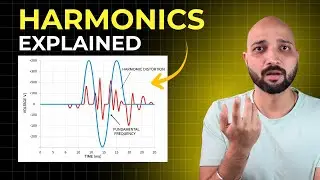
TDCG Total Dissolved Combustible Gas Explained ⚡Transformer DGA Severity and Action Plan (IEEE/IEC)
Автор: ELECTRIVERSE
Загружено: 2025-12-23
Просмотров: 20
Описание:
TDCG Total Dissolved Combustible Gas is one of the most important transformer DGA indicators to judge the overall severity of active faults.
A senior engineer uses TDCG to answer one question
Is the transformer condition stable, worsening, or critical
In this video, you will clearly understand TDCG in transformer DGA using practical engineering logic.
What TDCG means and which gases are included
Why TDCG is used for overall fault severity assessment
How TDCG levels are classified as normal, caution and critical
Why trend rate is more important than a single TDCG value
How to combine TDCG with key gas method and ratio methods
How sampling interval should change based on TDCG level
What actions to take for each TDCG condition level
Common mistakes engineers make while using TDCG
This video is part of the Transformer DGA Master Series for utilities, OEMs, EPCs and reliability engineers worldwide.
Comment your DGA gases or your TDCG value with trend history and voltage level
I will reply with severity direction and next recommended action.
Like and Subscribe for detailed videos on all DGA gases, Duval methods, moisture, BDV, TAN, IFT, furan and complete oil report diagnosis.
Disclaimer: Educational content only. Always follow OEM manuals, site procedures and applicable IEEE and IEC standards.
🔹 WHY TCG IS IMPORTANT
TCG is used for:
• Risk ranking • Maintenance prioritization • Management decisions • Load continuation or reduction • Outage planning
This is why most utilities track TCG trend first, then analyze individual gases.
🔹 IEEE C57.104 — TCG CONDITION LEVELS
This is the heart of TCG interpretation.
Condition 1 — Normal
• TCG below 720 ppm • Normal operation • No active fault
Action: Routine monitoring only
Condition 2 — Elevated
• TCG 720 to 1920 ppm • Possible fault initiation
Action: Increase monitoring frequency Perform detailed gas analysis
Condition 3 — High
• TCG 1920 to 4630 ppm • Active fault likely
Action: Engineering investigation required Load review and diagnostics
Condition 4 — Severe
• TCG above 4630 ppm • High probability of failure
Action: Immediate action Prepare for outage or internal inspection
🔹 ENGINEERING INTERPRETATION (REAL-WORLD LOGIC)
TCG is a traffic light system.
• Green → Continue operation • Yellow → Watch closely • Orange → Act • Red → Prepare for failure
But here is the key point:
TCG must always be interpreted with individual gas composition.
High TCG dominated by CO means ageing.
High TCG dominated by Acetylene means danger.
🔹 WHAT TCG CANNOT TELL YOU
Very important:
TCG does not identify fault type.
Two transformers may have same TCG but completely different risk levels.
That is why senior engineers use:
TCG for classification, and individual gases for diagnosis.
🔹 WHAT TO DO BASED ON TCG CONDITION
Condition 1
• Continue normal operation • Maintain routine DGA schedule
Condition 2
• Increase DGA frequency • Analyze gas trends • Check loading and cooling
Condition 3
• Perform root cause analysis • Conduct IR, PD, or electrical tests • Prepare contingency plans
Condition 4
• Reduce load immediately • Prepare for outage • Plan internal inspection or replacement
TCG tells you when to act. Other gases tell you how to act.
🔹 PRACTICAL FIELD ADVICE
Never panic over TCG alone.
Always ask:
• Which gas dominates TCG? • Is TCG rising fast or slowly? • How old is the transformer?
Trend is more important than value.
#Transformer
#DGA
#TDCG
#TotalDissolvedCombustibleGas
#TransformerOil
#ConditionMonitoring
#PowerTransformer
#Substation
#HighVoltage
#ElectricalEngineering
#PowerSystems
#TransformerMaintenance
#ReliabilityEngineering
#AssetManagement
#IEEE
#IEC
#OilTesting
Повторяем попытку...

Доступные форматы для скачивания:
Скачать видео
-
Информация по загрузке: