The Swiss Cheese Model in Risk Management
Автор: Health topic
Загружено: 2025-07-01
Просмотров: 971
Описание:
This paper, titled "A comprehensive review of the Swiss cheese model in risk management," by Tapiwa Shabani, Steven Jerie, and Takunda Shabani, provides an in-depth analysis of the Swiss Cheese Model (SCM).
The primary aim of this review is to offer a comprehensive understanding of the SCM in the context of risk management. To achieve this, the authors conducted an extensive literature search across various reputable academic databases, including PubMed, African Journals Online, Science Direct, Scopus, Springer, Google Scholar, and Sage Publications, considering English journals published up to 2023.
Here are some key insights from the review:
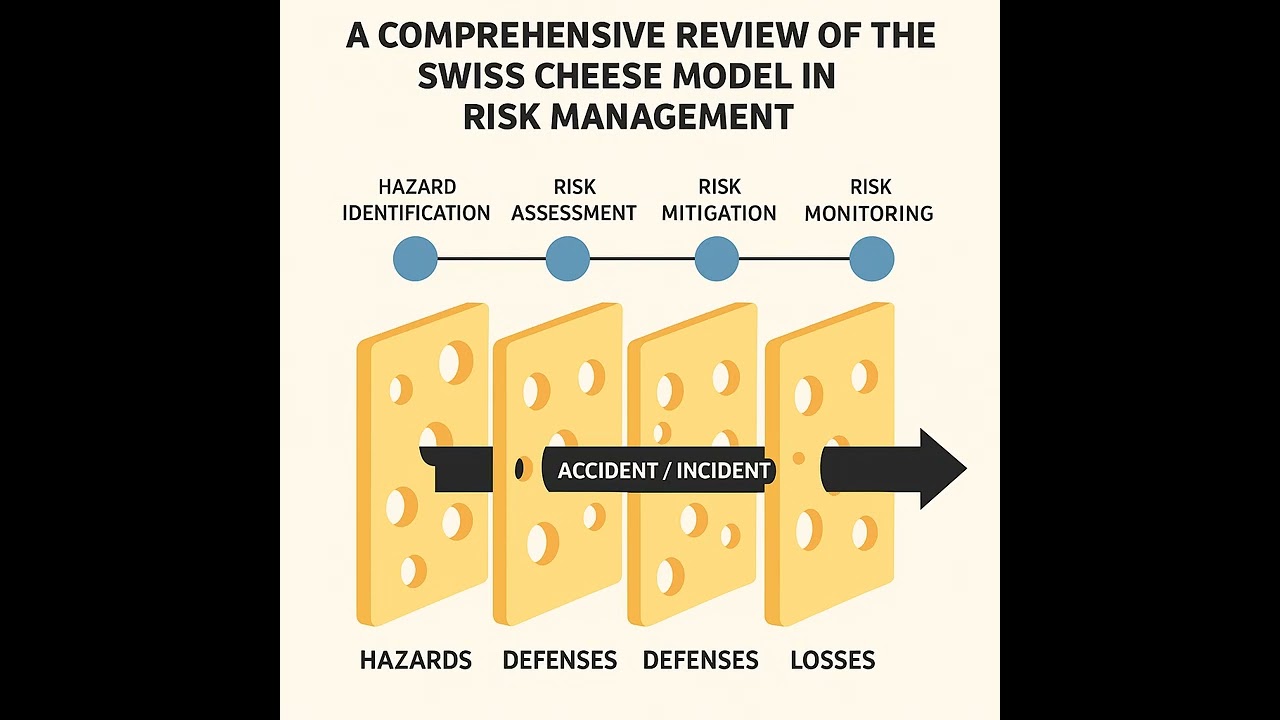
Origin and Core Concept: The SCM was developed by James Reason in the 1990s and is a widely recognized framework for understanding and managing risks in complex systems. It metaphorically represents multiple layers of defenses as "slices of cheese with holes," where these holes signify potential weaknesses or failures. The model posits that accidents or errors occur when these "holes" align across different layers of defense, creating an unobstructed pathway for a hazard to lead to an adverse event.
Key Components: The SCM includes several key components that interact to determine a system's safety or vulnerability:
Active failures are immediate errors or violations by individuals directly involved in the system's operation (e.g., mistakes by pilots or surgeons). These are often the triggers for accidents but not necessarily the root causes.
Latent conditions are underlying weaknesses or vulnerabilities within an organization or system (e.g., inadequate training, poor communication, insufficient resources, or flawed organizational culture) that contribute to the occurrence or severity of active failures. They can exist long before an accident occurs.
Defenses and barriers are measures implemented to prevent or mitigate risks, such as safety protocols, procedures, training programs, and equipment design.
Holes represent the weaknesses or vulnerabilities within each layer of defense, caused by factors like human error, equipment malfunction, or inadequate training.
Widespread Application: The SCM has been widely adopted and proven effective in identifying potential risks, understanding their underlying causes, and implementing preventive measures across diverse industries, including healthcare, aviation, nuclear power, and transportation. It has also been applied in job hazard analysis in oil servicing companies, petroleum product distribution, and even accident analysis in driving schools.
Strengths:
Clear Visual Representation: It provides an intuitive visual model that simplifies complex systems and their vulnerabilities, making it easier for stakeholders to understand how failures can align to cause accidents.
Holistic Perspective: The model promotes a comprehensive view of risk management by considering both active and latent failures.
Proactive Approach: It encourages organizations to identify systemic weaknesses and implement preventive measures rather than solely focusing on individual errors, fostering a culture of continuous improvement.
Limitations and Critiques: Despite its value, the SCM faces certain critiques:
Oversimplification: It simplifies complex systems into discrete layers, potentially oversimplifying real-world intricacies and leading to a false sense of security.
Narrow Focus on Human Error: Critics argue that its primary focus on human error as the main contributor to accidents can lead to a blame-oriented approach, neglecting broader organizational and systemic issues.
Lack of Specificity: The model's simplicity, while accessible, may lack the specificity and guidance needed for effective practical implementation of risk management strategies.
Static Nature: It is often criticized for assuming that defense layers remain constant over time, whereas real-world systems are dynamic and constantly evolving.
Reference: Shabani, T., Jerie, S., & Shabani, T. (2024). A comprehensive review of the Swiss cheese model in risk management. Safety in Extreme Environments, 6(1), 43–57. https://doi.org/10.1007/s42797-023-00...
Повторяем попытку...
Доступные форматы для скачивания:
Скачать видео
-
Информация по загрузке: