Unizor - Geometry3D - Spherical Caps
Автор: Zor Shekhtman on UNIZOR Education
Загружено: 2015-11-24
Просмотров: 4341
Описание:
Unizor - Creative Minds through Art of Mathematics - Math4Teens
Notes to a video lecture on http://www.unizor.com
Spherical Cap
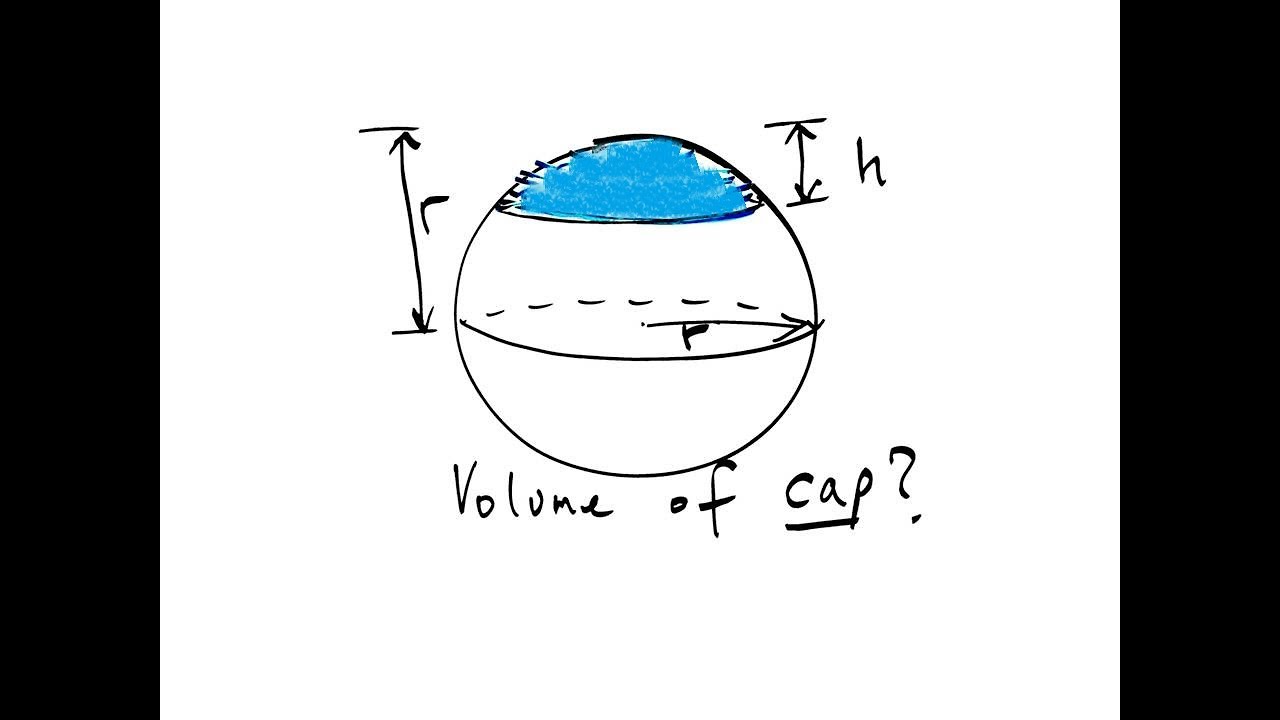
A spherical cap is formed when a plane cuts through a sphere. This cut divides a sphere into two parts, and each can be called, technically, a spherical cap. Usually, however, it's the smaller one that is considered a "true" cap. The part of a cutting plane that is inside a sphere is a base of a spherical cap, and we know from the previous problems that it is a circle. The part of a sphere that belongs to a cap forms its dome.
A spherical cap is defined by two parameters - radius of a main sphere R, from which it is cut, and the height H defined as the length of the longest segment from a dome onto a base along a perpendicular to it. For "true" spherical caps, the ones we will be considering here, height H is smaller or equal to radius R of a main sphere.
Volume of a Cap
Let's start with a volume of a spherical cap of radius R and height H using already familiar process of approximation of this volume as a sum of volumes of cylinders of the same but small altitude and different radiuses stacked on each other.
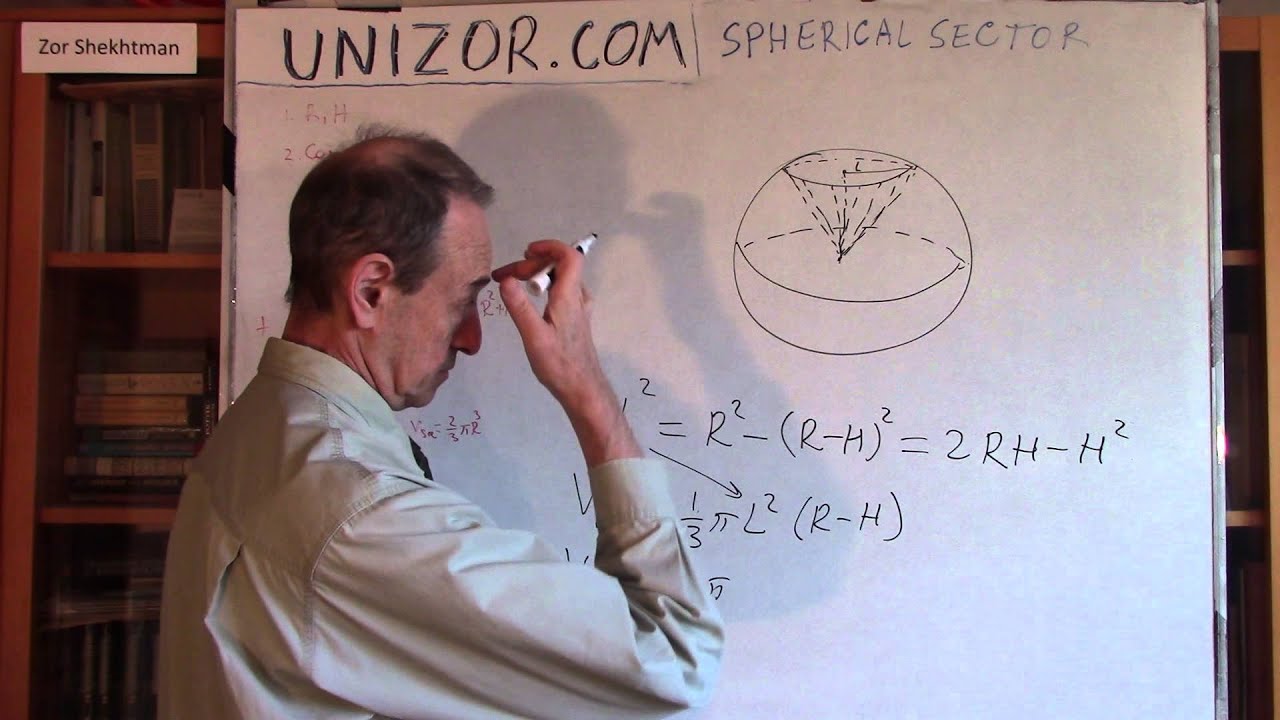
The radius of the base circle (in terms of the radius of a main sphere R and the height of a spherical cap H) equals, by Pythagorean Theorem, to
L = √R²−(R−H)² = √2RH−H²
Let AB be a segment that lies along the height of our cap. Divide segment AB into N equal parts by points A1, A2,,, AN-1 from the "top" of the dome down (for uniformity, we can designate point A, the center of a base circle, as AN and point B at the "top" of the dome as A0) and draw planes parallel to a base through each such division point.
The intersection of each plane and a sphere is a circle with a center at a corresponding division point Ak because, if we take any two points X and Y on this intersection, lengths of AkX and AkY are equal since right triangles ΔOAkX and ΔOAkY are congruent by a common cathetus OAk and congruent hypotenuses OX=OY=R.
These planes slice our spherical cap into layers. Each layer resembles a cylinder in a way that it is bounded from top and bottom by two parallel planes and is somewhat rounded in shape, but it's not a true cylinder because its side surface is not formed by straight lines parallel to the same generatrix.
The next step is to make a cylinder within each layer preserving it's circular top base and replacing the side surface with a cylindrical surface by dropping perpendiculars from each point on the upper base towards its bottom base.
Now it's time to make a leap of faith and consider a reasonable, intuitively obvious statement that, as N→∞, the total volume of cylinders tends to some limit that we can call the volume of our spherical cap.
Our task is to calculate a sum of volumes of the N cylinders as a formula, that depends on radius of a sphere R, height of the cap H and the number of division points N, and to find its limit as N→∞, which will depend only on radius R and height H.
Let's calculate a volume of a cylinder #k and then summarize it by k∈[1,N].
By Pythagorean theorem, for any point X on a circle with center Ak
AkX² = OX² − OAk²
Point X is on a sphere, therefore OX=R
Point Ak is kth point of division of segment AB into N equal parts, therefore
OAk=R−H·k/N.
Hence, the square of a radius of a base of the kth cylinder equals to AkX² = R²−(R−H·k/N)²
Its altitude is, obviously, H/N.
Therefore, the volume Vk of the kth cylinder is
π[2RHk/N−(Hk/N)²]·H/N =2πRH²k/N² − πH³k²/N³
Now we have to summarize the volumes of all N cylinders and find the limit of this sum as N→∞.
We will use a symbol Σ for summation by k from 1 to N
V = Σ(Vk) = πRH²(N+1)/N − πH³(N+1)(2N+1)/6N²
Note that we have used a known and previously derived expressions for a sum of numbers from 1 to N:
Σk = N(N+1)/2
and for a sum of squares from 1 to N:
Σ(k²)=N(N+1)(2N+1)/6
The limit of (N+1)/N is 1. The limit of (N+1)(2N+1)/6N² is 2/6=1/3.
Therefore, the volume of the spherical cap equals to
Vcap = πRH² − πH³/3 = πH²(3R−H)/3
Повторяем попытку...

Доступные форматы для скачивания:
Скачать видео
-
Информация по загрузке: