pumping of laser
Автор: e Tution
Загружено: 2017-06-28
Просмотров: 53489
Описание:
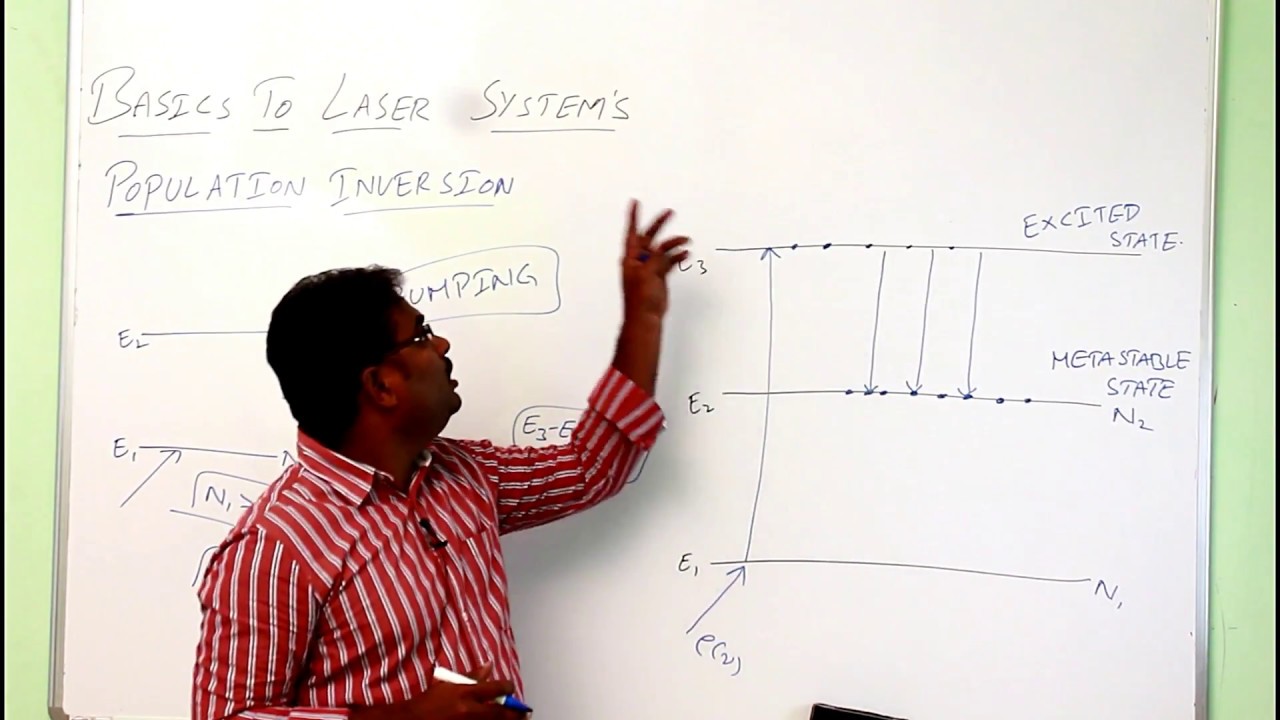
pumping of a laser:
Laser pumping is the act of energy transfer from an external source into the gain medium of a laser. The energy is absorbed in the medium, producing excited states in its atoms. ... The pump power must be higher than the lasing threshold of the laser.
https://en.wikipedia.org/wiki/Laser_p...
Pumping cavities[edit]
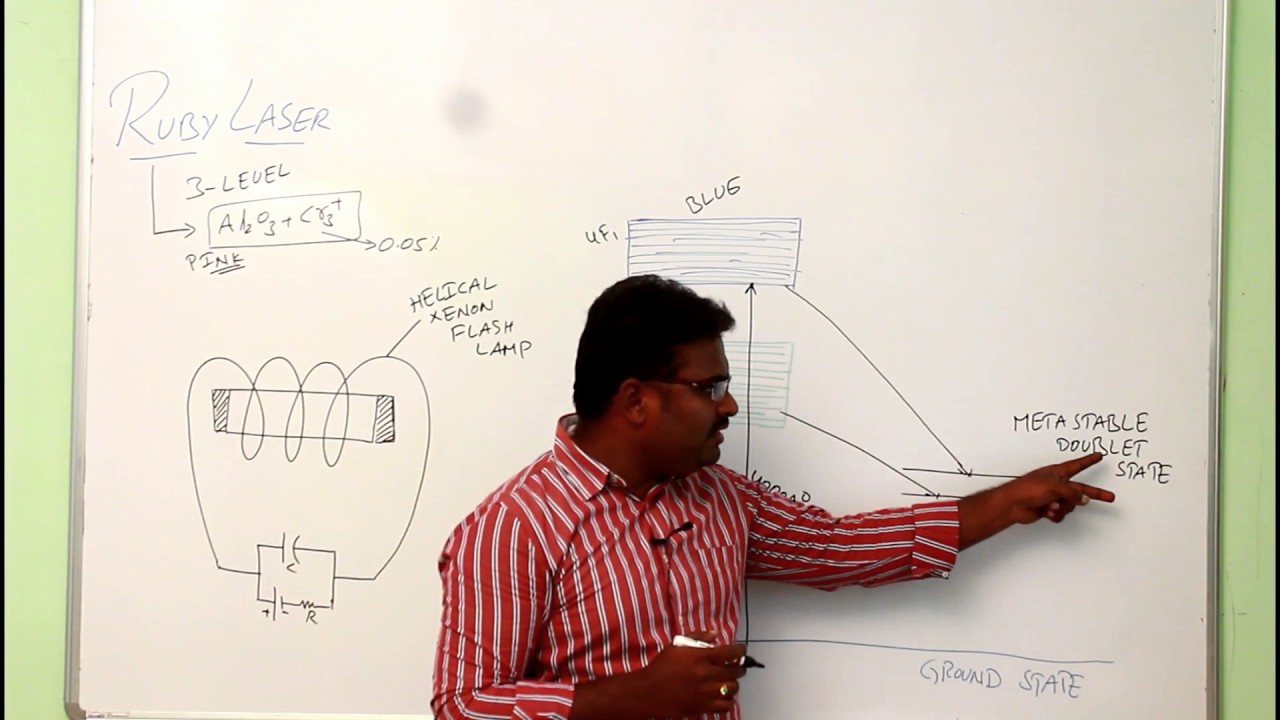
A laser pumped with an arc lamp or a flashlamp is usually pumped through the lateral wall of the lasing medium, which is often in the form of a crystal rod containing a metallic impurity or a glass tube containing a liquid dye, in a condition known as "side-pumping." To use the lamp's energy most efficiently, the lamps and lasing medium are contained in a reflective cavity that will redirect most of the lamp's energy into the rod or dye cell.
Various laser pumping cavity configurations.
In the most common configuration, the gain medium is in the form of a rod located at one focus of a mirrored cavity, consisting of an elliptical cross-section perpendicular to the rod's axis. The flashlamp is a tube located at the other focus of the ellipse. Often the mirror's coating is chosen to reflect wavelengths that are shorter than the lasing output while absorbing or transmitting wavelengths that are the same or longer, to minimize thermal lensing. In other cases an absorber for the longer wavelengths is used. Often, the lamp is surrounded by a cylindrical jacket called a flow tube. This flow tube is usually made of a glass that will absorb unsuitable wavelengths, such as ultraviolet, or provide a path for cooling water which absorbs infrared. Often, the jacket is given a dielectric coating that reflects unsuitable wavelengths of light back into the lamp. This light is absorbed and some of it is re-emitted at suitable wavelengths. The flow tube also serves to protect the rod in the event of a violent lamp failure.
Smaller ellipses create fewer reflections, (a condition called "close-coupling"), giving higher intensity in the center of the rod.[1] For a single flashlamp, if the lamp and rod are equal diameter, an ellipse that is twice as wide as it is high is usually the most efficient at imaging the light into the rod. The rod and the lamp are relatively long to minimize the effect of losses at the end faces and to provide a sufficient length of gain medium. Longer flashlamps are also more efficient at transferring electrical energy into light, due to higher impedance.[2] However, if the rod is too long in relation to its diameter a condition called "prelasing" can occur, depleting the rod's energy before it can properly build up.[3] Rod ends are often antireflection coated or cut at Brewster's angle to minimize this effect.[4] Flat mirrors are also often used at the ends of the pump cavity to reduce loss.[5]
Variations on this design use more complex mirrors composed of overlapping elliptical shapes, to allow multiple flashlamps to pump a single rod. This allows greater power, but are less efficient because not all of the light is correctly imaged into the rod, leading to increased thermal losses. These losses can be minimized by using a close-coupled cavity. This approach may allow more symmetric pumping, increasing beam quality, however.[5]
Another configuration uses a rod and a flashlamp in a cavity made of a diffuse reflecting material, such as spectralon or powdered barium sulfate. These cavities are often circular or oblong, as focusing the light is not a primary objective. This doesn't couple the light as well into the lasing medium, since the light makes many reflections before reaching the rod, but often requires less maintenance than metalized reflectors.[6] The increased number of reflections is compensated for by the diffuse medium's higher reflectivity: 99% compared to 97% for a gold mirror.[7] This approach is more compatible with unpolished rods or multiple lamps.
Parasitic modes occur when reflections are generated in directions other than along the length of the rod, which can use up energy that would otherwise be available to the beam. This can be a particular problem if the barrel of the rod is polished. Cylindrical laser rods support whispering gallery modes due to total internal reflection between the rod and the cooling water, which reflect continuously around the circumference of the rod. Light pipe modes can reflect down the length of the rod in a zig-zag path. If the rod has an antireflection coating, or is immersed in a fluid that matches its refractive index, it can dramatically reduce these parasitic reflections. Likewise, if the barrel of the rod is rough ground (frosted), or grooved, internal reflections can be dispersed.[8]
Pumping with a single lamp tends to focus most of the energy on one side, worsening the beam profile.........
~-~~-~~~-~~-~
Please watch: "#CHARACTERSTICS OF LASER LIGHT || ENGINEERING PHYSICS ||"
• #CHARACTERSTICS OF LASER LIGHT || ENGINEE...
~-~~-~~~-~~-~
Повторяем попытку...

Доступные форматы для скачивания:
Скачать видео
-
Информация по загрузке: