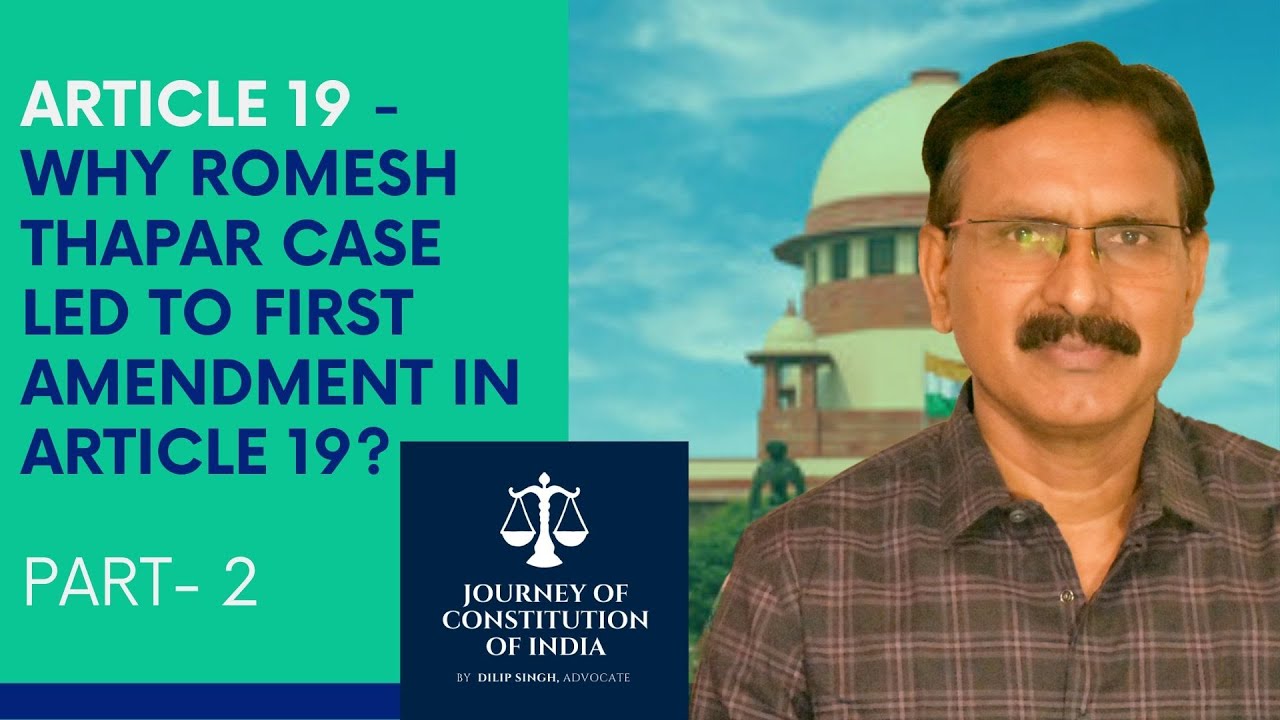
Article 19: Why Freedom of Press is essential for development of Democracy? Romesh Thapar Case(2020)
Автор: LEGAL OUTLOOK... By Dilip Singh
Загружено: 2020-06-27
Просмотров: 134
Описание:
On 4th July, 1944 speaking in a rally in Burma Netaji Subhash Chandra Bose gave this famous slogan:" Give me blood, I will give you freedom".
23rd March,1775: Verginia Convention
"Give me liberty or give me death"by Patric Henry
. Some 170 years ago of that slogan, on 23rd March, 1775, a similar slogan was given against British Rule at Second Virginia Convention by an American lawyer. His name was Patric Henry and the famous line was: "Give me liberty, or give me death!"
He told: “The Constitution is not an instrument for the Government to restrain the people, it is an instrument for the people to restrain the Government.”
I would like to quote a line from famous case of M F Hussain Vs. Raj Kumar Pandey [2008 Cr.L.J. 4107], the case of great Indian painter: The freedom of speech is the matrix, the indispensable condition of nearly every other form of freedom."
After reading this line of SC, I searched meaning of 'Matrix' in dictionary to see the context in which it is used? The meaning of matrix is: the cultural, social, or political environment in which something develops.
The Preamble expresses two ideas which complement each other: First, Rights of the individual which correspond to the duties of the State towards the individual, and
Second, Duties of the individual towards the State which correspond to the rights of the society against the individual.
In United States, the Bill of Rights itself does not provide any such limitations as reasonalbe restrictions to the rights of individuals and it has been left to court to invent doctrine like "Police power of the state" to impose limitations.
FREEDOM OF PRESS: There is no specific provision for freedom of press as it is in 1st amendment of American Constitution.The United States Bill of Rights, 1787 comprises the first ten amendments to the United States Constitution. 1st Amendment: " Congress shall make no law respecting abridging the freedom of speech, or of the press; or the right of the people to assemble peacefully,."
The first important case for press freedom was "Romesh Thapar vs. Stae of Madras(AIR 1950 SC 124).
This case was decided by a constitution bench of 6 judges presided by Chief Justice Kania. The jusgment wa delivered in 5:1. However the full court unanimously held that Freedom of speech and expression includes freedom of propagation of ideas and it also ensures the freedom of circulation.
Brief facts: The petitioner in the matter was the printer, publisher and editor of a weekly English journal "Cross Roads" printed and published in Bombay. The Government of Madras passed an order dated 1st March, 1950 u/s 9 (1-A) of the Madras Maintenance of Public Order Act, 1949 (the impugned Act), and imposed a ban upon the entry and circulation of the journal in the State.
The Court observed that freedom of speech and of the press lay at the foundation of all democratic organisations. Without free political discussion, there can be no public education. So freedom of press is essential for the proper functioning of the government. No doubt, a freedom of such amplitude might involve some risks of abuse. The framers of constitution were aware of such risk and so made provisions accordingly. This judgment resulted in the 1st Amendment of the Consitution and Article 19(2) appeared in the present Avtar with new word of 'Reasonalbe Restriction'. Two more grounds were added "public order", incitement to an offence.”
Later by 16th Amendment in 1963, another ground of "friendly relations with foreign States," was added.
The issue is how to secure Individual liberty vis a vis Social Interest. We need to see from different angle.
Let me share my view: Genuine respect for the laws can only spring from an understanding of the true purposes of the Law.
Our understanding expresses our notions of Right and Wrong or Just and Unjust or Dharma. European jurists have used various terms (Jus, Droit, Dritto, Recht) to signify what is "Dharma" in our society.
Our ancient concept of the Law embraces in its fold the principle of "Virtue". Montesquieu, the renowned French judge and political thinker called it in his "Espirit des lois" i.e Spirit of Laws.
"Espirit des lois" is a treatise on political theory and a pioneering work in comparative law, published in 1748.
Let me tell you about Montesquieu, was a French judge, thinker and political philosopher. He is famous for the theory of separation of powers.
Повторяем попытку...
Доступные форматы для скачивания:
Скачать видео
-
Информация по загрузке: