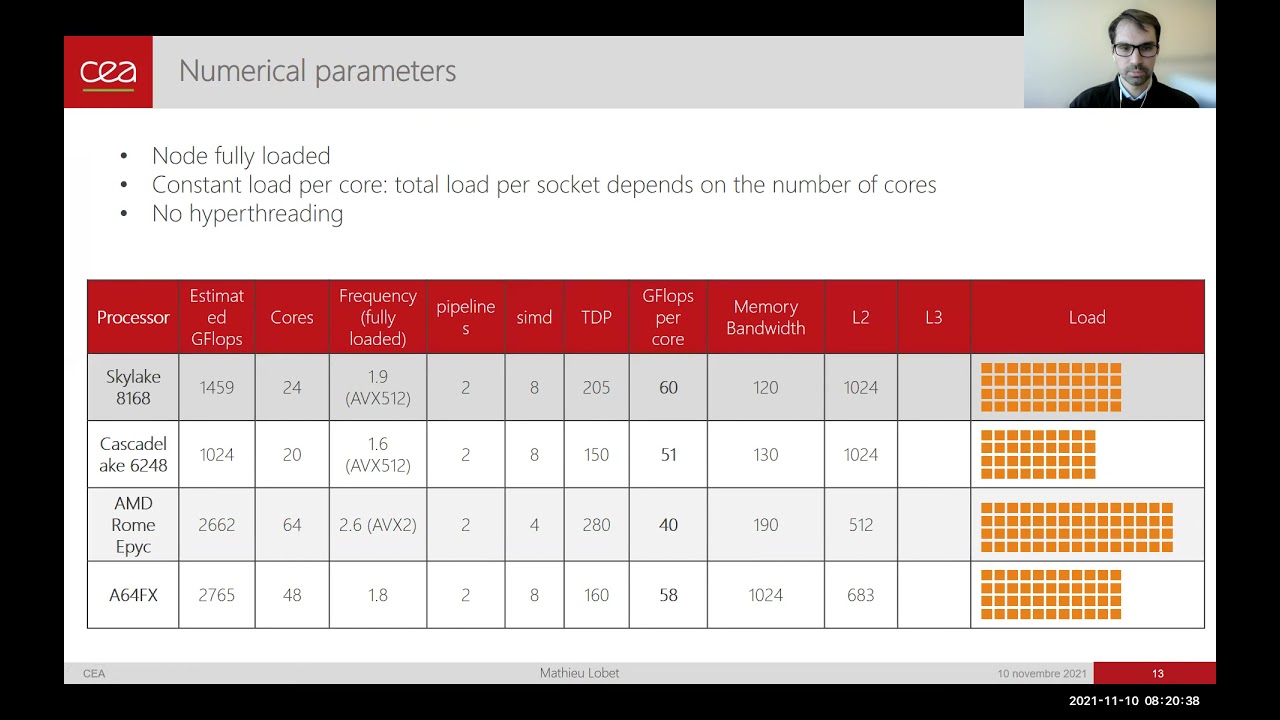
Mathieu Lobet - Feedback and Results for Porting Smilei on the Fujitsu A64FX Processor - AHUG SC21
Автор: ARM HPC User Group
Загружено: 2021-11-17
Просмотров: 105
Описание:
Title: Feedback and Results for Porting the Particle-In-Cell code Smilei on the Fujitsu A64FX processor
Abstract: In this presentation, we would like to present the porting and optimization work done in the scientific code Smilei to improve the performance on the Fujitsu A64FX processor. Smilei is a parallel and open-source particle-in-cell code dedicated to the study of laser-matter interaction, particle acceleration, strong-field physics and astrophysical plasma scientific domains. The code is written in classical C++ (inheritance and basic templating) and does not use modern feature or advanced abstracted programming model.
A few years ago, we obtained an efficient vectorization by rewriting and optimizing the main time-consuming operators to take advantage of the AVX512 instruction set on Intel processors. Although most of our vectorized algorithms should similarly work with the ARM SVE vector instructions, first performance studies without code adaptation have shown many vectorization issues and poor performance on A64FX. This presentation aims at presenting in pedagogic way the different issues we had and the simple adaptations made in Smilei focusing on vectorized algorithm efficiency including branching, unrolling, inlining, loop fission and more. The performance on A64FX has been studied using 3 different compilers: Fujitsu, GNU and ARM. The comparison has been made with an Intel Skylake, an Intel Cascade Lake and an AMD Rome processor using the Intel compiler. Currently, the ARM compiler provides the best vectorization efficiency with runtimes comparable to Skylake.
Speaker Bio: Dr. Lobet received his PhD in 2015 at CEA and Bordeaux University in France on the numerical study of extreme-intensity laser-matter interaction. After his PhD, he moved to HPC by joining the NERSC team at LBNL as a postdoc. During this period, he mainly worked on various optimization, parallelization and vectorization methods for particle-in-cell codes. In 2017, he joined the Maison de la Simulation team as a CEA research engineer. Since then, he has participated in various HPC research projects including the Energy Oriented Center of Excellence European project. His research topics are CPU and GPU programming, task-based programming methods and core-level optimization.
Повторяем попытку...
Доступные форматы для скачивания:
Скачать видео
-
Информация по загрузке:

![Как происходит модернизация остаточных соединений [mHC]](https://image.4k-video.ru/id-video/jYn_1PpRzxI)


![Почему работает теория шести рукопожатий? [Veritasium]](https://image.4k-video.ru/id-video/ggI1xKzoANs)


![Пожалуй, главное заблуждение об электричестве [Veritasium]](https://image.4k-video.ru/id-video/6Hv2GLtnf2c)


![Как сжимаются изображения? [46 МБ ↘↘ 4,07 МБ] JPEG в деталях](https://image.4k-video.ru/id-video/Kv1Hiv3ox8I)