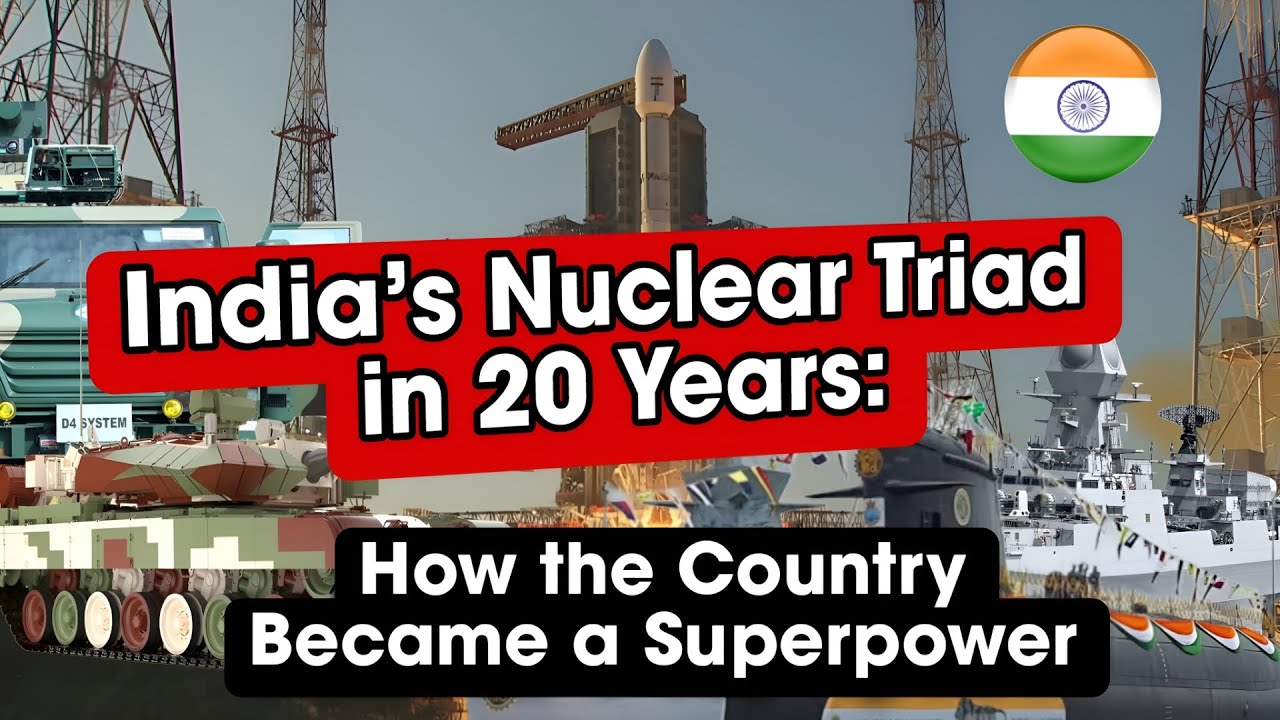
India’s Nuclear Triad in 20 Years: How the Country Became a Superpower
Автор: History News Ticker
Загружено: 2025-06-16
Просмотров: 918
Описание:
Over the past twenty years, India has transformed from a regional military power into a full-fledged holder of a nuclear triad and secured its place among the world’s superpowers. In this video:
2005: Defence budget stood at $20 billion. Equipment was mostly aging Soviet hardware: one aircraft carrier (INS Viraat) and short‑range Prithvi missiles. India’s deterrent was limited, facing threats from both Pakistan and China.
Early Triad Challenges: After the 1998 Pokhran tests, India’s nuclear capability remained largely on paper. Prithvi missiles lacked the range to threaten China, Mirage 2000 fighters were vulnerable, and the sea‑based leg was non‑existent. The INS Arihant project stalled on technical hurdles.
2010: The budget rose to $37 billion. Agni‑II missiles entered service, and Su‑30MKI aircraft were upgraded to carry nuclear payloads - laying the groundwork for the air leg. INS Arihant was launched with K‑15 SLBMs (750 km), the first real step toward a sea‑based deterrent.
2015: Defence spending reached $50 billion. Agni‑III missiles gave India the reach to strike Beijing and Shanghai. India signed for 36 Rafale fighters, and deliveries began. INS Arihant was officially commissioned, and the “Make in India” drive accelerated domestic defence production.
2019: Operation Shakti showcased India’s counter‑space capability with an ASAT test, and a Defence Space Agency was established. Launches of NavIC navigation satellites, RISAT reconnaissance satellites, and EMISAT electronic‑intelligence satellites strengthened surveillance, communications, and targeting.
2020: The budget climbed to $73 billion. Agni‑IV and Agni‑V missiles, Arjun Mk 1A tanks, and armed/reconnaissance UAVs joined the arsenal. INS Arihant and its sister ship Arighat were equipped with K‑4 SLBMs (3 500 km), completing the sea leg of the triad.
2025: A record defence budget of $84 billion cements a fully operational nuclear triad. The Army fields modern Arjun Mk 1A tanks and drones, the Air Force flies Rafale, Su‑30MKI, and LCA Tejas fighters, and the Navy keeps two SSBNs on deterrent patrol. Quad and Malabar exercises reinforce India’s Indo‑Pacific partnerships, while border infrastructure and deployments along the China frontier and cooperation with Bhutan, Bangladesh, and the Maldives - underscore its strategic resolve.
From Agni to Arihant, Mirage 2000 to Rafale, Pokhran to Malabar - this 10‑minute journey covers the key events and technologies that forged India’s path to military autonomy and superpower status.
#India #MilitaryPower #NuclearTriad #Defense #Geopolitics
Повторяем попытку...
Доступные форматы для скачивания:
Скачать видео
-
Информация по загрузке: