Keep Your Commitment to Yourself | Edgar Jones – Speaker and Coach, Former NFL Linebacker
Автор: Paper Napkin Wisdom | Entrepreneur Podcast
Загружено: 2026-01-29
Просмотров: 5
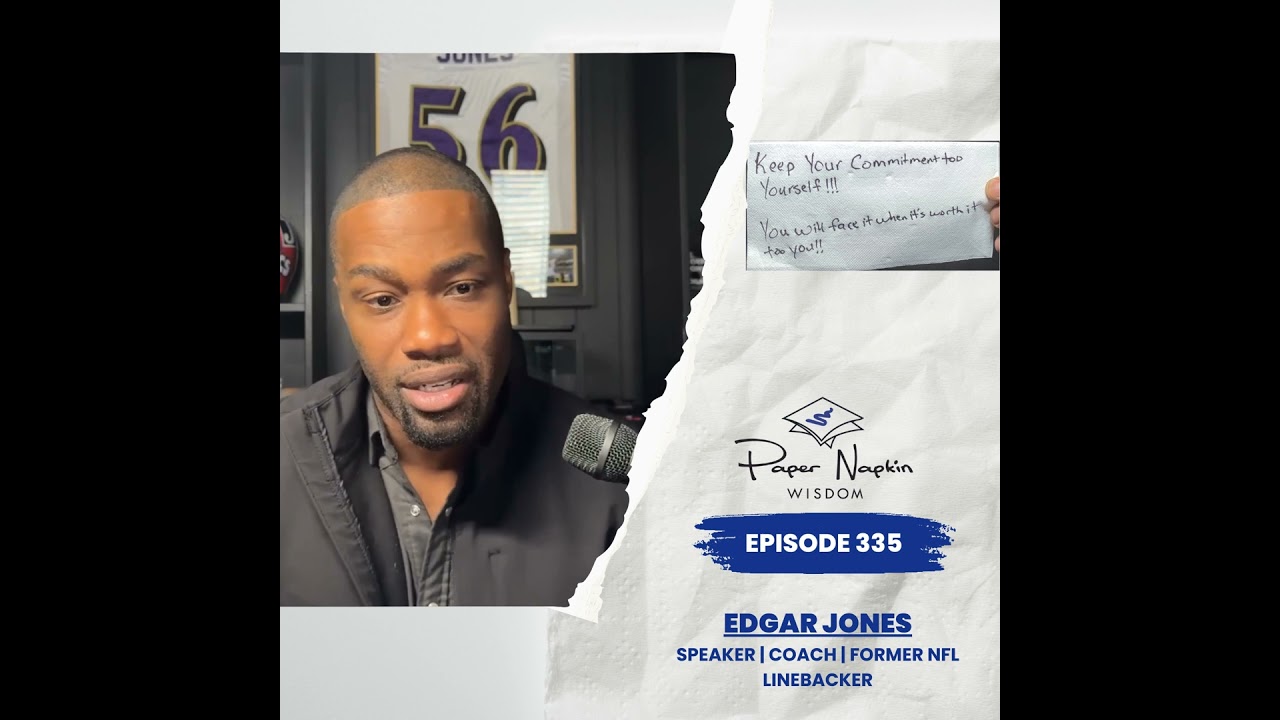
Описание: Some wisdom doesn't shout. It waits. It waits patiently until you're ready to stop running… until you're willing to turn around… until facing it finally becomes worth it to you. That's exactly what Edgar Jones brought to the Paper Napkin Wisdom table. On his napkin, Edgar wrote: "Keep your commitment to yourself!!! You will face it when it's worth it to you." At first glance, it feels simple. But as you'll hear in this conversation, that sentence carries the weight of lived experience—of professional sports, sobriety, leadership, loss, and the quiet work of becoming whole again. About Edgar Jones Edgar Jones is a former NFL linebacker who played at the highest level of professional football after entering the league as an undrafted free agent. Beyond the field, Edgar is a speaker, leadership coach, and creator of practical tools that help leaders slow down, reconnect with themselves, and reset how they define success. What makes Edgar's voice especially powerful is that it's not theoretical. It's earned—through pressure, loss, recovery, faith, and reflection. This conversation is not about motivation. It's about truth. You Will Face It When It's Worth It to You Edgar traces this phrase back to a scene in King Arthur (Guy Ritchie's version). After Arthur emerges from the Darklands—the place where he's forced to confront his past—a mage asks him what he saw. When he avoids the truth, she responds: "We all look away… but you will face it when it's worth it to you." That line stayed with Edgar because it mirrored his own life. For years, Edgar was doing the right things—but for the wrong reasons. When he first chose sobriety, he did it for his family. For his wife. For his kids. All honorable reasons. But something subtle happened beneath the surface: expectations crept in. The need for validation. The quiet hope for applause. And when that applause didn't come? The old patterns waited patiently. The breakthrough came when Edgar realized this truth: "I had to learn how to say, 'Edgar, great job.' If someone else said it, that was just a bonus." That shift—from external approval to internal commitment—changed everything. The Red Dot Problem Edgar shared a story from his NFL days that perfectly captures how performance culture shapes us. Each week during film review, coaches would highlight strong plays with a red dot. The dot meant recognition. Validation. Proof that you mattered. One game, Edgar played his heart out—six tackles, full effort. He sat in the meeting waiting for the red dot. It never came. "I walked out of that meeting feeling lesser than… all because I wanted that red dot." Seventy thousand fans could be cheering in the stadium, but that didn't matter. What mattered was the one person whose approval he didn't receive. That experience planted a powerful leadership lesson Edgar carries today: People don't just want to perform. They want to be seen. As a leader now, Edgar is intentional about naming what he sees in others—clearly, specifically, and honestly. Because recognition isn't a scarce resource. The more you give it away, the more connection you create. Turning Around to Face the Dog One of the most striking moments in this conversation is a childhood story Edgar shares. Growing up in rural Louisiana, Edgar would run home from the school bus every day—not because he loved running, but because a neighbor's Rottweiler chased him relentlessly. One day, mid-sprint, Edgar realized something: "I'm not going to outrun this dog." So he stopped. Turned around. And screamed. The dog froze… and ran away. It never chased him again. Years later, Edgar saw the parallel. When he retired from the NFL, he wasn't just stepping away from football. He was running—from grief, from unresolved loss, from pain he hadn't fully faced. Including the traumatic loss of a teammate in 2012 that left a deep, unprocessed mark. Eventually, the running stopped working. "I realized there were some dogs that had been chasing me that I needed to turn around and face." That's what the napkin means. You don't face everything right away. You face it when it becomes worth it. And when you do, something loosens its grip. Slowing Down to Perform Better In football, Edgar explains, the best teams do something counterintuitive during the playoffs. They slow down. Walkthroughs replace full-speed reps. Players literally walk through plays—thinking, noticing, aligning—so that when it's time to move fast, mistakes are minimized. Rehab did the same thing for Edgar's life. It slowed him down long enough to ask better questions. To notice patterns. To reset what "winning" actually meant beyond performance and survival. "We've confused fast with good and slow with bad." But growth doesn't happen at full speed. It happens in the walkthroughs. Defining Your Own Scoreboard One of the most practical tools Edgar shares is his Five C's—his personal, internal scoreboard. Not a scale of 1–10. Just yes or no. Did it happen or didn't it? The Five C's: C...
Повторяем попытку...
Доступные форматы для скачивания:
Скачать видео
-
Информация по загрузке: