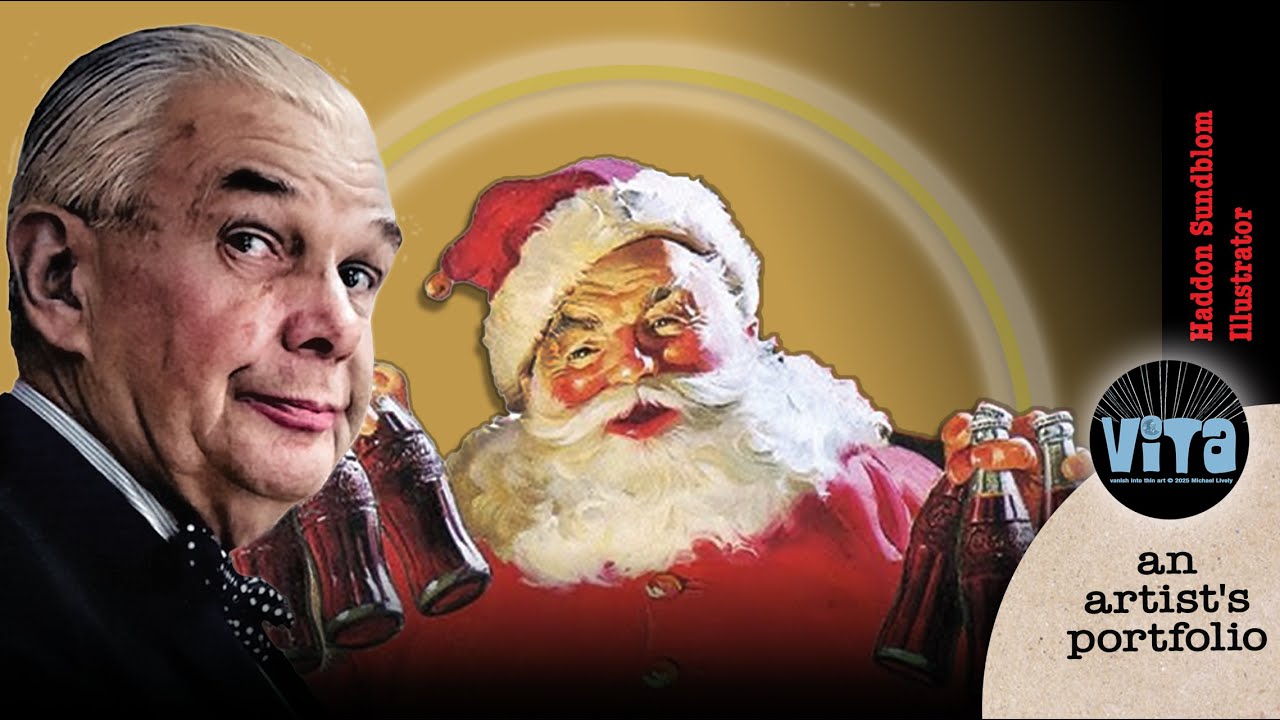
Haddon Sundblom - Illustrator / Santa's Illustrator
Автор: Vanish Into Thin Art
Загружено: 2023-12-01
Просмотров: 913
Описание:
"Art is not merely an imitation of life; it's the alchemy of transforming the ordinary into extraordinary, the everyday into the enduring."
—Haddon Sundblom
In the pantheon of commercial art, few figures loom as large as Haddon Sundblom, the man who gave the modern world its beloved image of Santa Claus.
Armed with a paintbrush and an uncanny ability to breathe life into characters, Sundblom transformed the landscape of holiday advertising and left an indelible mark on pop culture.
This is a journey into the life and legacy of Haddon Sundblom’s art.
The artist who not only painted Santa Claus, but also crafted an enduring chapter in the story of American culture.
As the calendar flipped to 1931, Sundblom, under the commission of Coca-Cola, found himself tasked with creating a Santa Claus that could appeal to the masses.
Sundblom turned to his friend, Lou Prentice.
Prentice was a retired salesman, known for his full figure and jovial demeanor, a living, breathing manifestation of what Santa Claus should be.
In the glow of the lamp and the indolence of oil paints, Sundblom transferred Prentice's hearty laughter, twinkling eyes, and jolly spirit onto his canvas.
This was not just any Santa.
This was a Santa who was human and amiable, a Santa who exuded warmth and friendliness, a Santa who children would love and adults would reminisce about.
It's worth noting that Sundblom was following in the footsteps of other artists, including Thomas Nast, who had begun shaping an Americanized Santa Claus image in the 19th century. But it was Sundblom's vision that was to stick. Santa, with his twinkling eyes and belly-like bowl full of jelly, became a sensation.
The years following 1931 saw a blossoming collaboration between Sundblom and Coca-Cola.
Each winter, the public eagerly awaited the arrival of Sundblom's Santa, who was now a staple in Coca-Cola's Christmas advertisements.
This Santa was different from his predecessors—he interacted with children, read letters, enjoyed a Coke, and was often found in homely environments that echoed the essence of Christmas: warmth, joy, and family.
During these years, Coca-Cola's marketing team, led by Archie Lee, worked closely with Sundblom, offering ideas and input.
But it was Sundblom's artistic genius that brought the character to life year after year, solidifying Santa's image in the hearts of millions.
It was a match made in advertising heaven, a synergy of creativity and commerce that would stand the test of time.
As the globe was thrown into the chaos of World War II, Sundblom was asked to temporarily shift his focus from Santa to a more military-driven assignment.
He began crafting illustrations of glamorous, confident women, the so-called 'pin-up girls,' for the soldiers abroad.
These illustrations, enticing and yet endearing, soon found their way into the hearts of the soldiers, adorning the walls of their barracks and even the noses of their bomber planes.
The popularity of these sultry sirens soared among the servicemen.
For them, the pin-up girls became a symbol of the comfort and familiarity of home, a beacon of hope amidst the fog of war.
While the creation of pin-up girls marked a stark departure from Sundblom's previous work, there was a shared essence in these divergent threads of his artistry.
Both his Santa and the pin-ups represented a sort of longing—a yearning for warmth, joy, and comfort.
One was a symbol of home for children around the world, the other, a symbol of home for soldiers fighting far from their own.
As the 1960s dawned, Sundblom found himself extending his creative vision beyond the borders of holiday advertising.
His next significant creation was none other than the Quaker Oats man.
This character, as humble and iconic as his Santa, came to life through Sundblom's brushstrokes. Every crease, every line on the Quaker's face was carefully rendered, ensuring the figure was comforting, trustworthy - a testament to the product he represented.
But the Quaker Oats man was just the beginning. Sundblom also dipped his brush in the colors of Aunt Jemima's pancake mix package. Creating the artwork for this famous brand, Sundblom turned another everyday character into an icon of American advertising.
Haddon Sundblom passed away in 1976, but his legacy lives on.
His Santa Claus is not just on Coke bottles and advertisements—it's also in the Smithsonian National Museum of American History, a testament to its cultural significance.
Haddon Sundblom, with his brush and palette, painted not just advertisements but also a cultural iconography that continues to shape our collective imagination.
They remind us that art has the power to infuse magic into the mundane and turn the ordinary into something extraordinary.
https://www.historyoasis.com/post/had...
I don't hold copyright on images or music. Just the assembly of these elements. Created for fun and education. Enjoy
Повторяем попытку...
Доступные форматы для скачивания:
Скачать видео
-
Информация по загрузке: