Ion-exchange chromatography(Animated)|Separation of charged molecules by ion-exchange chromatography
Автор: Revathi Purushothaman
Загружено: 2020-08-09
Просмотров: 16358
Описание:
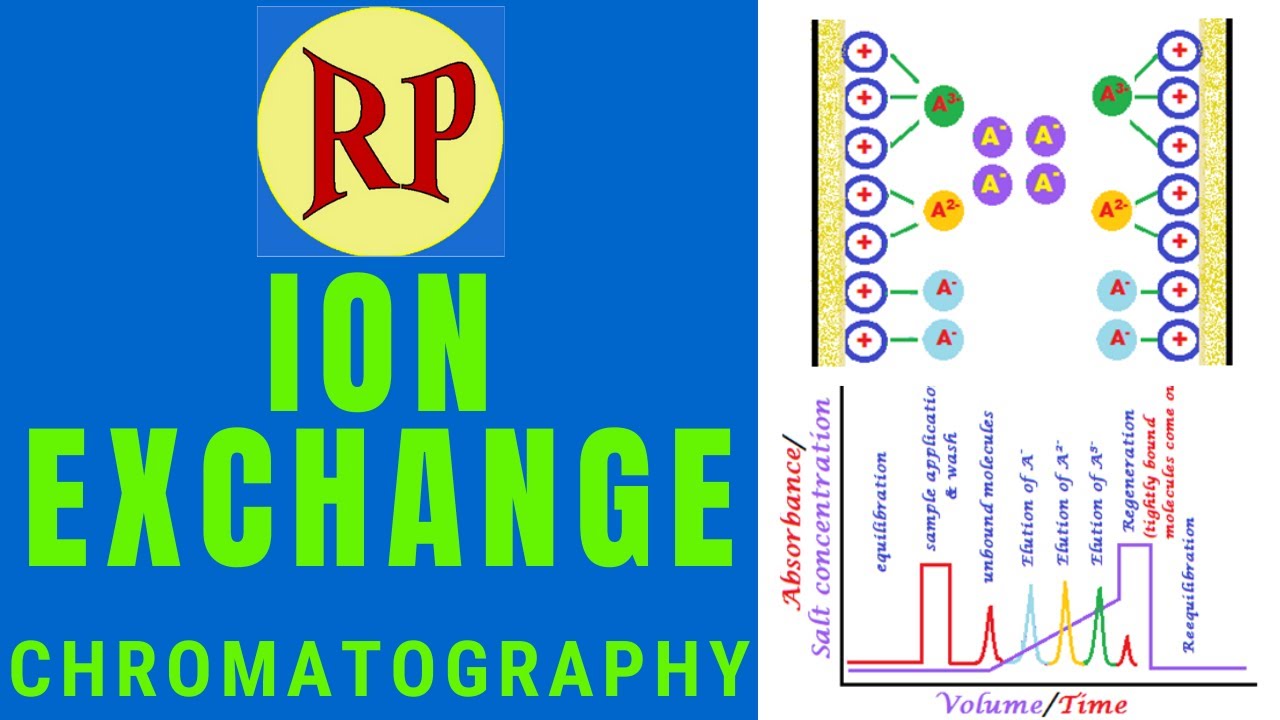
This video describes the ion-exchange chromatography. It explains the process with animation. The separation of charged particles can be done using this process. The principle and definition of ion-exchange chromatography is explained. The two types of ion-exchangers (cation and anion exchangers). The process of separating amino-acids is described in this video. The elution process is explained with animation in two ways: salt gradient method and pH gradient method. The process is also explained using the graph. The isoelectric point (pI) is also explained. This video also explains how to choose the correct pH and appropriate ion-exchanger for a given mixture to be separated. The advantages, disadvantages (limitations) and applications of ion-exchange chromatography is also explained. It explains the separation of proteins and amino acids.
Learning Objectives
You will be able to
elucidate the principle of ion-exchange chromatography.
describe the types of ion-exchangers and how to choose the appropriate ion-exchanger for the separation of a given mixture.
explain the steps involved in the separation of charged components.
discuss the elution process by salt gradient and pH gradient method.
list out the advantages, disadvantages and applications of this technique.
Ion-exchange chromatography is a technique used to separate the ionizable molecules or charged molecules present in a mixture by the difference in their net charge using the stationary phase (ion-exchangers) and the mobile phase (salt solutions or buffer solutions).
Very commonly used to separate charged biological molecules such as proteins, peptides, amino acids, nucleotides etc..
Stationary phase – insoluble solid matrix (porous or non-porous) with ionic functional groups
Cation-exchanger– possesses functional groups with negative charge
Strong – Sulfopropyl, Methyl sulfonate (0-14 pH)
Weak – Carboxymethyl (small range of pH)
Anion-exchanger– possesses functional groups with positive charge
Strong –quaternary ammonium (0-14 pH)
Weak – Diethylaminoethyl (DEAE), Diethylaminopropyl (small range of pH)
Mobile phase – salt solution (NaCl)/buffer solution
Start buffer – During equilibration (salt solution with low concentration/ionic strength).
Sample buffer – During sample application (salt solution with same concentration/ionic strength).
Elution buffer – During elution (salt solution gradient with increasing concentration).
Mobile phase – salt solution (NaCl)/buffer solution
Start buffer – During equilibration, pH pI for anionic exchanger and pH pI for cationic exchanger
Sample buffer – During sample application same pH as start buffer.
Elution buffer – During elution pH=pI of the molecule of interest.
Ion-exchange Process
Equilibration – To equilibrate the stationary phase to the required conditions by choosing
the proper buffer with appropriate salt concentration and pH (the exchangeable counter
ions are bound to stationary phase)
Sample application – To bind the targeted molecules and wash out the unwanted molecules.
Elution– To elute the targeted molecules one by one by altering the salt concentration (salt gradient) or altering the pH (pH gradient).
Regeneration – To wash out the tightly bound molecules by using the salt solution with high concentration. Ion-exchanger is available for next run with full capacity.
Advantages of Ion-exchange Process
Efficient method to separate charged particles and can achieve high yield.
Any kind of charged particles from large proteins, nucleotides to small amino acids
Permits high flow rate.
Disadvantages of Ion-exchange Process
Different salt buffers are required for elution
Applications of Ion exchange process
Routine analysis– analysis of amino-acid mixture, proteins, nucleic acids.
Water softening – removal of cations and anions (deionisation/demineralisation).
Clinical analysis – hydrolysis of proteins or isolation and identification of amino-acids from blood serum.
Food industries – study of wheat, rice, corn varieties.
Trace metals - present in seawater and rocks/earth.
It is highly pH dependent. With slight change in pH, resins lose the capacity and resolution.
Suitable only for charged molecules.
Повторяем попытку...
Доступные форматы для скачивания:
Скачать видео
-
Информация по загрузке: