ycliper

Популярное

Музыка Кино и Анимация Автомобили Животные Спорт Путешествия Игры Юмор

Интересные видео

2025 Сериалы Трейлеры Новости Как сделать Видеоуроки Diy своими руками

Топ запросов

смотреть а4 schoolboy runaway турецкий сериал смотреть мультфильмы эдисон
Скачать

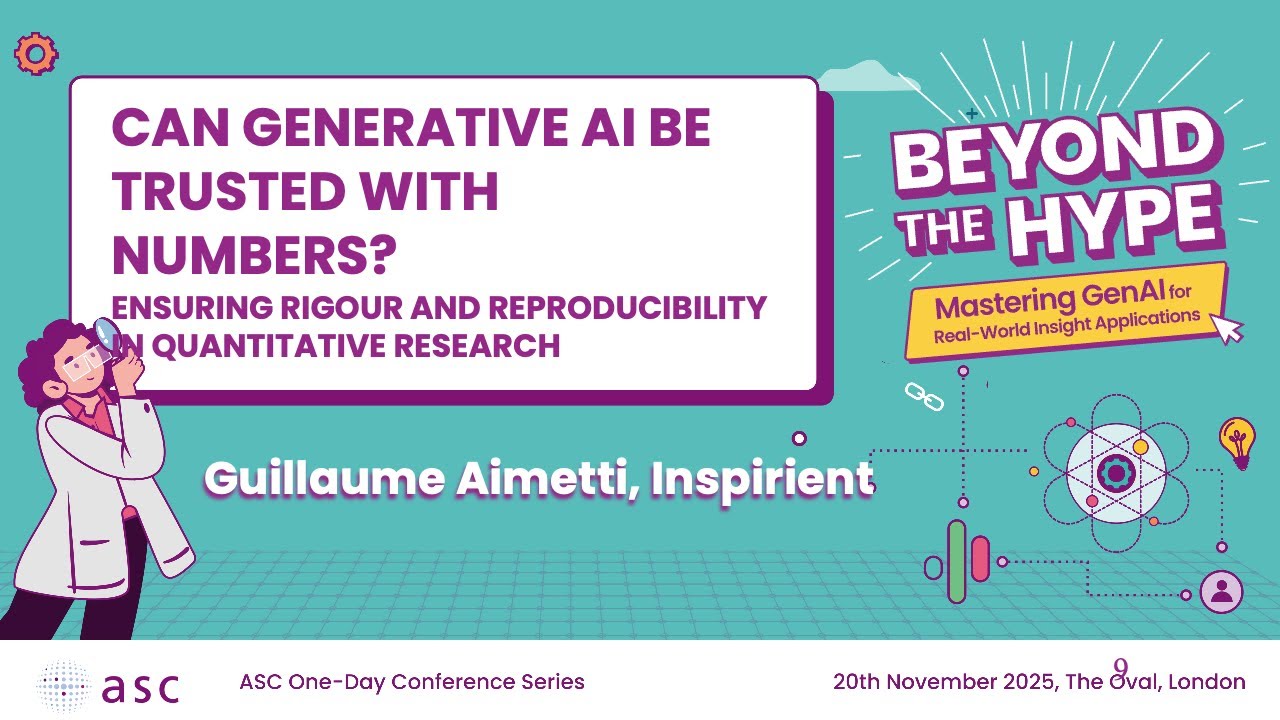
Can Generative AI Be Trusted With Numbers? Ensuring Rigour& Reproducibility in Quantitative Research

Автор: Association for Survey Computing (ASC)

Загружено: 2025-11-27

Просмотров: 16

Описание: By Guillaume Aimetti , Co-founder / CTO, Inspirient GmbH

Generative AI has captured enormous attention in survey research, but its application has been uneven. While qualitative tasks such as coding open-ends have seen dramatic gains, quantitative analysis has remained more resistant. The reason is straightforward: quantitative research relies on mathematical precision, reproducibility, and statistical rigour, which are qualities that large language models are notoriously poor at delivering. When business-critical decisions depend on numbers, “approximately correct” is not good enough. This paper addresses the central question: can generative AI be trusted with numbers? Drawing on practical implementations in survey research, we argue that it can, but only if designed with determinism and transparency at its core. The paper contrasts conventional LLM approaches, which generate text probabilistically, with a hybrid architecture that embeds validated statistical methods within an autonomous AI system. Rather than producing answers that “sound right,” such systems produce findings that can be independently verified, replicated, and trusted. We will review the methodological principles underpinning this approach, including automated crosstabulations, significance testing, regressions, and anomaly detection. Special attention will be given to how the system prioritises meaningful findings, avoiding the pitfalls of surface-level dashboards while reducing analysis time from weeks to minutes. Case studies from organisations such as De Beers, Bose, and leading agencies illustrate how rigorous automation changes practice: from improving data quality, to accelerating delivery, to supporting exploratory analysis. Beyond technical detail, the paper reflects on broader implications for the research industry. If reproducible quant insights can be produced at speed and scale, what does this mean for the role of analysts? How can insight teams ensure that automation enhances, rather than erodes, their professional standards? And how might we reconcile the flexibility of generative AI with the discipline of statistical science?

In addressing these questions, the paper contributes to an urgent debate. Generative AI promises efficiency and accessibility, but only by ensuring rigour and reproducibility can it be trusted as a foundation for quantitative research.

Не удается загрузить Youtube-плеер. Проверьте блокировку Youtube в вашей сети.
Повторяем попытку...
Can Generative AI Be Trusted With Numbers? Ensuring Rigour& Reproducibility in Quantitative Research

Поделиться в:

Доступные форматы для скачивания:

Скачать видео

  • Информация по загрузке:

Скачать аудио

Похожие видео

Next-Gen Shopper Research: Faster, Smarter, and More Accurate Fixture Creation

Next-Gen Shopper Research: Faster, Smarter, and More Accurate Fixture Creation

Nvidia CEO Jensen Huang talks about his company's latest innovations at CES 2026

Nvidia CEO Jensen Huang talks about his company's latest innovations at CES 2026

What the Standard Model Still Can’t Explain

What the Standard Model Still Can’t Explain

The Trust Index – a new approach to building brand trust and equity

The Trust Index – a new approach to building brand trust and equity

Live from CES: What is the point of a robot that falls over? | The Vergecast

Live from CES: What is the point of a robot that falls over? | The Vergecast

Почему Андрей Карпати чувствует себя

Почему Андрей Карпати чувствует себя "отстающим" (и что это значит для вашей карьеры)

The Expertise Paradox: Why AI Tools Need Better Researchers, Not Fewer

The Expertise Paradox: Why AI Tools Need Better Researchers, Not Fewer

Удалось ли Терри Тао решить уравнение стоимостью 1 000 000 долларов, которое нарушает законы физики?

Удалось ли Терри Тао решить уравнение стоимостью 1 000 000 долларов, которое нарушает законы физики?

How to Solve the Biggest Problem with AI

How to Solve the Biggest Problem with AI

21 Coolest Tech at CES 2026

21 Coolest Tech at CES 2026

Using synthetic data to predict category norms

Using synthetic data to predict category norms

New OpenAI GUMDROP AI Device Turns ChatGPT Physical

New OpenAI GUMDROP AI Device Turns ChatGPT Physical

I Made a Classic Refactoring Mistake

I Made a Classic Refactoring Mistake

Zrobili to! Nowy silnik Honda V3 jest obłędem technicznym

Zrobili to! Nowy silnik Honda V3 jest obłędem technicznym

Mind the Gap: Where AI Analytics Platforms Help (and Where They Don’t)

Mind the Gap: Where AI Analytics Platforms Help (and Where They Don’t)

Python in Excel Workshop - ASC Labs - How to build a word cloud

Python in Excel Workshop - ASC Labs - How to build a word cloud

How Effective LLMs Evaluating Draft Survey Questions Using Rule-Based Question Appraisal Frameworks?

How Effective LLMs Evaluating Draft Survey Questions Using Rule-Based Question Appraisal Frameworks?

Tajny plan Jakuba Bermana, który zmienił Polskę

Tajny plan Jakuba Bermana, który zmienił Polskę

Where Research Tech Goes Next

Where Research Tech Goes Next

Mongo DB v1 4k+ Boot Dev

Mongo DB v1 4k+ Boot Dev

© 2025 ycliper. Все права защищены.


  • Контакты
  • О нас
  • Политика конфиденциальности


Контакты для правообладателей: [email protected]