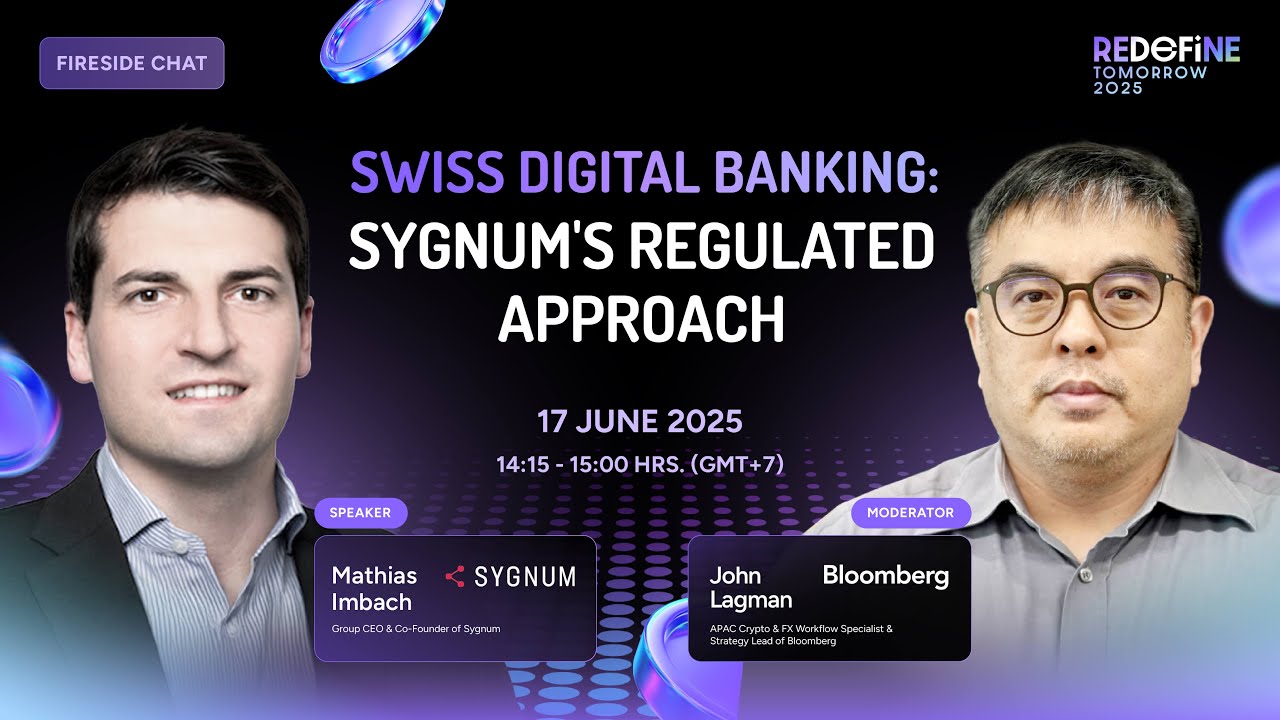
Swiss Digital Banking: Sygnum's Regulated Approach
Автор: SCB 10X
Загружено: 2025-06-17
Просмотров: 5453
Описание:
1/ Swiss Digital Banking: Sygnum's Regulated Approach - Key insights from CEO Mathias Imbach on building a crypto bank through 8 years of market cycles, regulatory evolution, and institutional adoption.
2/ Sygnum took a contrarian approach in 2017 - while the industry championed trustless, decentralized systems, they pursued full banking licenses in Switzerland and Singapore. The thesis: "future has heritage" - combining blockchain innovation with traditional financial infrastructure.
3/ Regulatory hurdles were paradoxically easier in 2017-2019 than today. Regulators were open to technology-neutral frameworks. The team has conducted workshops with regulators on compliance, travel rule implementation, and risk management - applying traditional banking rules to crypto.
4/ 2024 growth metrics: spot trading volumes doubled, derivatives trading increased 500%. The Bitcoin ETF approval in Feb 2024 was a watershed moment - signaling crypto as a permanent asset class and triggering institutional demand.
5/ Beyond ETFs: Sygnum offers 24/7 trading, crypto-collateralized lending, staking yields, and full banking services. Their fastest growing segment is prime brokerage products like Sygnum Protect - providing off-exchange custody with virtual margin for trading on major exchanges.
6/ Tokenization infrastructure breakthrough with Chainlink and Fidelity: bringing NAV data on-chain for tokenized assets. Focus areas include US Treasuries, money market funds, SME debt structures, and private market access (reducing minimums from $250k to $1k through efficiency gains).
7/ B2B expansion: Over 20 banks now use Sygnum's infrastructure. Switzerland leads globally with 40 banks dealing in blockchain/crypto in some form. The Trump administration's crypto-friendly stance provided "air cover" for traditional banks to accelerate adoption.
8/ Geographic revenue split: 50% Switzerland, 20% Singapore, 30% Europe/Asia. Asian clients favor trading, while Swiss clients use the full banking suite - holding crypto/fiat, traditional ETFs, Bitcoin derivatives, and taking loans against crypto collateral.
9/ Key challenge: Connecting DeFi with TradFi requires solving complex regulatory puzzles. Example: How do you apply "material outsourcing" due diligence requirements to smart contracts? These technical/regulatory bridges are being actively worked through.
10/ Tokenization reality check: Despite predictions of trillions on-chain by now, it remains a small revenue portion. The entire value chain needs upgrading - from securities laws to prospectus creation to risk management. US regulatory progress (stablecoin bill, market structure bill) is encouraging.
11/ [Commentary added by organizer] This aligns with industry observations - tokenization adoption has been slower than predicted due to infrastructure gaps rather than technology limitations.
12/ Professionalization trend: Major foundations now hire seasoned TradFi professionals as CFOs/CEOs. They bring institutional approaches to treasury management, custody diversification, counterparty risk, and tax reporting - a significant shift over the past 12 months.
14/ Looking ahead: International banks will start offering crypto services from H2 2025. Sygnum's competitive advantage: deep ecosystem relationships built since early days, specialized products, and enabling medium/small banks that won't build infrastructure themselves.
15/ Call to action: The industry needs more real-world use cases beyond Bitcoin as an asset and stablecoins for payments. These two proven tools should be leveraged to create applications touching everyday life - the key trigger for mass adoption.
Повторяем попытку...
Доступные форматы для скачивания:
Скачать видео
-
Информация по загрузке: