St. Mark Passion by Charles Wood
Автор: Dr. Homer A. Ferguson III
Загружено: 2025-04-12
Просмотров: 457
Описание:
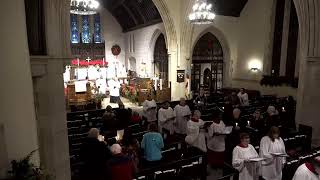
The St. Mark Passion was performed as part of the Lenten season offerings of Emmanuel Episcopal Church, April 4, 2025. In addition to music offered by The Emmanuel Choir and guest musicians, much of the Gospel narrative was sung by tenor Theodore Schwamm, in the role of the Evangelist, and baritone Robert Mobsby, in the role of Jesus.
Using the translation from the King James Version of the Bible, composer Charles Wood (1866-1926) structured the work into five sections, The Last Supper, Gethsemane and Betrayal, Trial Before the High Priest, Trial Before Pilate, and The Crucifixion. Unlike other musical settings of the Passion, there are no arias. Instead, Wood adopted a style of narration and choral singing of the Gospel that is more closely related to the Passion settings of William Byrd and his contemporaries.
The work is introduced with the plainsong hymn "Sing, my tongue, the glorious battle," and is brought to its conclusion with the last verse of the same hymn. Several times during the performance of this work, the congregation sings as participants in the Passion. Before the concluding hymn, The Reverend Dr. Talmage Bandy led a moment of silence and prayer. These elements of the Passion are in keeping with the original form of the work.
The Reverend Dr. Eric Milner-White, former Dean of King's College, Cambridge, recounted how the Saint Mark Passion came into existence: “The then Provost of King’s, Richard Durnford, asked me to enrich Holy Week in King’s Chapel if possible. For two years my imagination totally failed. Then I went into hospital for appendicitis, and as I actually came round from the anesthetic, the St. Mark’s Passion was fully born in my mind, and a note was sent from my bedside to Charles Wood, whom I did not then know personally, to seek his assistance. He came at once, sat by my bedside, we outlined the whole act, including the hymns, and he then completed it within a month.”
Wood in fact composed the piece over the course of nine days, 1 August to 9 August 1920. It received its first performance Good Friday 1922 at King's College Chapel.
Charles Wood was a central figure in the reawakening of English music. His relatively small output belies his influence, with a particular contribution to Anglican church music. "O Thou the central orb" is without a doubt a classic of the genre which defines in many people's minds the Anglican 'cathedral sound'. As Professor of Music at Cambridge University he passed on his traditional craftsmanship to some significant figures of the Twentieth Century, among them Michael Tippett and Ralph Vaughan Williams.
Today, Wood’s liturgical settings remain part of cathedral and parish choral repertoire. These compositions include some twenty settings of the evensong canticles, the Magnificat and the Nunc dimittis, more than thirty anthems, two settings of the Te Deum and Benedictus, and four of the Communion Service. While some of these may be the most familiar elements of Wood’s work, his compositions also include six string quartets, a piano concerto, solo songs and arrangements of Irish folk-songs, and a number of cantatas, settings of texts taken from Shelley, Herrick, Swinburne, Milton, Whitman, Scott and Elizabeth Barrett-Browning.
In addition to the roles of the Evangelist and Jesus, others singing solo roles include Benny Edwards as Peter, Randall Frye as Judas, Jack Neely, as the High Priest, Harper Cook as Pilate, Ginger Peterson as Maid I, Sarah Harris as Maid II, Emily Hartsoe, soprano, and Stephen Gourley, Bystander.
Dr. Homer Ashton Ferguson III
Organist & Choirmaster
Повторяем попытку...

Доступные форматы для скачивания:
Скачать видео
-
Информация по загрузке: