Why Is India So Dirty? It’s Not What You Think
Автор: Why Not
Загружено: 2026-10-21
Просмотров: 33
Описание:
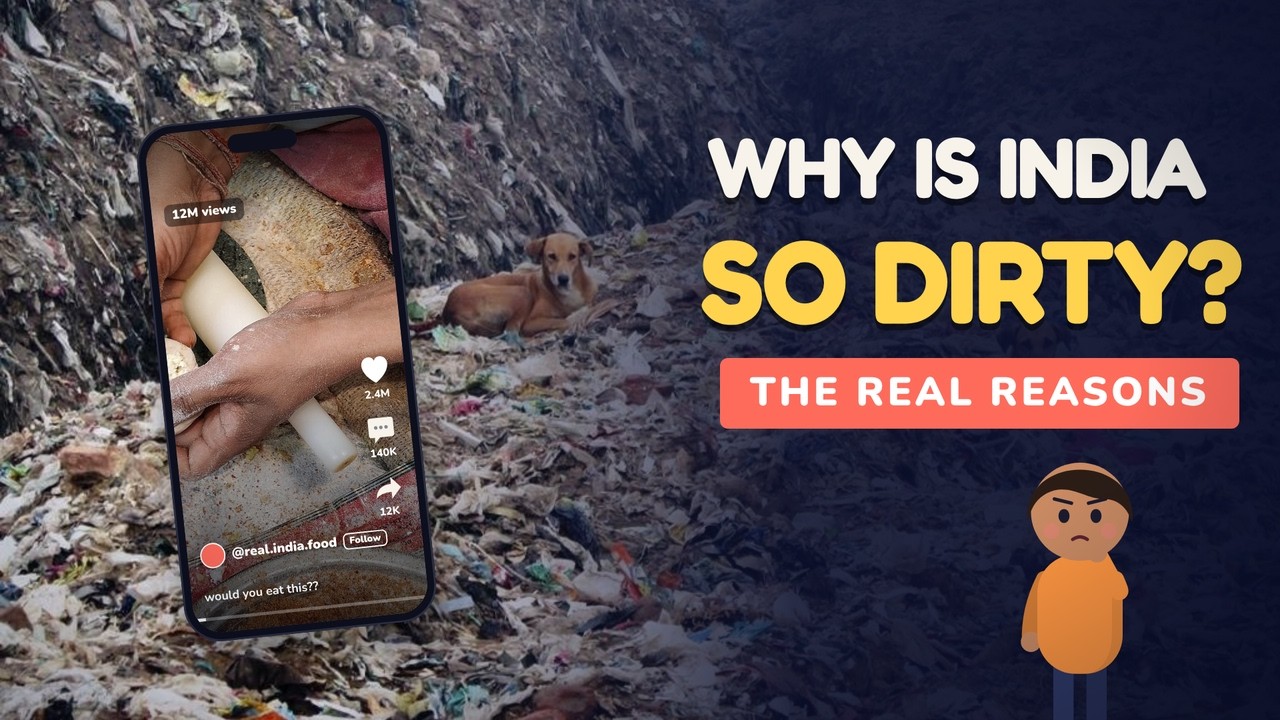
Millions of people watch viral videos of Indian street food, foaming rivers and mountains of garbage — and the same question fills the comments: why is India so dirty? Not because Indians don't care. The real answer involves cities that grew faster than their budgets, the caste history of cleaning, a street that "belongs to no one", and plastic that arrived before the systems to deal with it. And it explains how any country gets clean — including Indian cities that are doing it right now.
CHAPTERS
0:00 Intro
1:00 The Two Indias
3:31 A Mountain of Garbage
5:35 The Price of Dirt
6:53 Cities That Grew Too Fast
8:45 Nobody's Space
10:18 Who Cleans?
12:03 Plastic, Everywhere
14:02 Every Country Was Dirty
16:25 India Is Changing
18:34 So, Why?
SOURCES & FURTHER READING
• Robertson, C.E. et al. (2023). Negativity drives online news consumption. Nature Human Behaviour.
• Central Pollution Control Board (2021). Annual Report on Solid Waste Management Rules, 2020–21.
• Kaza, S. et al. (2018). What a Waste 2.0. World Bank.
• Ministry of Housing & Urban Affairs — Swachh Bharat Mission (Urban) 2.0: legacy dumpsite remediation; Swachh Survekshan city rankings.
• Water and Sanitation Program (2011). The Economic Impacts of Inadequate Sanitation in India. World Bank.
• Spears, D. (2013). How Much International Variation in Child Height Can Sanitation Explain? World Bank Policy Research Working Paper 6351.
• Census of India (1951, 2011); UN World Urbanization Prospects.
• Reserve Bank of India (2022). Report on Municipal Finances.
• Kaviraj, S. (1997). Filth and the Public Sphere: Concepts and Practices about Space in Calcutta. Public Culture 10(1).
• Cialdini, R.B., Reno, R.R. & Kallgren, C.A. (1990). A Focus Theory of Normative Conduct. Journal of Personality and Social Psychology.
• Employment of Manual Scavengers and Construction of Dry Latrines (Prohibition) Act, 1993; Prohibition of Employment as Manual Scavengers and their Rehabilitation Act, 2013.
• Ministry of Social Justice & Empowerment, reply in Lok Sabha (July 2022) on deaths while cleaning sewers and septic tanks, 2017–2021.
• Plastic Waste Management (Amendment) Rules, 2021 (single-use plastic ban from 1 July 2022).
• NASA Earth Observatory imagery of the Deonar dump fire, Mumbai (2016).
• On the Great Stink (1858) and Joseph Bazalgette's sewers; George E. Waring Jr. and New York's street cleaners (1895); Singapore's Keep Singapore Clean campaign (1968) and Singapore River clean-up (1977–1987); the Surat plague (1994).
• UN Environment Programme — Afroz Shah, Champion of the Earth (2016), Versova beach clean-up.
PHOTOS — Wikimedia Commons, used unaltered (full titles, licences and links in the pinned comment):
Joseph Bazalgette (public domain); Shishirdasika (CC BY-SA 4.0); Ravi Khemka (CC BY 2.0); Utcursch (CC BY-SA 3.0); Harsh Agrawal (CC BY 2.0); Ravi Dwivedi (CC BY-SA 4.0); Patrick Barry (CC BY-SA 2.0); erin (CC BY 2.0); Mike Prince (CC BY 2.0); Bernard Gagnon (CC BY-SA 4.0); TheodoreIndiana (CC BY-SA 3.0); Deolekar (CC BY-SA 3.0); FacetsOfNonStickPans (CC BY-SA 4.0); ANKAN (CC BY-SA 4.0); Radosław Botev (CC BY 3.0 pl); SuSanA Secretariat (CC BY 2.0); PJeganathan (CC BY-SA 4.0); AmanAgrahari01 (CC BY-SA 4.0); Muhammed Shafi (CC BY 2.0); Punch Magazine (public domain); melgupta (CC BY-SA 2.0); Aafi (CC BY-SA 4.0); Biswarup Ganguly (CC BY 3.0); McKay Savage (CC BY 2.0); Dudva (CC0); Mother Voluntary (CC0); Baranagore Ramakrishna Mission Ashrama High School (public domain); Joseph Austin Benwell (public domain); John Leech (public domain); nesnad (CC BY 3.0); STLLR Photo (CC BY 2.0); Sangameshwar Reddy (CC BY 4.0)
Narration: synthetic voice. Music and sound effects: original. Maps show land only, without political borders.
#India #Explainer #StreetFood #SwachhBharat
Повторяем попытку...
Доступные форматы для скачивания:
Скачать видео
-
Информация по загрузке: