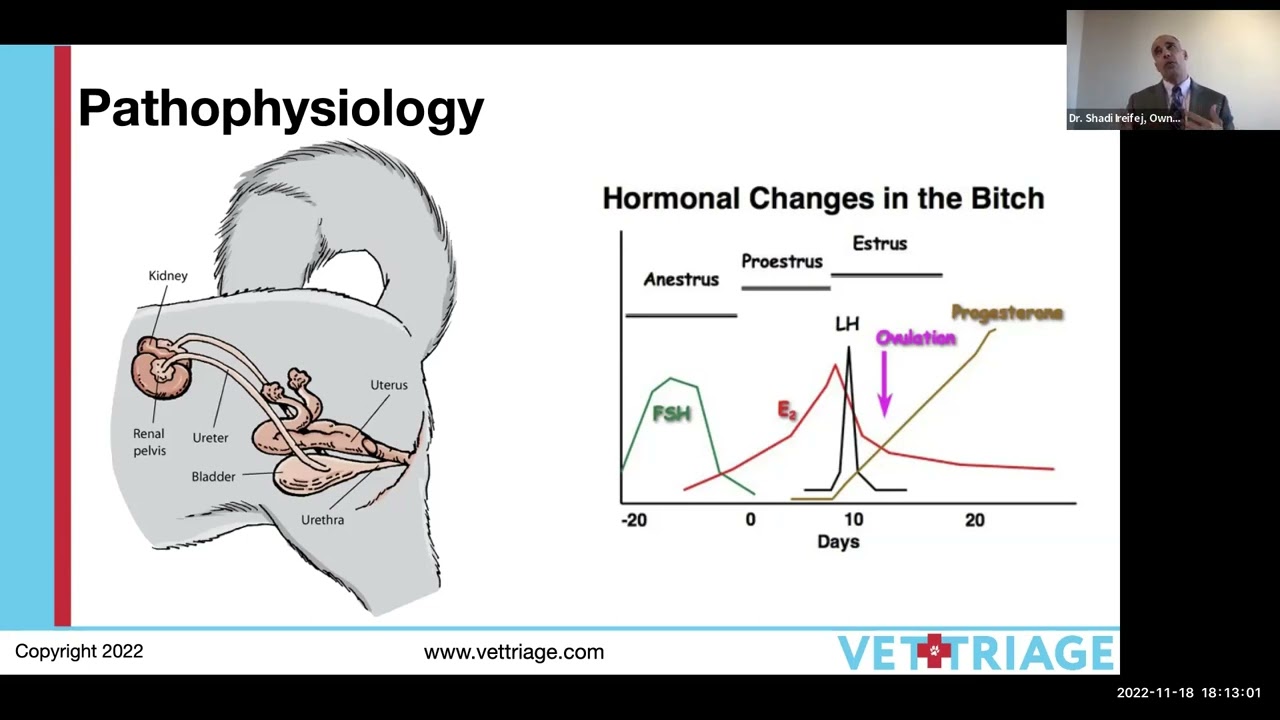
Pyometra in dogs | dvm360 fetch conference | Long Beach, California | December 2024
Автор: Dr. Shadi Ireifej
Загружено: 2024-12-17
Просмотров: 242
Описание:
#spay_and_neuter #ovarian #uterus #pregnancy
Ventral midline celiotomy
The routine ovariohysterectomy is usually recommended at 6 to 9 months of age (considered prepubertal) but can be performed as early as 8 to16 weeks of age. This may risk growth plate closure. If performed by a mean of 9 weeks of age, an increase in bone length and development in a small vulva may occur. The surgery can also be performed by 4 months or older, after vaccinations are completed, or before adoption is confirmed.
The purpose of this surgery is to decrease pregnancy and correct dimorphic sexual aggression between females and between male and females. Nonsexual dimorphic behaviors due not resolve post-operatively. Other indications for this procedure include uterine disease prevention or treatment, mammary gland tumor prevention or adjunct treatment, diabetes mellitus treatment, and epilepsy treatment.
The open surgical approach in those dogs over 5 months of age requires an incision positioned from the cranial one-third distance between the umbilicus to the pubis. In the prepubertal dog, the incision is located within the middle third of that distance.
Increased serous peritoneal fluid is encountered in the young pets. The spay hook or the surgeons index finger is applied to the uterus. Kelly or mosquito hemostatic forceps are applied to the proper ligament. The suspensory ligament is used for caudal and medial traction to be stretched or strained gently. The broad ligament is perforated with hemostatic forceps at the junction of the mesovarium and mesometrium. Rochester-Carmalt forceps are applied to the pedicles using the clamp technique.
Firstly 0 to 3-0 monofilament nonabsorbable suture is placed ventral to the first ligature placed around the mesovarium. This ligature is placed close to the aorta and cranial to the broad ligament defect created. The ligature is formed with the use of a surgeons throw and the ligature is placed within the forceps groove imprinted on the tissue. The second ligature is secured via transfixation or an encircling suture and secured with single square throws. The second ligature is placed 10 to 20 mm distal to the first ligature. The third ligature is placed distal to the second ligature, closer to the ovary, mesosalpinx, or ovarian or uterine vessels at the proper ligament.
Transection of the pedicle is performed distal to the second and proximal to the third clamp. The mesovarium and broad ligament are transected. The mesovarium may be ligated if the bitch is in estrus. The uterus is ligated with encircling ligatures placed cranial to the cervix using double ligatures placed 2 to 5 mm in between. The second ligature is a transfixing or encircling ligature with one square knot and two throws that then encircle 2 to 3 throws. A surgeons throw along with square knots are applied to the contralateral uterine artery and vein. In the pregnant uterus, bilateral transfixation with encircling sutures are used. Transection is 5 mm cranial to the cranial suture. Closure is via the external rectus facia. A 2-layer closure is performed if no subcutaneous fat is present. The ovarian bursa is explored.
In a routine ovariohysterectomy, the triple clamp technique is used. Doyen forceps are used. The surgeon avoids oversewing the uterus or a Parker-Herr oversew can be used if the cervix is distended. Open or closed abdominal drainage is considered in cases of peritonitis. Sutures used are 3 or 4-0 absorbable monofilament for pedicle and uterine ligation. With uterine rupture 50 mg/kg of lavage is used.
The use of bipolar vessels sealant devices for sealing uterine horns and bodies in dogs results in an uterine horn bursting pressure of 300 mmHg (range 0 to 300 mmHg) and 100 mmHg in those structures that are 9 mm or more in diameter Suture bursting pressure is 300 mmHg ranging from 200 to 300 mmHg. The uterine body bursting pressure is 237 mmHg and those structures that are 9 mm or more in diameter, failure occurs at 125 mmHg, with no burst seen in 20% of cases. Therefore the bipolar vessel sealant device is not recommended for uterine bodies that are 9 mm or more in diameter. The greater the uterine body diameter, the higher the sealing device application number. The vessel sealing device fails at a pressure that is less than that of suture.
Conventional ovariohysterectomy surgical time is 69 to 91 minutes.
Повторяем попытку...

Доступные форматы для скачивания:
Скачать видео
-
Информация по загрузке: