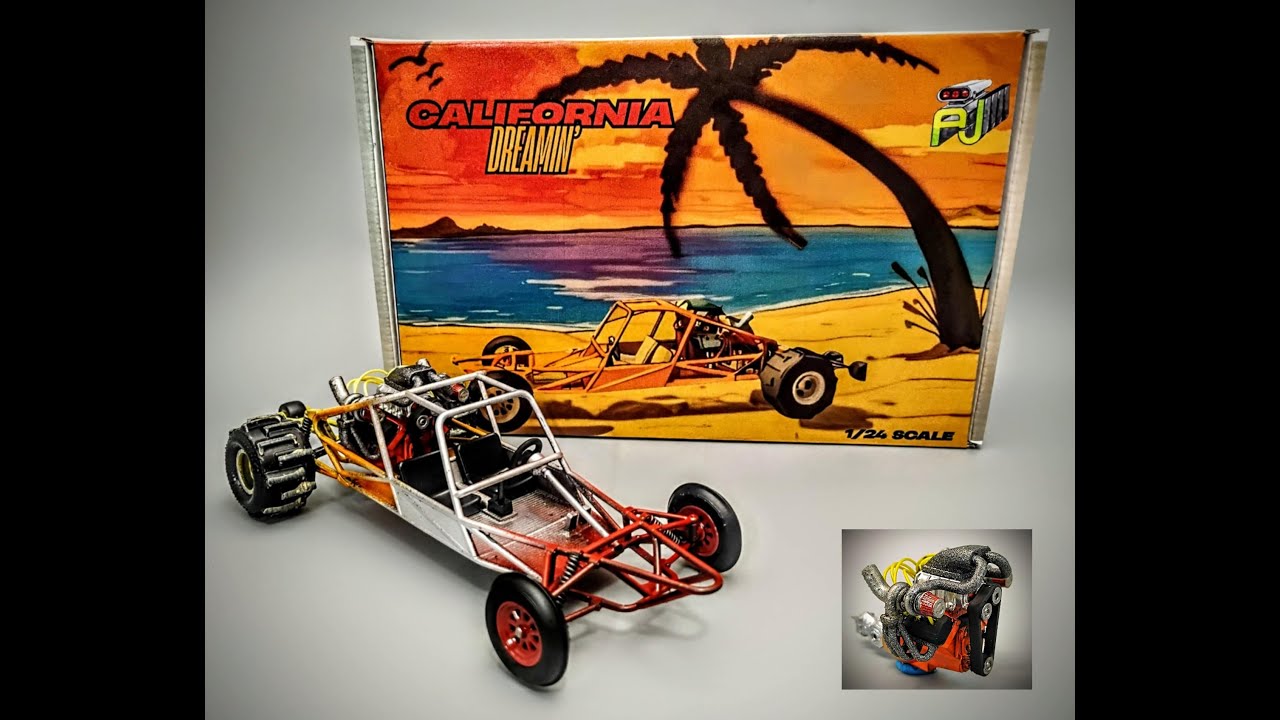
3D Printed Hemi Sand Rail Dune Buggy 1/24 Scale Model Kit Build How To Assemble Paint Wire Engine
Автор: hpiguys Workshop
Загружено: 2025-07-16
Просмотров: 5648
Описание:
https://ajmodelkits.com/products/cali...
Join this channel to get access to perks:
/ @hpiguy
California Dreamin’ - Sand Buggy 3D Printed Blown Hemi Sand Rail Dune Buggy 1/24 Scale Model Kit Build How To Assemble Paint Wire Engine Paddle Tires Turbo Supercharger Supercharged
A sandrail, also called a sand rail, rail, or sand car, is a lightweight off-road motor vehicle specifically built for traveling in sandy terrain. Synonymously referred to as dune buggies, a sandrail is a type of speciality vehicle.[1] They are popularly operated on actual sand dunes. Sandrails can be driven on other types of terrain but are designed specifically for sand.
History
Sandrail, 1973
Sandrail frame advertisement circa 1978
At the end of World War II thousands of soldiers returning from the war had spent years driving Jeeps, tanks, and half-tracks with few or no roads. Having an increased disposable income, these GIs formed the original core of off-road enthusiasts. Initially, they used surplus Jeeps and cut-up cars to build their off-road vehicles. Soon these "off-roaders" discovered that with little more than a skid plate, they could get a stock air-cooled Volkswagen Beetle to go almost anywhere.[2] Throughout the 1950s the sport continued to develop.
In 1958 Pete Beiring of Oceano, Calif., took the body frame or "pan" from a damaged Volkswagen and shortened it into a new machine that eventually became the precursor to the dune buggy. This eventually led to the first production dune buggy called the "Sportster", which was developed around 1960 by the EMPI Imp Company. It was an angular sheet metal vehicle built on a stripped-down Volkswagen chassis. Many others followed including the ever popular Meyers Manx design.[3] Dune buggies had a style all their own with fiberglass siding and other "heavy" body features.
As the late 1960s and early '70s approached, enthusiasts developed lighter and more powerful sand vehicles capable of ascending steeper and higher dunes. Many started experimenting at home by building super light weight vehicle frames from metal tubing, often without a roll cage. Many were nothing more than a frame, engine, transmission, wheels and one or two seats. Because of their versatility, light weight and simplicity the air-cooled Volkswagen engine and transmission were the power plant of choice for many owners. By placing the motor and transmission in the rear of the frame it allowed the front of the sandrail to remain extremely light and thus able to "float" over the sand dunes. An added value of placing the engine in the rear of the vehicle was that heat created by the motor did not blow into the face of the driver and passengers. From the 1970s forward, sandrail builders continued to push the delicate balance between weight and power.
The Chrysler Hemi engine, known by the trademark Hemi or HEMI, refers to a series of high-performance American overhead valve V8 engines built by Chrysler with hemispherical combustion chambers. Three generations have been produced: the FirePower series (with displacements from 241 cu in (3.9 L) to 392 cu in (6.4 L)) from 1951 to 1958;[1] a famed 426 cu in (7.0 L) race and street engine from 1964-1971; and family of advanced Hemis (displacing between 5.7 L (348 cu in) 6.4 L (391 cu in) since 2003.
Although Chrysler is most identified with the use of "Hemi" as a marketing term, many other auto manufacturers have incorporated similar cylinder head designs. The engine block and cylinder heads were cast and manufactured at Indianapolis Foundry.[which?][when?][citation needed]
During the 1970s and 1980s, Chrysler also applied the term Hemi to their Australian-made Hemi-6 Engine, and a 4-cylinder Mitsubishi 2.6L engine installed in various North American market vehicles.
Повторяем попытку...
Доступные форматы для скачивания:
Скачать видео
-
Информация по загрузке: