NASA's Hubble Telescope CRASHING! What's the REAL Reason Behind Its Rapid Descent...??
Автор: Future Shock
Загружено: 2026-02-15
Просмотров: 6
Описание:
A school-bus-sized telescope is slowly losing altitude above Earth.
It has changed the way humanity sees the universe.
And within the next decade, it could fall back through our atmosphere.
The Hubble Space Telescope has been orbiting Earth since 1990, delivering some of the most breathtaking and scientifically groundbreaking images ever captured. From the famous Deep Field photograph revealing thousands of distant galaxies to precise measurements of the universe’s expansion, Hubble has fundamentally reshaped modern astronomy. But now, something few people are talking about outside scientific circles is becoming impossible to ignore: Hubble is gradually descending.
Orbiting at roughly 17,500 miles per hour, Hubble doesn’t simply “float” in space. Even at its altitude, there is a trace amount of atmosphere. That thin drag slowly steals energy from the telescope’s orbit. Without periodic boosts — like the servicing missions conducted by NASA astronauts in the 1990s and 2000s — objects in low Earth orbit inevitably spiral downward. And Hubble no longer receives regular servicing missions.
The question is no longer whether Hubble will eventually reenter Earth’s atmosphere. It’s when.
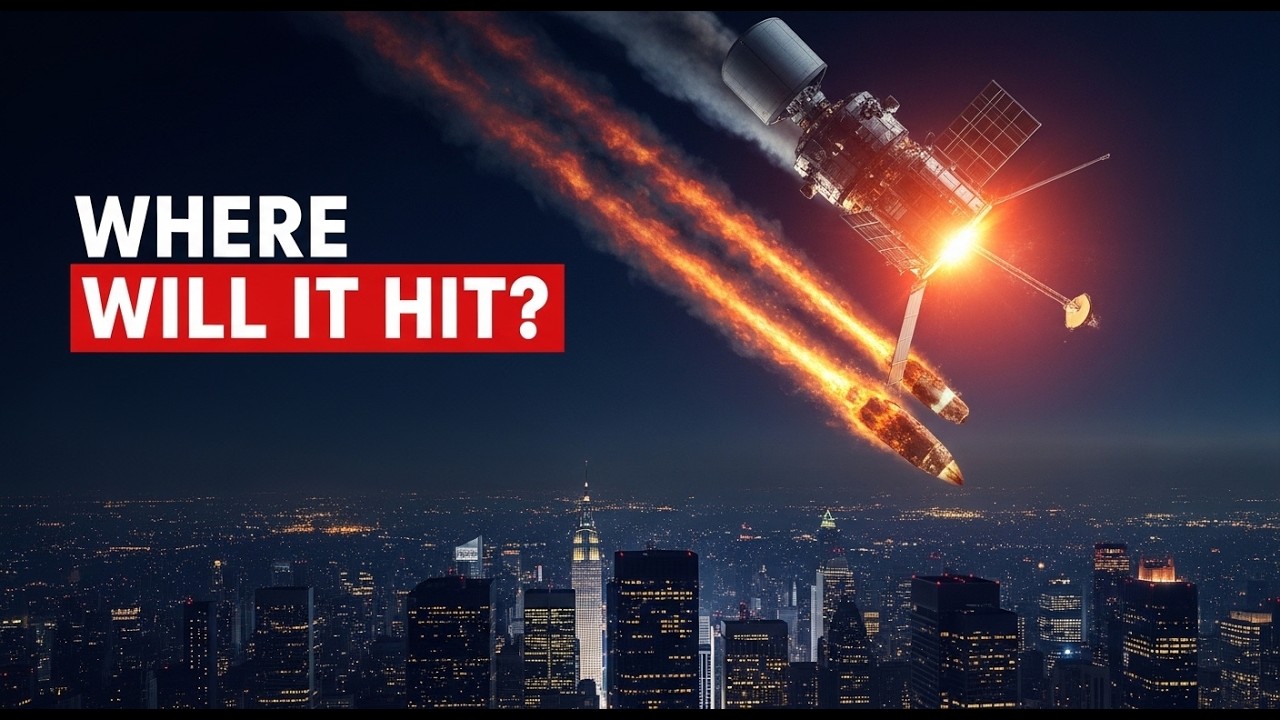
Current projections suggest that sometime in the early 2030s — possibly around 2033 — Hubble’s orbit will decay enough for atmospheric reentry to become unavoidable. During reentry, intense heat and friction will tear apart most of the structure. But not necessarily all of it.
Large satellites do not always burn up completely.
Dense components such as gyroscopes, reaction wheels, and structural elements can survive reentry. That doesn’t mean Hubble will crash into a city — the most likely scenario is that debris falls harmlessly into ocean. But orbital decay calculations are notoriously sensitive. Tiny atmospheric variations caused by solar activity can shift predicted landing zones by thousands of miles.
And that uncertainty is what makes this story compelling.
The Hubble Space Telescope is not just another satellite. It is arguably the most important scientific instrument humanity has ever placed in orbit. It confirmed the accelerating expansion of the universe. It helped refine the age of the cosmos to approximately 13.8 billion years. It mapped dark matter distribution in distant galaxy clusters. It captured images that became cultural icons in both the UK and the United States.
When people search for “Hubble crash,” “Hubble falling,” or “Hubble reentry date,” they are often shocked to learn this isn’t science fiction. Orbital decay is physics. Gravity doesn’t negotiate.
There are options on the table.
NASA has studied the possibility of attaching a propulsion module to Hubble — either to boost it into a higher, safer orbit or to guide it into a controlled reentry over a remote ocean region. Such a mission would cost hundreds of millions of dollars. In the context of national budgets, that might not sound astronomical. But space agencies must balance priorities: planetary defense, lunar missions, Mars exploration, climate satellites, and more.
Meanwhile, the James Webb Space Telescope now dominates headlines. Webb observes primarily in infrared, allowing it to peer deeper into dusty star-forming regions and early cosmic epochs. But Webb does not replace Hubble. Hubble operates in visible and ultraviolet wavelengths, offering a different slice of the electromagnetic spectrum. Losing Hubble would mean losing capabilities that no other current telescope fully replicates.
That’s why the debate isn’t simple.
Inside the scientific community, two viewpoints quietly exist. One side argues that allowing an uncontrolled reentry — even if statistically safe — carries reputational and risk implications. The other emphasizes fiscal responsibility and the realities of space policy. Controlled deorbit missions are complex and expensive.
#HubbleTelescope
#NASA
#SpaceNews
#Hubble
#SpaceDocumentary
#SatelliteReentry
#OrbitalDecay
#Astronomy
#SpaceScience
#JamesWebb
#JWST
#NASAUpdate
#SpaceExploration
#BreakingSpace
#ScienceExplained
#Astrophysics
#Universe
#DeepField
#SpaceMystery
#UKScience
#USAScience
#SpaceDebate
#CosmicNews
#LowEarthOrbit
#Reentry
#SpaceFacts
#OuterSpace
#ScienceChannel
#STEM
#SpaceHistory
#FutureOfSpace
#NASA2026
#SpacePolicy
#EarthOrbit
#CosmicDiscovery
#SpaceTechnology
#FutureOfHumanity, #Futurism, #Science, #Technology, #ScienceFiction, #SpeculativeScience, #FutureShock, #WhatIfScenarios, #AIFuture, #TechFuture, #NextGenTechnology, #AdvancedTechnology, #Robotics, #MachineLearning, #AGI, #DigitalFuture, #FutureWorld, #SciFiTech, #AIRevolution, #HumanVsAI, #TechEvolution, #TomorrowTechnology, #FutureTrends, #Innovation, #AIStories
Повторяем попытку...
Доступные форматы для скачивания:
Скачать видео
-
Информация по загрузке: