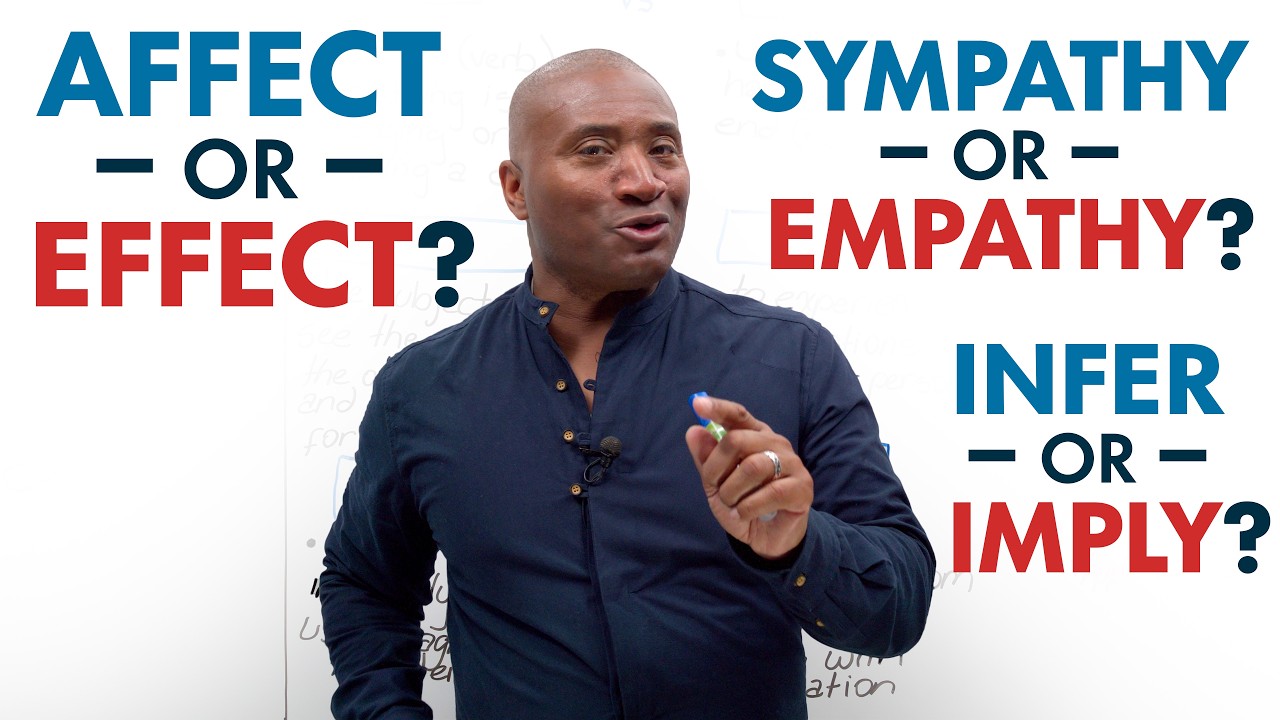
AFFECT or EFFECT? Infer or Imply? Sympathy or Empathy?
Автор: ENGLISH with James · engVid
Загружено: 2025-02-03
Просмотров: 43097
Описание:
Do you have sympathy for someone or empathy? Did the medicine have an affect on you, or an effect? Did the world leader infer that he was going to attack or imply it? Don’t worry, even many native English speakers get these wrong! In this class, I’ll explain three of the most commonly misused word pairs in English and show you simple tricks to remember the correct meanings and usage. Stop making these mistakes, sound more confident, and have fun with the language. Perfect for intermediate and advanced English learners who want to polish up their vocabulary! Watch now and never misuse these words again. https://www.engvid.com/affect-effect-...
More of my vocabulary lessons:
Improve Your Vocabulary: 8 Words for Intermediate English Learners • Improve Your Vocabulary: 8 Words for Inter...
7 Ways to Master Vocabulary • 7 Ways to Master Vocabulary
In this lesson:
0:00 3 Pairs of Confusing Words
1:20 "affect" or "effect"?
3:49 "sympathy" or "empathy"?
10:37 "imply" or "infer"?
TRANSCRIPT:
Hey, that or this?
First of all, it's "this" or "that".
Hi.
James from engVid.
He's doing a common mistake called a "malapropism".
What?
Malapropism?
Don't worry.
I don't know what it means either.
It means...
Really?
It means word confusion.
It's when we use the wrong word in a different situation.
In this case-right?-so you don't need to know the big word "malapropism", just know that
you're using a word that you think means this, but it may not.
And that could be for a variety of reasons.
It can be because it's a homophone, which means it sounds the same, but when you write
it down, they look different.
Or it can actually have a different meaning, even though they kind of look the same.
Right?
So, today I have chosen six words, and we're calling them pairs because usually the person
will make the mistake thinking one word means the other.
But I'm going to try and show you in a way that you won't make that mistake.
Okay?
And to make this lesson fun, because learning English is hard, and you're here to work,
but there's no reason you can't have a little fun, I'm going to throw in a fun fact for
you to help you remember these things.
Are you ready?
Let's go to the board.
You might notice the first one says "action verb", something is changing or making a difference,
versus "Batman v Superman".
We know who won that one, right?
Versus "what you get in the end".
This is a commonly confused pair of words, with even native speakers making this mistake,
because they sound very similar, it's a slight difference in pronunciation, but how you're
supposed to use them is very different.
Okay?
And the first difference we can see is one is a verb and one is a noun.
Okay?
And I'm going to put it here and I'm going to help you with it, because it's going to
start with "a", and this is "effect".
When you use this word, you want to show a difference or a change.
So, if someone's using "medicine", for instance, you would say "How is the medicine affecting
them?
What change is happening because they're taking the medicine?"
And I've done "a" and "a" so you can remember, think of a verb and think of an action, that's
what's happening when you get an effect.
Now, what about the other word that people confuse it?
Ah, they almost look so much the same, that's the problem, and that's "effect".
When we talk about the effect of something, we talk about the end result.
What was the end?
So, we say "How is the medicine affecting Victoria?"
And you can say "The effect was she lost her foot."
That's the end.
Do-do-dum-dum-psh.
Another nice ending, but that's the effect, and we can remember that by looking at the
letter "e" for "effect".
So, if you want to talk about the end result of something, use "effect", which is a noun,
but when you want to talk about the action of something, how it's changing, use "affect"
with the "a".
All right.
I already know some of you guys out there, you keyboard warriors, "James, there's time
so 'effect' can be a verb, too, and you're forgetting 'affect' as a noun, which is a
psychological..."
I don't care.
I talk...
I'm talking about how we normally use it, and I just told you I know.
Okay?
Okay.
But that's not for this lesson.
I'm talking about, basically, how it's used and misused.
And as long as we can remember, I think ending for "effect" and "affect" with "action", you're
going to beat most native speakers.
Cool?
All right.
All right.
The next one I'm going to talk about is this one.
"The subject can see the pain in the other person and feel sorry for them", versus...
I feel like I'm in a Tyson fight.
I wouldn't be in a Tyson fight if he...
He out.
He didn't even fight.
He's leaving.
He doesn't want to die.
Sorry.
Serious.
Okay.
Okay.
The next one is "to experience the emotions of another person". […]
Повторяем попытку...
Доступные форматы для скачивания:
Скачать видео
-
Информация по загрузке: