Acute Dystonia - Causes & Management @Dr Rezaul Hamid
Автор: Mindcare Mandia
Загружено: 2022-01-22
Просмотров: 488
Описание:
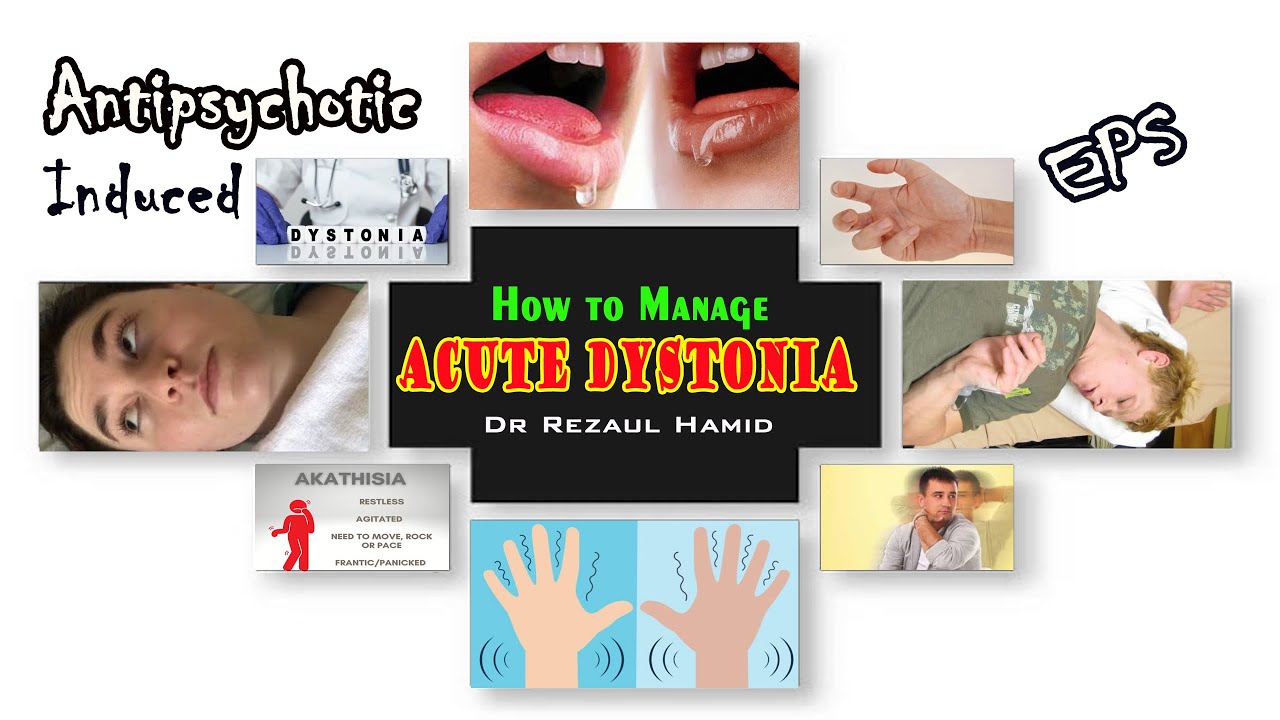
An acute dystonic reaction is characterized by involuntary contractions of muscles of the extremities, face, neck, abdomen, pelvis, or larynx in either sustained or intermittent patterns that lead to abnormal movements or postures. The symptoms may be reversible or irreversible and can occur after taking any dopamine receptor-blocking agents. The etiology of acute dystonic reaction is thought to be due to dopaminergic-cholinergic imbalance in the basal ganglia. Reactions usually occur shortly after the initiation of an offending agent or an increased dose of a possible offending agent. Anticholinergic agents and benzodiazepines are the most commonly used agents to reverse or reduce symptoms in acute dystonic reaction. Acute dystonic reactions are often transient but can cause significant distress to the patient. Although rare, laryngeal dystonia can cause life-threatening airway obstruction.
Antipsychotic and antiemetic agents are among the most commonly described causative agents of acute dystonic reactions. Other agents including anti-malarial, antidepressants, antihistamines, and anticonvulsants have also been implicated in cases of acute dystonic reaction. Antipsychotic agents with a dopamine-blocking mechanism are commonly used to treat acute psychosis, acute agitation, bipolar mania, and many other psychiatric conditions. All currently known antipsychotic medications carry a risk of causing an acute dystonic reaction. First-generation antipsychotics including haloperidol and thioridazine are associated with a higher risk of acute dystonic reaction. Second-generation antipsychotics including olanzapine, risperidone, and quetiapine are associated with a reduced risk of dystonic reaction which is postulated to be due to more rapid dissociation of the drugs from the D2 receptor sites. The antiemetic agents metoclopramide and prochlorperazine are also common agents leading to an acute dystonic reaction, even leading some practitioners to co-administer diphenhydramine.
The basal ganglia are a collection of subcortical nuclei through which information from the cortex is modulated and returned to the cortex to execute a coordinated movement. Acetylcholine has grossly inhibitory effects on movement, and dopamine has grossly excitatory effects on movement. Certain medications act to block dopamine receptors, leading to a potential pro-movement state. Acute dystonic reactions are postulated to be a result of an imbalance of anticholinergic and dopaminergic effects in this pathway.
Treatment of acute dystonic reaction centers around balancing the disrupted dopaminergic-cholinergic balance in the basal ganglia and discontinuation of the offending agent.
The half-life of most antipsychotic agents is longer than that of most diphenhydramine or benztropine requiring re-dosing of anticholinergic medications.
Повторяем попытку...
Доступные форматы для скачивания:
Скачать видео
-
Информация по загрузке:


![GOSPODARKA WOJENNA ROSJI - CZY PUTIN JUŻ PRODUKUJE CZOŁGI ZAMIAST LODÓWEK [BOJKE]](https://image.4k-video.ru/id-video/g2t5npoRfBA)


