Lone Pairs and Resonance Stabilization | Stability, Mechanism & GOC Explained by Cogitavers
Автор: CogitaVerse-Urdu Hindi
Загружено: 2026-01-10
Просмотров: 5
Описание:
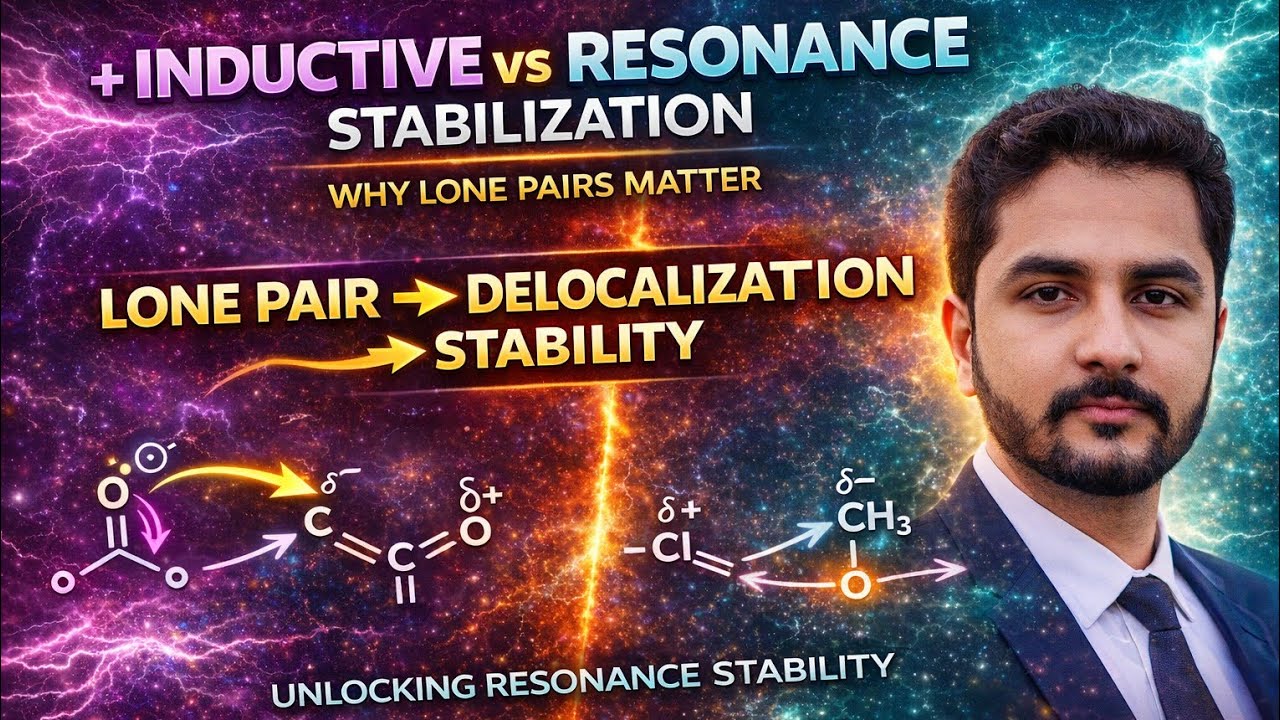
In this comprehensive and academically enriched lecture on Lone Pairs and Resonance Stabilization, Cogitavers presents a deep, structured, and mechanism-oriented exploration of one of the most central ideas in Organic Chemistry and GOC. With stability, electron distribution, and structural reactivity front-loaded as major thematic pillars, this session clarifies how lone pairs influence resonance behavior, modify electron delocalization, and ultimately govern the overall chemical stability of molecular frameworks.
Cogitavers maintains a clear, high-precision narrative to ensure that learners at intermediate and advanced levels can appreciate not only what resonance stabilization is, but why lone pairs often play the decisive role in enhancing or even enabling it.
This lecture begins by introducing the conceptual foundation of electron density localization, unpacking how a non-bonding electron pair positioned adjacent to a π-system or a partial positive center can participate in conjugation. By articulating the subtle movement of electrons without employing formal symbolic equations, Cogitavers ensures the explanation remains academically rigorous yet visually intuitive. The discussion emphasizes how lone pairs, when appropriately positioned in the molecular geometry, transform into powerful contributors to resonance structures, effectively expanding the hybridized orbital interactions and stabilizing the molecule via extended delocalization.
A key analytical component of this lecture focuses on hybridization changes that occur when lone pairs engage in resonance. Cogitavers explains why atoms originally bearing an sp³ configuration may adopt partial sp² characteristics as their lone pairs enter conjugated pathways, thereby lowering the system’s overall energy. This hybridization shift—though subtle—plays a profound role in stabilizing carbocations, strengthening aromaticity, and modifying acid–base character across functional groups.
The video also highlights the comparative stabilizing power of lone pair–driven resonance versus classical σ-inductive influences. Learners will come to understand why resonance stabilization, especially involving lone pairs, often overrides simple electronegativity-based reasoning. Examples span common functional groups such as phenols, amides, esters, and heterocyclic systems, demonstrating how lone pair delocalization dictates reactivity patterns, nucleophilicity, electrophilicity, and overall reaction feasibility.
To enrich conceptual clarity, Cogitavers dissects multiple real-world molecular examples where lone pairs define structural chemistry:
— Lone pair involvement in amide resonance and its role in peptide stability.
— Conjugation of heteroatoms like oxygen, nitrogen, and halogens with aromatic rings.
— Lone pair participation in carbocation stabilization, particularly in allylic and benzylic systems.
— How resonance withdrawal and resonance donation differ in the presence of lone pairs.
Throughout this lecture, Cogitavers maintains a balance between academic depth and practical insight, ensuring that students preparing for competitive exams or university-level organic chemistry can integrate these principles seamlessly into their problem-solving strategies. By the end of this video, learners will not only understand the theoretical basis for lone pair–driven resonance stabilization but also master the predictive skill of evaluating molecular stability across varied organic frameworks.
🌐 Website: CogitaVerse.com
📘 Facebook: Facebook.com/cogitaverse
📸 Instagram: Instagram.com/cogita_verse
Повторяем попытку...
Доступные форматы для скачивания:
Скачать видео
-
Информация по загрузке: