Quantifying the Earliest Signals of Alzheimer’s Disease: Baseline Amyloid PET as a Predictor-Podcast
Автор: Jeffrey Chen by SmartRad AI
Загружено: 2026-01-17
Просмотров: 4
Описание:
Quantifying the Earliest Signals of Alzheimer’s Disease: Baseline Amyloid PET as a Predictor of Future Amyloid Accumulation and Cognitive Decline
Professional Summary
This presentation synthesizes the findings of the FACEHBI longitudinal cohort study, which rigorously examines whether quantitative baseline amyloid PET imaging can identify individuals with subjective cognitive decline (SCD) who are at increased risk for future amyloid accumulation and cognitive deterioration. Leveraging [¹⁸F]florbetaben PET quantified in Centiloids (CL) and up to five years of follow-up, the study provides compelling evidence that even sub-threshold amyloid burden carries prognostic significance.
The work addresses a critical gap in preclinical Alzheimer’s disease (AD) research: how to stratify risk among cognitively normal individuals who report subjective decline but fall below conventional amyloid positivity thresholds. By integrating advanced longitudinal modeling, amyloid accumulation metrics, and voxel-wise parametric analysis, the study offers a refined framework for early disease detection and trial enrichment.
Study Design and Methods
Cohort
197 individuals with SCD from the Fundació ACE Healthy Brain Initiative (FACEHBI).
Imaging
Serial [¹⁸F]florbetaben amyloid PET scans (two to three scans per participant over approximately five years), quantified using the Centiloid scale.
Baseline Stratification
Amyloid positive (Aβ+): CL greater than 35.7
Grey Zone (GZ): CL between 20 and 35.7
Amyloid negative (Aβ−): CL 20 or lower, further subdivided into:
N1: CL 13.5 or lower (very low amyloid)
N2: CL between 13.5 and 20 (near-threshold)
Outcomes
Conversion from SCD to mild cognitive impairment (MCI)
Annualized amyloid accumulation rate (ARC) derived from linear mixed-effects modeling
Spatial patterns of early amyloid signal using voxel-wise SPM analysis
Key Results
1. Baseline Amyloid Burden Predicts Clinical Progression
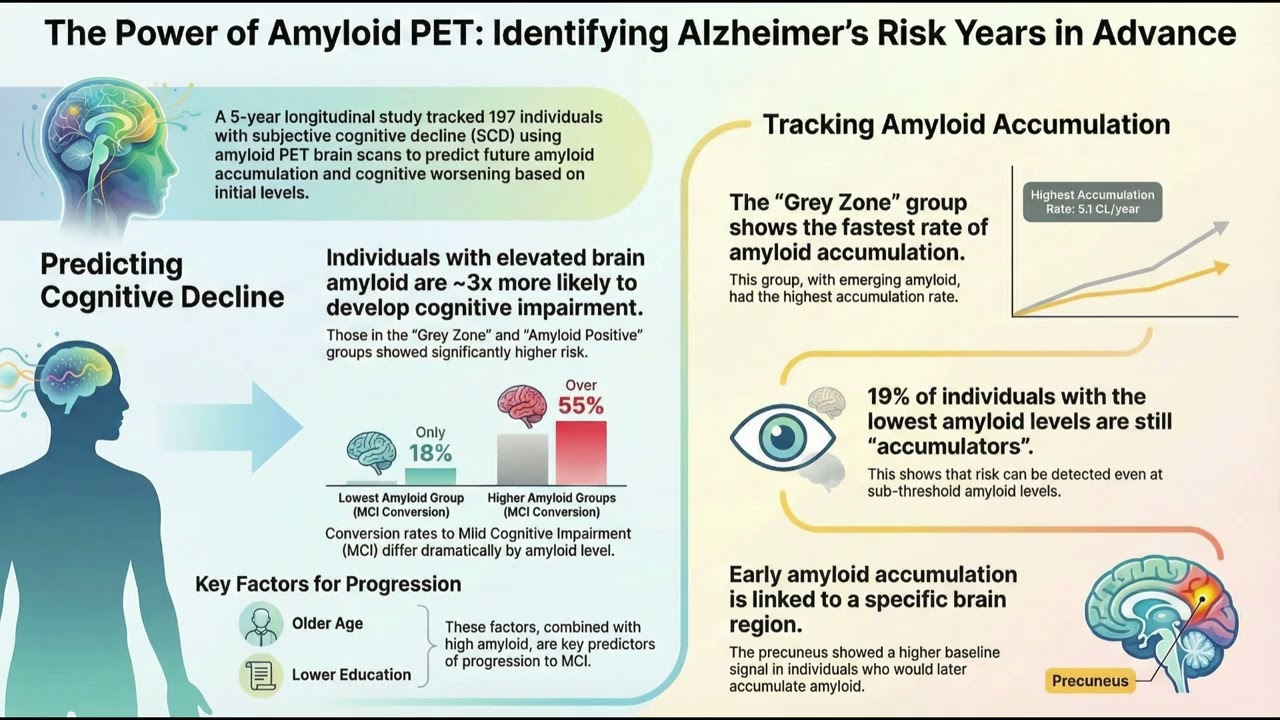
Individuals in the Grey Zone and Aβ+ groups demonstrated an approximately threefold higher hazard of conversion to MCI, even after adjustment for age and education. Older age increased risk, whereas higher educational attainment exerted a modest protective effect.
2. Sub-threshold Amyloid Is Not Benign
Among participants classified as amyloid negative at baseline:
89% of N2 individuals and 100% of Grey Zone individuals exhibited significant amyloid accumulation over time.
Notably, approximately 19% of N1 individuals, despite extremely low baseline CL values, showed meaningful amyloid accumulation, defined as an ARC exceeding 1.5 CL per year.
3. Distinct Accumulation Dynamics Across the Amyloid Spectrum
The Grey Zone group exhibited the fastest accumulation rates, approximately 5.1 CL per year.
The Aβ+ group showed slightly slower rates, consistent with a sigmoidal model of amyloid deposition approaching a plateau.
N1 and N2 groups demonstrated clearly divergent trajectories, supporting the biological relevance of this sub-classification.
4. Precuneus as an Early Vulnerability Region
Voxel-wise analysis revealed a focal region within the precuneus and posterior cingulate where baseline amyloid signal was higher in N1 individuals who later accumulated amyloid. This finding aligns with established models of early cortical amyloid deposition and highlights the sensitivity of quantitative PET in detecting incipient pathology invisible to visual reads.
Clinical and Research Implications
Risk Stratification: Quantitative amyloid PET enables identification of high-risk individuals before crossing conventional positivity thresholds.
Trial Enrichment
Precision Prevention
Conceptual Shift
Conclusion
This study demonstrates that baseline quantitative amyloid PET is a powerful predictor of future amyloid accumulation and cognitive decline, even in individuals with very low initial amyloid burden. The identification of early accumulation patterns—particularly within the precuneus—underscores the value of Centiloid-based PET quantification for detecting preclinical Alzheimer’s disease at its earliest, most actionable stage.
Reference (APA 7th Edition)
Kolinger, G. D., Sotolongo-Grau, O., Roé-Vellvé, N., Tartari, J. P., Sanabria, Á., Pérez-Martínez, E., & Marquié, M. (2025). Quantification of baseline amyloid PET in individuals with subjective cognitive decline can identify risk of amyloid accumulation and cognitive worsening: The FACEHBI study. European Journal of Nuclear Medicine and Molecular Imaging, 52, 3578–3590.
Suggested Hashtags
#AlzheimersDisease #AmyloidPET #Centiloid #SubjectiveCognitiveDecline #PreclinicalAD
#Neuroimaging #MolecularImaging #PrecisionMedicine #DementiaResearch #BrainHealth
#Dementia #Neuroscience #MedicalBreakthrough #EarlyDetection #MedicalResearch
#PreventativeMedicine #CognitiveScience #AmyloidBeta #PETScan #FACEHBI
© 2025 AI Chavelle™ by Jeffrey Chen / SmartRad AI. All rights reserved.
Повторяем попытку...
Доступные форматы для скачивания:
Скачать видео
-
Информация по загрузке:


