Viking Homes Never Froze, Even in Arctic Winters — But the Air Inside Was Quietly Killing Them
Автор: History in Ruins
Загружено: 2026-03-07
Просмотров: 30
Описание:
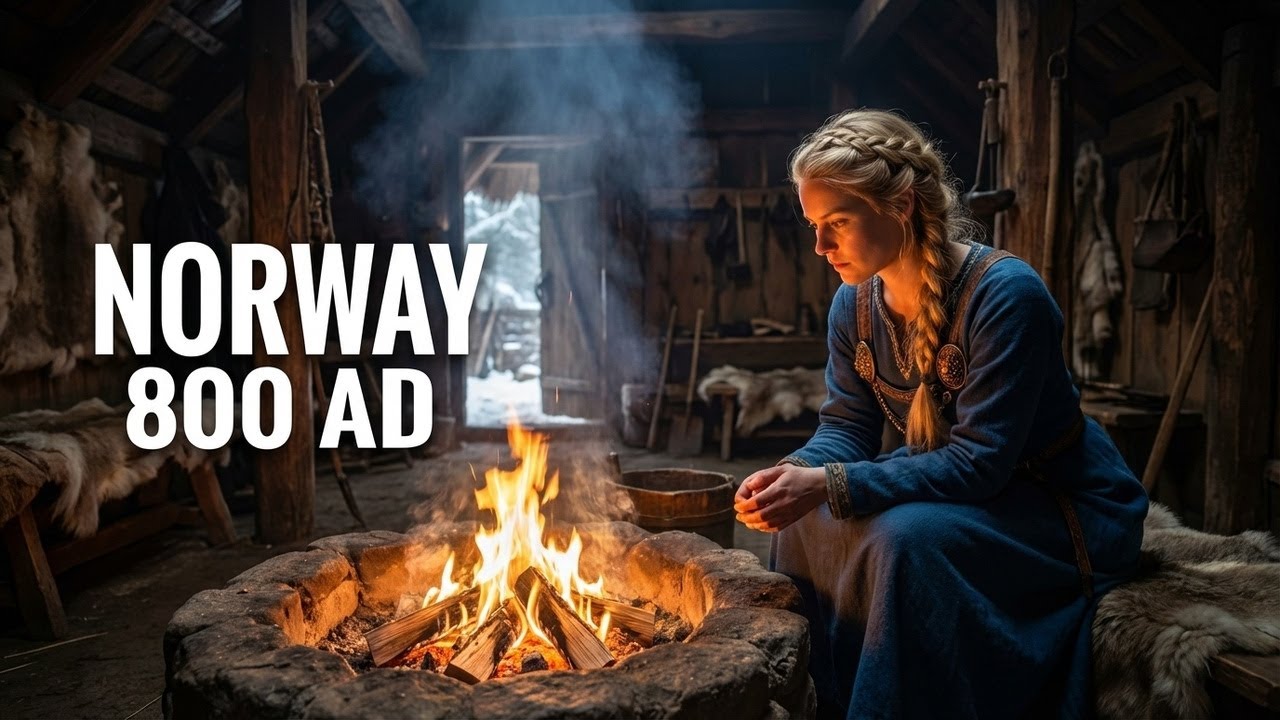
Viking homes never froze, even in the most brutal Arctic winters, longhouse engineering kept entire communities alive without chimneys, glass windows, or modern insulation. But the story of how Viking longhouse indoor air quality actually functioned has never been fully told. The same sealed walls and closed vents that mastered Norse longhouse heating system also trapped carbon monoxide and fine particulate matter at levels more than 200 times WHO safety limits, every single winter, for four hundred years.
Experimental archaeology at Aarhus University placed researchers inside reconstructed Viking-Age houses for thirteen winter weeks. After seven days, every participant showed measurable lung deterioration. The data on Viking health and disease archaeology tells the rest: sinusitis rates of 95% in urban Viking populations, chronic respiratory inflammation visible in bone across every burial site examined, and a gender distribution of damage that tracked exactly with who spent the most hours inside, women and children, positioned closest to the fire, breathing the worst air the longhouse produced.
This is not a story about Viking weakness. It is a story about a civilization that understood how Vikings survived arctic winters with extraordinary precision, and understood, with equal precision, what that survival cost. They adjusted the vent every night knowing both sides of the consequence. The Viking Age respiratory disease smoke exposure record, written into bone across Scandinavia, Iceland, and Greenland, is the other half of an engineering story that is usually only told from one direction.
The warmth was real. The cost was real. The system that produced both was the same system.
Christensen, J.M. & Ryhl-Svendsen, M. (2013) — "Living Conditions and Indoor Air Quality in a Reconstructed Viking House," The EXARC Journal. Experimental archaeology study measuring CO, PM2.5, and NO2 inside two reconstructed Danish Viking-Age longhouses over thirteen winter weeks, with real-time respiratory monitoring of human participants.
Christensen, C.S. et al. (2015) — "Household Air Pollution from Wood Burning in Two Reconstructed Houses from the Danish Viking Age," Indoor Air (Wiley). Peer-reviewed study measuring carbon monoxide averaging 16 ppm near the hearth and PM2.5 at 3.4 mg/m³ — more than 200 times WHO daily guidelines — inside operating longhouse reconstructions.
Bertilsson, C. et al. (2025) — "Findings from Computed Tomography Examinations of Viking Age Skulls," BDJ Open (University of Gothenburg). CT scans of fifteen Viking-Age skulls from Västergötland revealing chronic sinus infections, ear disease, and pathological bone growths across nearly every examined individual.
Raffield, B. & Sindbæk, S.M. (2013) — "Signs of Sinusitis in Times of Urbanization in Viking Age–Early Medieval Sweden," Journal of Archaeological Science (ScienceDirect). Analysis of maxillary sinusitis rates across Viking-Age burial populations at Birka and Sigtuna, recording rates of up to 95% in urban samples and a statistically significant gender differential in female remains.
Wikipedia — Longhouse (Wikipedia contributors) — "Longhouse," Wikipedia, The Free Encyclopedia. Overview of longhouse construction, regional variations across Scandinavia and the North Atlantic, structural features including the central hearth, roof vent design, turf wall construction, and livestock integration into the domestic living space.
Повторяем попытку...

Доступные форматы для скачивания:
Скачать видео
-
Информация по загрузке: