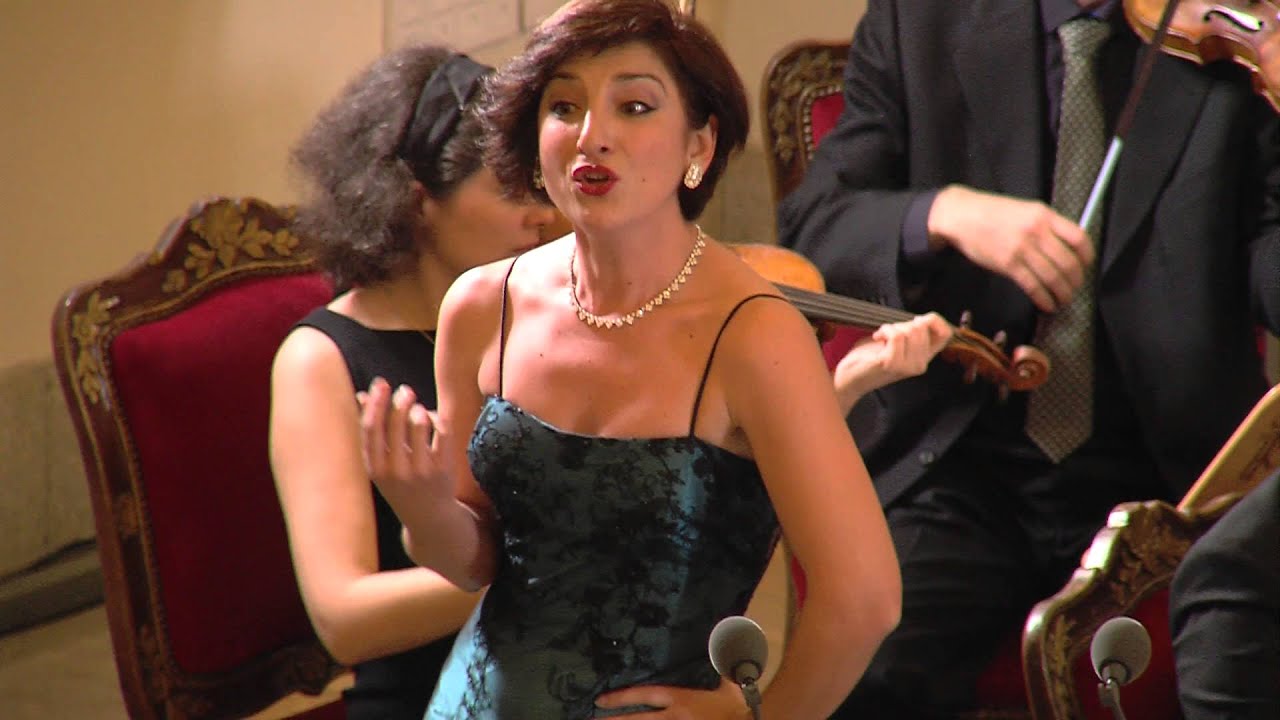
Martín y Soler: Seguidilla "Inocentita y linda" from Pesnolubie / Susana Cordón-Montaño-La Madrileña
Автор: La Madrileña Period Instrument Orchestra
Загружено: 2016-03-28
Просмотров: 8633
Описание:
LA MADRILEÑA
Website http://lamadrilegna.com/
Spotify https://open.spotify.com/intl-es/arti...
Instagram / lamadrilegna
Facebook / lamadrilegna.periodinstrumentorchestra
Twitter / la_madrilegna
JOSÉ ANTONIO MONTAÑO
Website http://joseantoniomontano.com/
Spotify https://open.spotify.com/intl-es/arti...
Instagram / montanodirector
Facebook / montanoconductor
Twitter / montanodirector
LA MADRILEÑA PERIOD INSTRUMENT ORCHESTRA / ORQUESTA CON INSTRUMENTOS DE ÉPOCA
Conductor / Director musical, José Antonio Montaño
Soprano, Susana Cordón
Seguidilla “Inocentita y linda” from Pesnolubie
This seguidilla was one of Martín y Soler’s most requested works; he did not confine
himself to inserting it in one of his operas, yet in three –Il tutore burlato (1775), In amor
ci vuol destrezza (1782) and Pesnolubie (1790)— effecting light alterations depending on
each case, in the accompaniment as in the verses. The version that will be heart belongs
to the Russian opera Pesnolubie [Love of music], composed by the Spaniard in 1789 based
on Alexander Jrapovitsky’s libretto; Jrapovitsky was the personal secretary of the empress
Catharine II of Russia and one of the directors of the Imperial Theatres during those years.
After a first staging in 1789 in Moscow, the official premiere was in January the following
year in the Hermitage Theatre of Saint Petersburg court. This opera did not last on the
Russian stages due to several political and social factors at the time, to which should be
added the lack of reserved sources, one of the reasons why the opera was not performed
for more than two centuries. This is, therefore, the premiere in modern times of three of
these arias, recovered from the only score preserved deposited in the Central Musical
Library of Saint Petersburg.
This comic Russian opera, whose plot ridicules the Italian love of music of the Russian
aristocracy, was actually composed by Martín y Soler on the style of the Italian buffa,
adjusting it to the Russian genre of the end of the XVIII century. This opera was structured
as a series of dialogues spoken with sang interspersed numbers.
The seguidilla “Inocentita y linda” is the first of three songs of national mood introduced
as a kind of a beginning in the development of the dramatic action: an element of Spanish
“exoticness”, a French arietta and a Russian song. These brief yet painteresque numbers
are introduced by the heroine, Allegra, who finding herself in front of a group of peasants
among which her beloved Ruslan was, makes an exhibition of her vocal virtues: “Isn’t here
a guitar?, she asks; – I would happily sing guispañol [sic], and by this you would know
what is a seguidilla”, to which Ruslan responds: “Ah! It has been long since I wanted to
hear guispañoles songs and a voice, my lady; you grant me a great gift with your seguidilla”.
Повторяем попытку...
Доступные форматы для скачивания:
Скачать видео
-
Информация по загрузке: