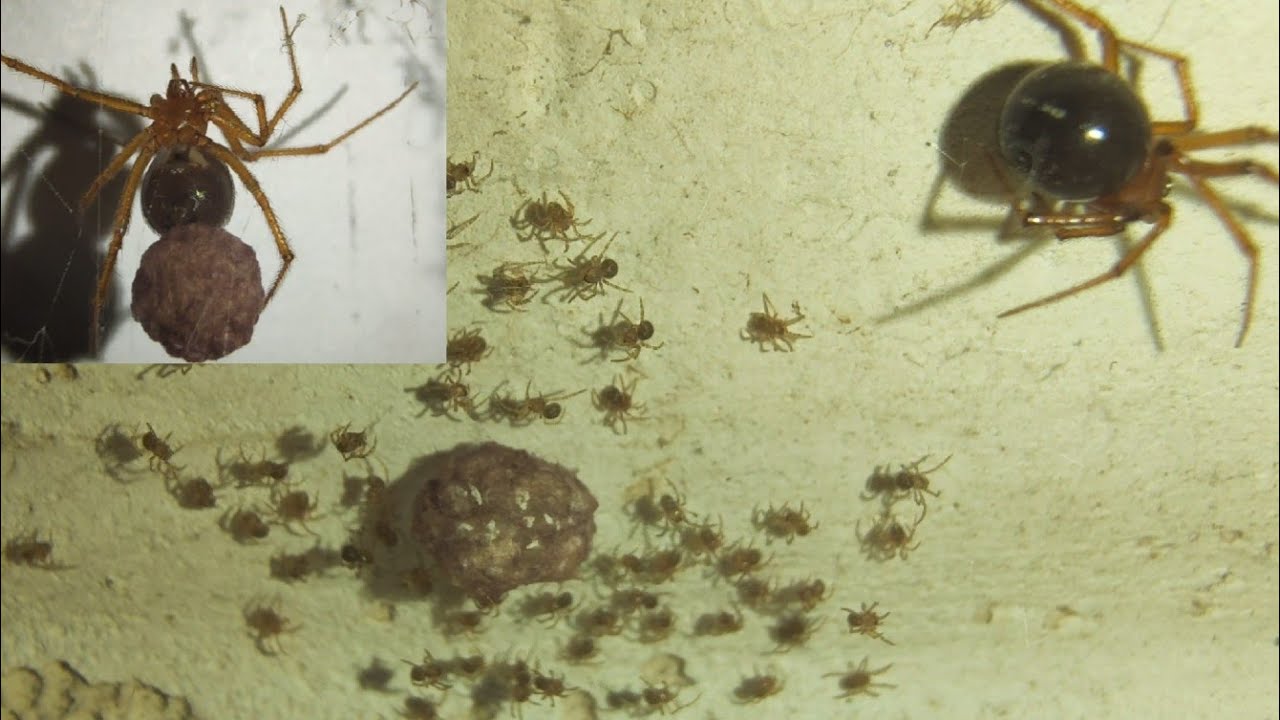
Spider Egg sac hatched - Red house spider / Nesticodes rufipes
Автор: Jani Nature Curiosity
Загружено: 2024-07-15
Просмотров: 146
Описание:
Video documenting a red house spider guarding her egg sac, mom with her newly hatched babies, and the slings’ first feeding.
Red house spider / Nesticodes rufipes. 🕷
Red House Spider or false widow spider
Nesticodes rufipes
Family - Theridiidae
Family: Theridiidae - Cobweb spiders, Tangle web spiders, Comb-footed spiders
Order: Araneae - Spiders
Class: Arachnida - Mites, Ticks, Spiders, Arachnids, Scorpions
Phylum: Arthropoda - Arthropod
Nesticodes rufipes is a small red-bodied spider, venomous, but not harmful to humans. They have been observed preying on insects such as mosquitoes,flies,and ants.
such a common spider. They're found in many places around the world,like from india to Florida and Hawaii.and has a pantropical distribution due to ship and air travel, and most often around human dwellings,They can be extremely common inside homes, building webs in dark corners and under furniture.
Description
The red house spider (Nesticodes rufipes) may have the color of rage and passion, but it is known as a timid spider that tends to avoid conflict if possible. When disturbed, it produces a drop line to reach the floor quickly and sprint away. In some cases, it can have a yellowish-brown body as well as a reddish body.
They have a dark brown, slightly mottled, globular abdomen and red-brown legs and cephalothorax. This spider builds a small, tangled web in dark corners inside houses or under rims of garden pots and similar structures. It is said to be capable of causing mild to severe local pain but bites are unlikely as it is rather timid.
Characteristics
AdultSize: 5-10 mm
Colors : BlackGrayOrange
Red Legs: One of the most distinctive features is the red coloration of their legs.
Cobwebs: The irregular, messy web is a common trait among cobweb spiders.
Diet: They primarily feed on small insects and other arthropods that get caught in their webs. I have seen mosquito and sink fly moth fly mostly .
Spidey Sense
Spiders have trichobothria, fine hairs on their body that are critical to their survival.
They are similar in shape to Red-back Spiders and Black Widows, and have a similar, but less potent, venom.
Are red house spider harmful?
The red house spider can cause toxic reactions with a wide range of severity. However, the toxins are typically targeted at their prey and predators. They are usually not fatal to humans.
Like all other spiders (Except Spiders of family Uloboridae) particularly the Theridiied spiders Nesticodes rufipes (Lucas, 1846) also have neurotoxin poisons in their lively uses and are considered to be
The red house spider's bite is painful, but since its venom is non-necrotic it should not cause death of skin cells and a lesion as does a brown recluse bite. These spiders are not aggressive, but will bite if their web is disturbed, so be cautious when cleaning out spider webs.
but they are actually the only species in their own lonely little genus.
Nesticodes is a monotypic genus of comb-footed spiders containing only the red house spider [Nesticodes rufipes (Lucas, 1846)]. It was first described by Allan Frost Archer in 1950,
Reproduction:
Egg Sac Protection: Female spiders often carry their egg sacs with them or attach them to their webs, providing protection until the spiderlings hatch.
Female spiders produce either one egg sac containing several to a thousand eggs or several egg sacs each with successively fewer eggs.
How Do Egg Sacs Form?
1. Silk Production: Female spiders produce silk from specialized glands called spinnerets located at the end of their abdomen.
2. Egg Encapsulation: After mating, the female lays eggs and encases them in a protective silk sac. This sac is often attached to a safe, hidden location or carried by the female.
3. Shape and Size: The shape and size of the egg sac can vary. Some are spherical, while others are disc-shaped or irregular. The silk layers can be thick or thin, depending on the species and environmental conditions.
Is It Incomplete Metamorphosis?
Yes: Spiders undergo incomplete metamorphosis, also known as direct development. This means that the young spiders (spiderlings) hatch from the egg sac looking like miniature versions of the adult spiders, rather than going through distinct larval and pupal stages as in complete metamorphosis.
Protection: The primary purpose of the egg sac is to protect the eggs from predators, parasites, and environmental hazards such as desiccation or flooding.
100 + new life , Spiderlings
arachnids!
Most house spiders are not harmful to humans and prefer to stay out of sight, feeding on various insects and other small arthropods.
Overall, Nesticodes rufipes is a beneficial spider to have around the house due to its insect-catching capabilities and non-threatening nature.
#spider #eggsacs #hatched #babyspider #lifecycle #information #Redhousespider #Nesticodes_rufipes
Повторяем попытку...
Доступные форматы для скачивания:
Скачать видео
-
Информация по загрузке: