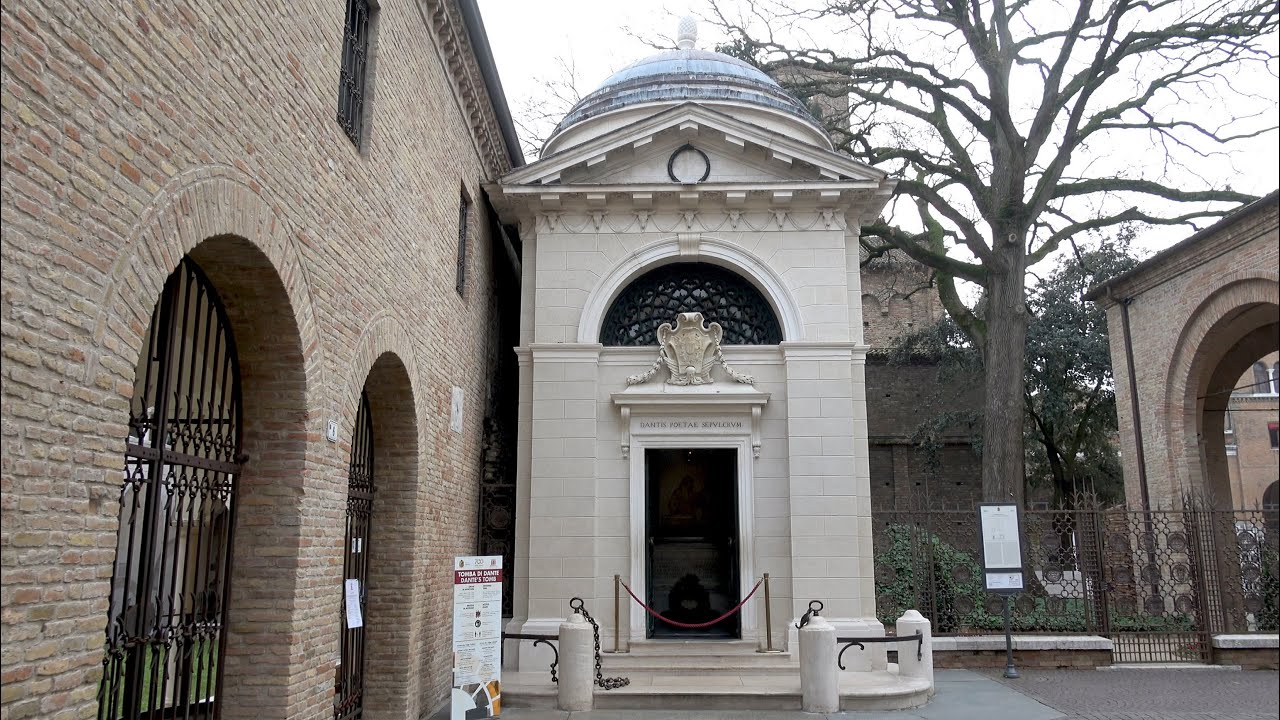
Dante's tomb (4K), Ravenna, Emilia-Romagna, Italy, Europe
Автор: Pietro Pecco
Загружено: 2020-12-14
Просмотров: 800
Описание: Dante's tomb is a monument erected at the Basilica of St. Francis in the center of Ravenna, the city where the great poet lived the last years of his life and died in 1321. Built in the years 1780-81 by the architect Camillo Morigia commissioned by Cardinal Legate Luigi Valenti Gonzaga and above the tomb erected by the fifteenth-century Venetian mayor of Ravenna Bernardo Bembo, the tomb is in the shape of a square neoclassical temple, crowned by a small dome. Separated from the street by a narrower definition, has a facade outside very simple, with a door surmounted by the crest of the archbishop Cardinal Gonzaga, and on whose lintel is written simply and in Latin: Dantis poetae sepulcrum. Inside the tomb itself, all covered in marble and stucco, consists of a Roman sarcophagus with carved above (always in Latin) the epitaph in verse dictated by Bernardo Canaccio in 1366): "Iura monarchies superos Phlaegetonta lacusque/glazing Cecini fairy volverunt quousque sed quia pars cessit melioribus hospita castris/actoremque suum petiit felicior astris hic claudor Dantes patriis extorris ab oris/quem genuit parvi Florentia mater amoris "(translation:" the rights of the monarchy, the heavens and the waters of Flegetonte (the underworld) visiting sang until my destiny turned deadly. however, since my soul went guest in the best places, and even more blessed reached between the stars his Creator, here I am enclosed, (I) Dante, exile from home ground, which begat Florence, mother of little love"). Above the tomb (remained virtually the same century), there is a valuable bas 1483 by Pietro Lombardo depicting Dante thoughtfully before a lectern. At the foot of the sarcophagus there is a garland in bronze donated in 1921 by veterans of the Great War. On the ceiling a votive lamp burns perpetually eighteenth century, fueled by olive oil of the Tuscan hills which is donated by Florence every year September 14 (the anniversary of the death of the poet). On the right wall, a marble plaque recalls the various restoration of the tomb, and its accommodation with marble decoration in 1921. On the spandrels of the time had to be depicted Virgilio, Brunetto Latini, Grande della Scala and Guido Novello da Polenta although they were never made. On the exterior of the monument, on the right, a gate leads into the fence Braccioforte part of the adjacent Convent of St. Francis, where he held the funeral of Dante and where the poet was originally buried. Currently, the tomb is a National Monument, and around it was set up a zone of respect and silence zone called Dante. In 2006-07 the tomb has undergone careful restoration, and the facade has been completely repainted. Not even in death Dante could enjoy the stability that had so longed for the past, tormentatissimi years of exile. The day after the death, the body of the poet was buried in the same tomb where it still stands, but that was then placed on the road, outside the cloister Braccioforte above named. Then, in the late fifteenth century, the Venetian mayor of Ravenna Bernardo Bembo moved the tomb on the west side of the cloister itself. The Florentines after a few years began to reclaim in Ravenna the relics of their most famous citizen. A "risk" that seemed to be certain when the papal throne ascended the two popes Florentines, and both of the Medici family, Leo X and Clement VII. The first, in fact, following a petition advocated also by Michelangelo, granted in 1519 to his fellow citizens permission to pick the bones of the poet to bring them to Florence, but when the Tuscan delegation opened the sarcophagus, the bones were gone. The Franciscan friars in fact, a short time before, had practiced, backed by a cloister, a hole in the wall and in the sarcophagus for "to rescue" the remains of the poet, who considered as one of them, and nothing will be worth the entreaties of restitution. The same sarcophagus was then moved in the same cloister and jealously guarded: in fact, when in 1692 he was made the maintenance of the tomb, the workers had to work under guard. The bones had been enclosed in 1677 in a box by the prior of the convent Antonio Sarti, and were put back in the urn original only in 1781, that is when the Morigia constructed the mausoleum that was integral to the convent. When in 1810 this was suppressed by order of Napoleon Bonaparte, the brothers hid again the cassette with the bones, this time in a walled-up door in the adjacent oratory of the cloisters of Braccioforte, where they will be discovered by chance in 1865 during the restoration work for the V centenary of the birth of Dante.
Повторяем попытку...
Доступные форматы для скачивания:
Скачать видео
-
Информация по загрузке:




![Roman Station Church: [XVII], Basilica di San Vitale, 4K Rome](https://image.4k-video.ru/id-video/SHONlMl4zb4)


