Word2Vec for Graphs: Understanding DeepWalk and Node2Vec
Автор: Antosh Dyade
Загружено: 2026-01-23
Просмотров: 4
Описание:
How do we feed complex networks like social graphs or biological systems into machine learning models? The answer lies in Graph Embedding—mapping nodes to low-dimensional vectors while preserving their structural information.
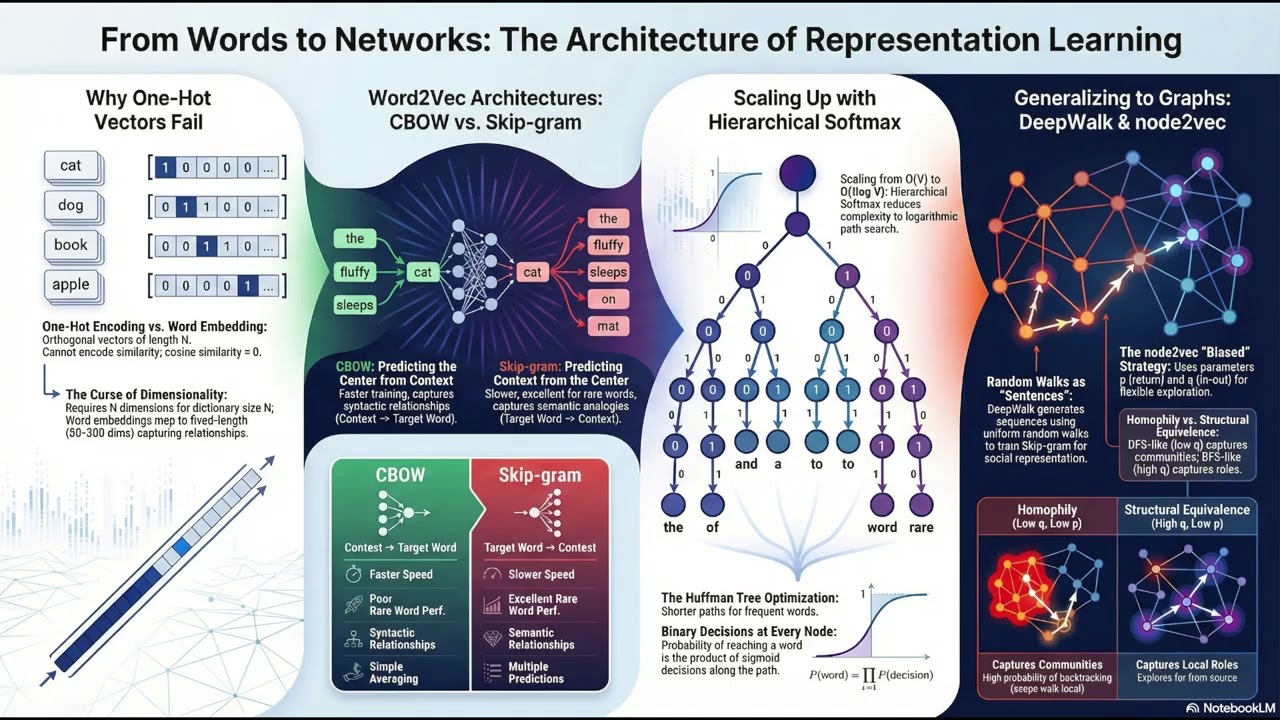
In this video, we bridge the gap between Natural Language Processing (NLP) and Graph Theory. We explore how algorithms like DeepWalk and Node2Vec adapted the revolutionary Word2Vec architecture to treat graph nodes like words and random walks like sentences.
In this video, you will learn:
1. The Foundation: Word2Vec & Skip-Gram We start by reviewing the intuition behind Word2Vec, specifically the Skip-gram architecture, which predicts context words given a target word.
• The Bottleneck: Standard Softmax is computationally expensive (O(V)).
• The Solution: We explain Hierarchical Softmax, which organizes words into a binary tree (often using Huffman coding), reducing complexity to O(logV).
2. DeepWalk: Graphs as Language We dive into DeepWalk, the algorithm that realized random walks on a graph follow a power-law distribution similar to word frequency in language (Zipf’s Law).
• Mechanism: DeepWalk uses uniform random walks to generate "sentences" of nodes, then feeds them into Skip-gram to learn latent representations.
• Use Case: Excellent for capturing community structures (homophily).
3. Node2Vec: Biased Random Walks We analyze Node2Vec, which improves upon DeepWalk by introducing a flexible search strategy.
• The p and q Parameters: We explain how the return parameter (p) and in-out parameter (q) allow the model to interpolate between BFS (Breadth-First Search) and DFS (Depth-First Search).
• Structural Equivalence vs. Homophily: Learn how tuning these parameters helps capture structural roles (e.g., bridge nodes) versus community clusters.
4. Real-World Applications We discuss how these embeddings are applied in:
• Link Prediction: Recommending friends on social media or discovering gene-disease associations.
• Node Classification: Categorizing documents or protein functions.
• Visualization: Mapping complex high-dimensional networks into 2D space.
Timestamps: 0:00 - Introduction to Graph Representation Learning 1:45 - Word2Vec: CBOW vs. Skip-gram 3:30 - Optimization: Hierarchical Softmax & Huffman Trees 5:15 - DeepWalk: Random Walks on Graphs 7:20 - Node2Vec: BFS vs. DFS Exploration 9:45 - The math behind p (return) and q (in-out) parameters 12:10 - Applications: Link Prediction & Drug Discovery
References & Further Reading:
• Word2Vec (Mikolov et al., 2013)
• DeepWalk (Perozzi et al., 2014)
• Node2Vec (Grover & Leskovec, 2016)
• Hierarchical Softmax Optimization
#MachineLearning #GraphNeuralNetworks #DataScience #DeepLearning #Node2Vec #DeepWalk #NLP
Повторяем попытку...
Доступные форматы для скачивания:
Скачать видео
-
Информация по загрузке: