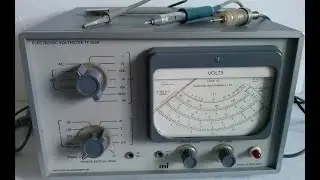
Why you need an Audio Impedance Meter for Commercial Sound Systems
Автор: CASProductVideos
Загружено: 2022-02-10
Просмотров: 2479
Описание:
In this video, we look at the impedance meter - an invaluable bit of kit when installing or fault finding speaker lines in commercial audio systems. It's very different from your multi-meter - watch the video to find out why an impedance meter is an asset to your toolbox!
An impedance meter is a device for measuring loudspeaker lines on constant voltage 100 Volt line PA systems. It's an essential tool for any audio engineer installing a new audio system or measuring a line on an existing system where there might be a fault.
An impedance meter sends out an AC signal on a one kilohertz tone and gives you a proper reading of all the loudspeakers on the line, helping to fault-find systems very quickly.
You can't do this with a multimeter because they are only designed to measure resistance and you'll just end up measuring the primaries on every transformer in every loudspeaker and the reading will be extremely low.
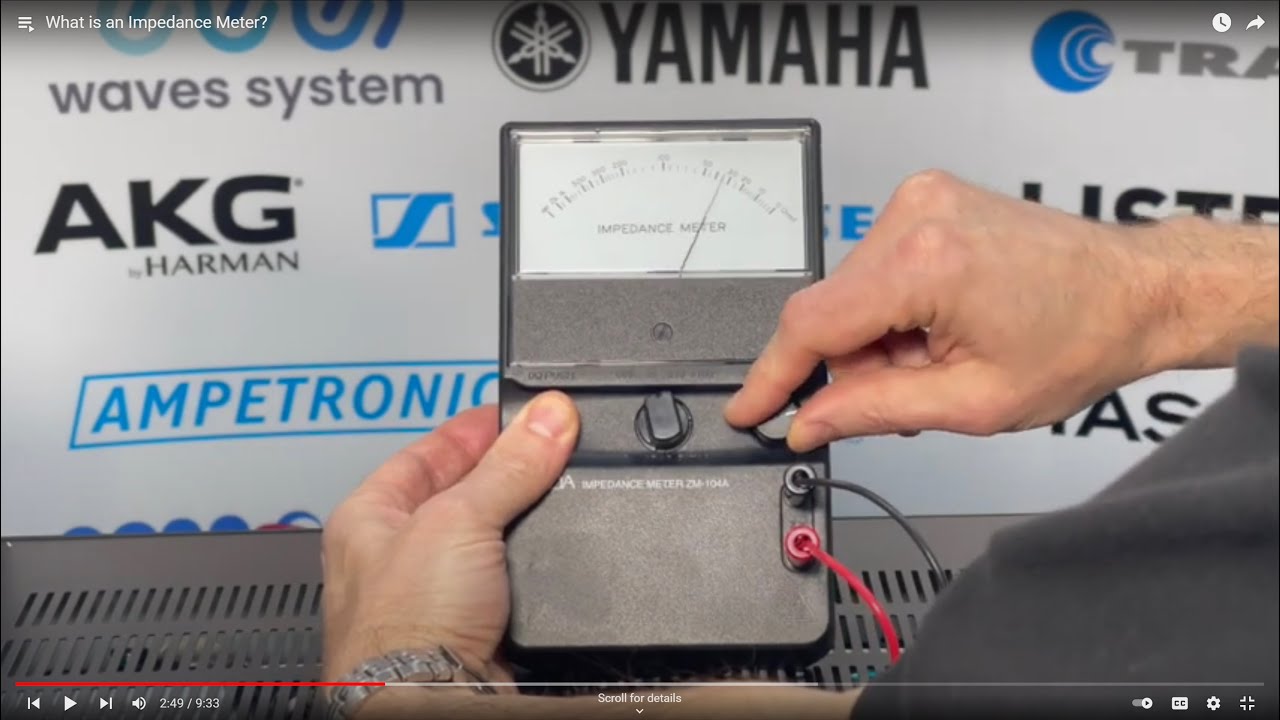
Our video shows the TOA ZM104A which is a very popular meter. There are others available and although some are Digital, this one is Analog and it’s very simple to use.
In the box is a pair of red and black leads which simply plug into the meter. Most often, you would use the ‘Times 1’ setting so select that and then it’s essential that you zero the meter on the scale.
You'll notice it goes from infinity all the way through to zero ohms. You can either connect the two terminals together or push the button on the left whilst turning the adjustment dial to indicate zero.
You’re now ready to check the load on the speaker lines.
For example, in a small system with a 15 watt cabinet speaker and a 20 watt projection speaker, we know the load should be about 35 watts on that line.
Disconnect the speaker lines from the amplifier (switch the amplifier off first) and connect the meter probes to the speaker lines (brown to red, blue to common/black) After a moment you'll hear a one kilohertz tone generated by the meter and you’ll see the reading is about 270 ohms. You can use a look up table to convert this but the basic equation for a 100 Volt line system is ‘100 divided by the impedance meter reading you've taken times by 100’. In this case the calculation would be:
100 ÷ 270 x 100 = 37.037
As you can see this is roughly the wattage we were expecting so everything seems to be in order. If a speaker had failed or wiring damaged, then this number would reflect that, and you would need to investigate further.
A simple walk around the system listening for the one kilohertz tone though each speaker may be enough to identify a non-working speaker or differences in volume where an incorrect tapping has been selected.
An impedance meter is also useful to find out the total load on the amplifier to prevent overloading. If the amplifier needs replacing it’s good practice to allow 20% headroom so, for example, if there is a load of 120 watts, select an amp rated at around 150 watts.
For more information, please get in touch or visit our website www.commercialaudiosolutions.com
Повторяем попытку...
Доступные форматы для скачивания:
Скачать видео
-
Информация по загрузке: