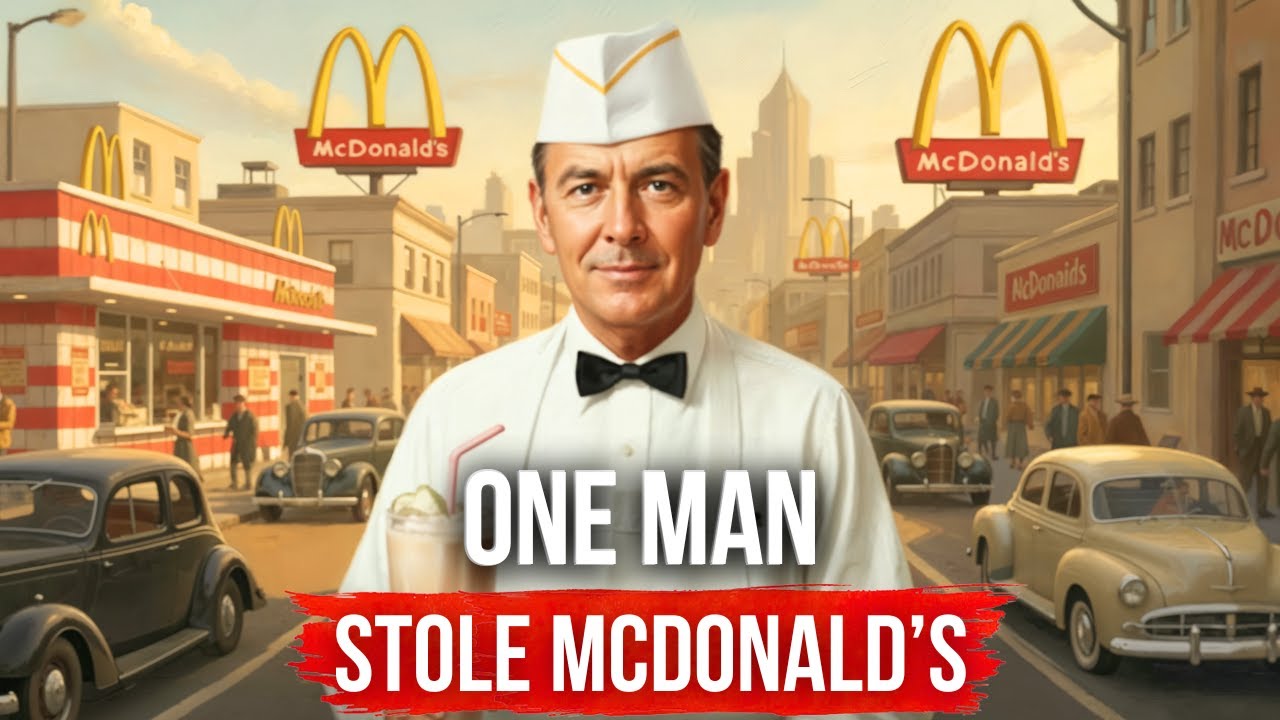
How A Milkshake Salesman Stole America's Biggest Restaurant (McDonalds)
Автор: BizMavericks
Загружено: 2026-01-03
Просмотров: 41
Описание:
Thanks for watching — if you learned something new about how wealth really works in today’s world, hit that subscribe button. Stay curious, stay bold, and let’s keep decoding the engines of modern money together.
The True Story of McDonald's: How Two Brothers Lost Everything to a Milkshake Salesman
In 1954, two brothers in San Bernardino, California had already revolutionized the restaurant industry. Dick and Mac McDonald had created a system so efficient it could produce a hamburger in thirty seconds flat. Their kitchen operated with the precision of a factory floor. Customers lined up by the hundreds. Then a desperate 52 year old salesman named Ray Kroc walked through their door and saw not a restaurant but an empire waiting to be claimed. What followed is one of the most troubling stories in American business history. A decade long relationship built on trust and verbal agreements. A buyout that stripped the brothers of everything including their own name. A handshake deal worth 100 million dollars per year that was never honored. By the time the dust settled, the brothers had been erased from their own legacy and a milkshake machine salesman had become one of the richest men in America.
THE BUSINESS PSYCHOLOGY
This story illuminates fundamental patterns in how value is created versus how value is captured. The McDonald brothers demonstrated what researchers call inventive genius combined with operational excellence. They optimized every variable in their restaurant through empirical testing, redesigning their kitchen on a tennis court using chalk and choreographed employee movements. Ray Kroc demonstrated what business historians recognize as entrepreneurial extraction, the ability to identify undervalued assets and acquire them through superior negotiation leverage and information asymmetry. The brothers trusted verbal agreements because that reflected their values. Kroc understood that undocumented promises have no legal weight. This case study appears in business schools worldwide as an example of how contractual sophistication determines who benefits from innovation.
SOURCES AND FURTHER READING
Kroc, Ray with Anderson, Robert. Grinding It Out: The Making of McDonald's. Henry Regnery Company, 1977.
McDonald, Richard and McDonald, Maurice. Interview transcripts, San Bernardino County Historical Archives, 1960 to 1971.
Love, John F. McDonald's: Behind the Arches. Bantam Books, 1986.
Halberstam, David. The Fifties. Villard Books, 1993.
Schlosser, Eric. Fast Food Nation: The Dark Side of the All American Meal. Houghton Mifflin, 2001.
Jakle, John A. and Sculle, Keith A. Fast Food: Roadside Restaurants in the Automobile Age. Johns Hopkins University Press, 1999.
Ozersky, Josh. The Hamburger: A History. Yale University Press, 2008.
Napoli, Lisa. Ray and Joan: The Man Who Made the McDonald's Fortune and the Woman Who Gave It All Away. Dutton, 2016.
The Founder. Directed by John Lee Hancock, The Weinstein Company, 2016.
San Bernardino County Museum Archives. Original McDonald Brothers Documents and Correspondence, 1940 to 1961.
ABOUT THIS CONTENT
This video is educational and informative content created to expand public knowledge about business history, entrepreneurship dynamics, and the often untold stories behind iconic American institutions. Our goal is to provide valuable historical context that helps viewers understand how innovation, negotiation, and power shape commercial outcomes. Every script is researched and written by humans on our team. All visuals and storyboard elements are conceptualized and developed internally through collaborative brainstorming sessions. We believe understanding these historical patterns helps people navigate their own professional and creative endeavors with greater awareness.
Повторяем попытку...
Доступные форматы для скачивания:
Скачать видео
-
Информация по загрузке: