Principles of STED microscopy
Автор: VisualViruses
Загружено: 2014-03-23
Просмотров: 38962
Описание:
This video outlines principles of super-resolution fluorescence microscopy technique called Stimulated Emission Depletion microscopy (STED). This technique is able to break the resolution limit of the conventional fluorescence microscopy (approx. 250 nm in the focal plane) and image biological samples at up 10x higher resolution than in a standard confocal fluorescence microscope. This microscopy technique was originally invented by Stefan W. Hell, MPI Göttingen. Ref: http://www.ncbi.nlm.nih.gov/pubmed/19...
Details:
Description of STED principles requires a look at what happens when laser light is focused on a theoretical sample placed in the laser scanning fluorescence microscope. Due to its wave-like nature a beam of light cannot be focused to infinity. At certain point photons start to interfere with each other and resulting light diffraction disallows any further light focusing. The width of the minimum focus diameter (~250 nm) achieved by a laser beam is related to its wavelength and is a cause of a fundamental resolution limit of a fluorescence microscope.
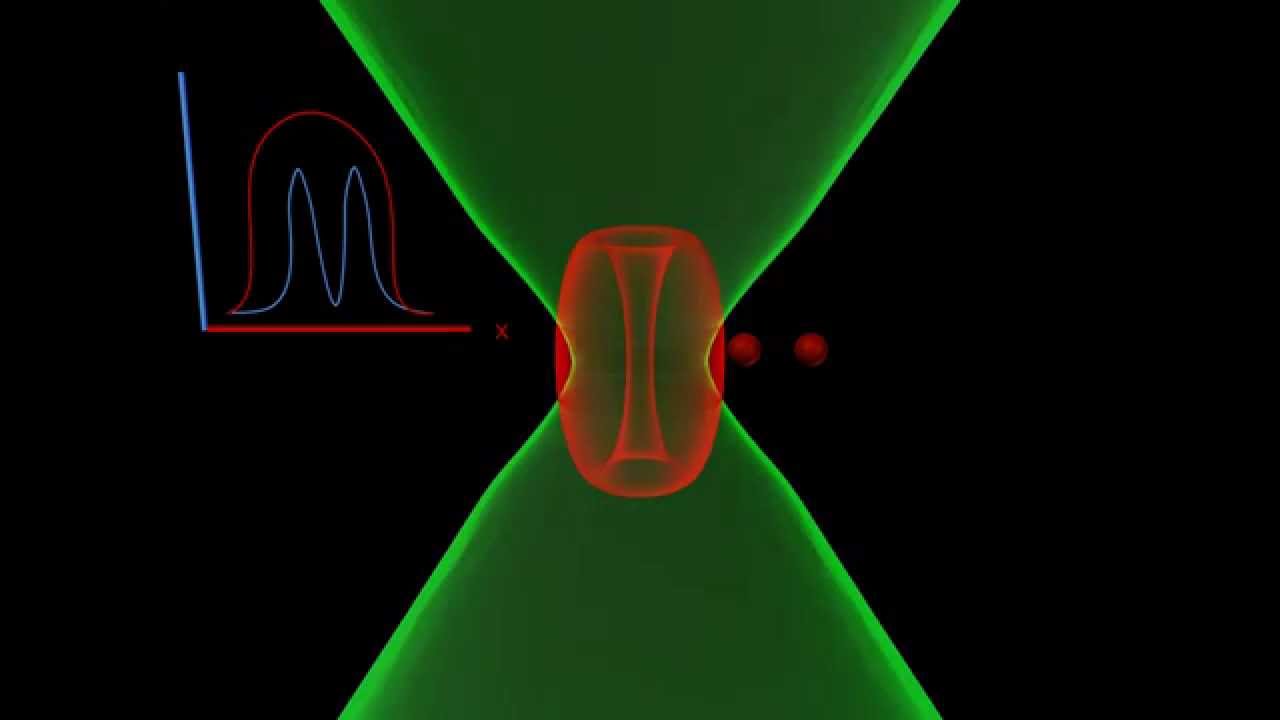
This is illustrated by a fluorescent signal acquisition from two hypothetical fluorescence spots separated by a distance much smaller than resolution limit of the microscope. When scanning laser beam excites the fluorescence spots both of them are excited and resulting detected signal does not show a gap between two spots.
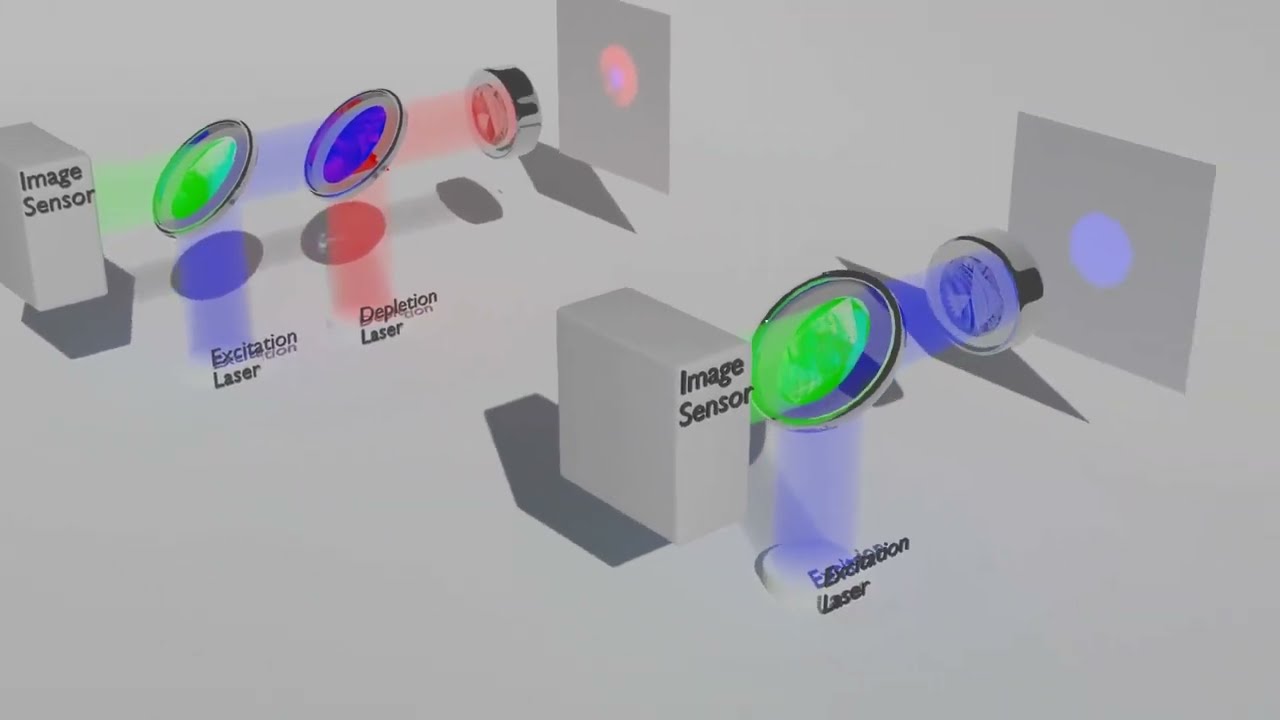
This limit is overcome by STED microscopy and is achieved by the addition of a second laser with a specific wavelength that depletes excited fluorophores back to a non-fluorescent state. This laser has a cross-section of a doughnut with a small zero-intensity region in the middle. The use of this laser effectively decreases the excitation area of the first laser and results in increased resolution.
This is illustrated by scanning once again across two fluorescent spots in STED mode. Now although, the fluorescent spots are within the excitation laser beam, their fluorescence remains depleted with the exception of a small zero-intensity region in the middle of STED laser. This allows for detection of fluorescence at much higher resolution thus revealing the separation between two fluorescent spots.
Повторяем попытку...
Доступные форматы для скачивания:
Скачать видео
-
Информация по загрузке: