Moments | GCSE Physics | Doodle Science
Автор: DoodleScience
Загружено: 2015-10-23
Просмотров: 110515
Описание:
GCSE Science
Doodle Science teaches you high school physics, in a less boring way, in almost no time!
Follow me: / doodlesci
You can support me at: / doodlescience
Script:
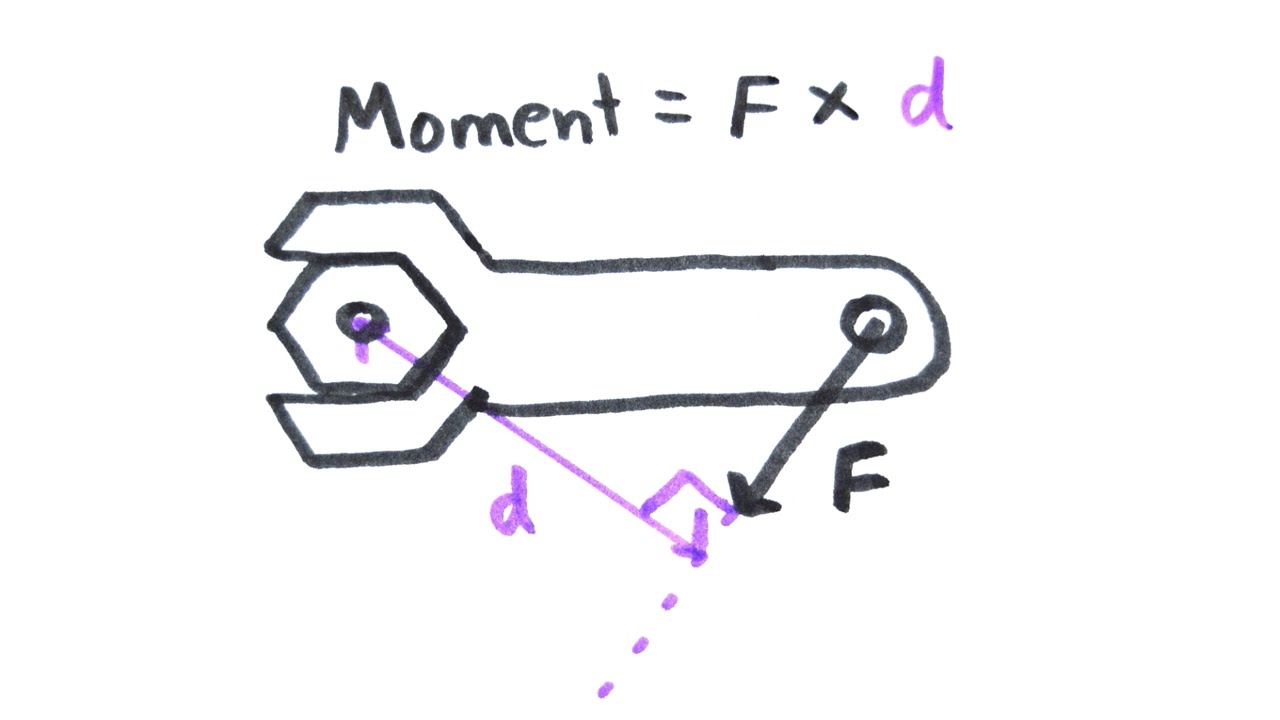
A moment is the turning effect of a force. It’s calculated by multiplying the force by the perpendicular distance between the force and the pivot. For example, by turning a spanner you are producing a moment. If you apply a force of 15N to the end of the spanner and the length of it is 0.1m, then the moment you are applying is 1.5Nm.
However you can apply a force that is not perpendicular, in which case the distance is not the length of the spanner but is the distance from the line of action of the force to the pivot. This will produce a smaller moment, so to produce the maximum moment, you need to apply force at 90 degrees.
Moments are often referred to as force multipliers because they reduce the force needed to perform certain tasks. You’ve probably all experienced this at some point in your lives but haven’t realised the reason why. Using a wheelbarrow is an example of a lever being used to reduce the effort necessary to lift the load. It works using the concept of balanced moments. An object is balanced when the sum of the clockwise moments about a pivot are equal to the sum of the anticlockwise moments about the same pivot.
For example, if a force of 300N is applied 2m from the pivot, and another force of 700N is applied on the other side of the pivot then it must be applied 0.86m from the pivot in order for the moments to balance. This means that you can apply small forces at further distances to achieve much greater forces on the other side. Which is why you’ll find it much easier to close your door from the handle rather than near the hinges.
References:
1. http://www.bbc.co.uk/education/subjec...
2. CGP GCSE Physics AQA Revision Guide.
Повторяем попытку...
Доступные форматы для скачивания:
Скачать видео
-
Информация по загрузке: