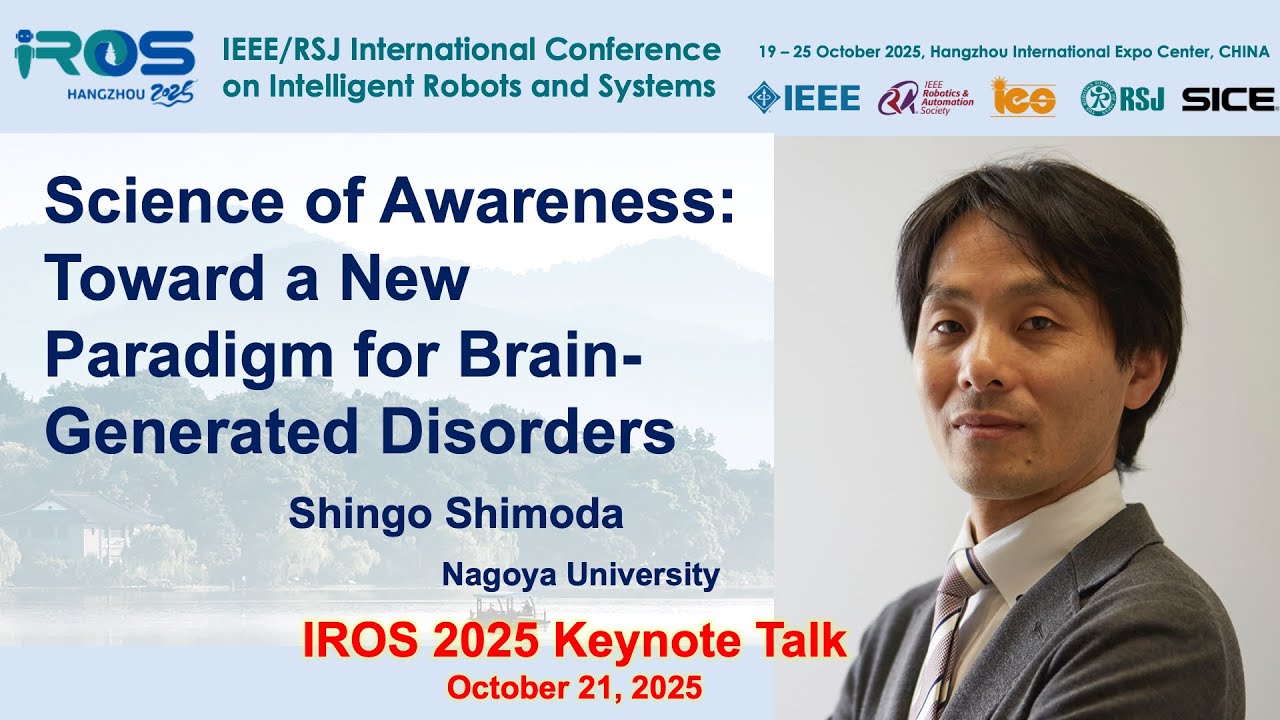
Shingo Shimoda - Science of Awareness: Toward a New Paradigm for Brain-Generated Disorders"
Автор: IEEE Robotics and Automation Society
Загружено: 2026-01-31
Просмотров: 24
Описание:
Speaker Biography
Shingo Shimoda received his Ph.D. in Engineering from the University of Tokyo in 2005. During his doctoral research on asteroid exploration robots, he became interested in flexible artificial intelligence and adaptive control. After a period as a visiting student at MIT, he joined the RIKEN Brain Science Institute in 2008, where he served as Unit Leader. His work there focused on the principles of motor control in the brain, highlighting behavioral adaptation to unknown environments as a key mechanism of flexible intelligence. He developed computational models of motor learning through body–environment interaction, applying them to humanoid locomotion and myoelectric prosthetics, for which he received the Cognitive Robotics Best Paper Award at IROS. In 2023, he was appointed Designated Professor at the Graduate School of Medicine, Nagoya University. His current research integrates engineering and medicine to visualize physiological signals, such as deep muscle activity and plantar pressure, and to elucidate the mechanisms of human motor control. As Project Manager of the Moonshot R&D Program, he has advanced the concept of “Unconscious Intelligence”—the human ability to adapt to unknown environments without conscious awareness—and is developing novel approaches, including Awareness AI, to predict disease risk and enhance motor function through subconscious robotic interventions.
Abstract
It is increasingly recognized that less than 10% of human neural activity is consciously accessible, while the vast majority is processed unconsciously. Importantly, such unconscious processing is not merely reflexive but reflects a sophisticated form of “unconscious intelligence,” which underlies adaptive motor control and contextual meaning attribution, closely related to the concept of affordances. Recent findings indicate that unconscious intelligence does not emerge from global optimization of brain activity but rather from the integration of localized processes. While adaptive in many cases, this mechanism can also result in maladaptive states, giving rise to brain-generated disorders. Notable examples include chronic nociplastic pain and functional movement disorders, where symptoms such as persistent pain or impaired voluntary movement occur in the absence of significant structural abnormalities. These conditions, which I describe as “software diseases,” are notoriously difficult to treat within conventional paradigms focused on hardware-level pathology. Our research aims to visualize maladaptive processes of unconscious intelligence and to develop novel therapeutic strategies by bridging conscious and unconscious functions. Building on recent insights that unconscious processes can, at least partially, be accessed via associative mechanisms, we are developing Awareness AI—a framework that integrates conscious and unconscious intelligence to resolve maladaptive loops and to promote positive awareness, such as relief of pain and recovery of movement. To this end, we have established a high-density electromyography platform that enables functional estimation of limb muscle activity, including deep muscles reflecting unconscious control. This system has successfully identified causative muscles in patients with writer’s cramp and other functional movement disorders, facilitating effective recovery by targeted intervention below the threshold of conscious awareness. These advances demonstrate the feasibility of restoring adaptive function through precise measurement and intervention at the unconscious level. Through Awareness AI, we seek to establish a new medical paradigm in which software diseases are addressed by harmonizing conscious and unconscious intelligence, ultimately contributing to innovative strategies for the treatment of brain-generated disorders.
Повторяем попытку...
Доступные форматы для скачивания:
Скачать видео
-
Информация по загрузке: