The fight of the devil of Algebra against the angel of Topology (bigger than) in Algebraic Topology
Автор: Central European University
Загружено: 2014-10-28
Просмотров: 1860
Описание:
Speaker: András Szűcs
Abstract. Around 1900 Poincaré (the father of Algebraic Topology) wanted to invent a tool for showing that certain nice spaces (so
called manifolds, i.e locally Euclidean spaces were topologically different, i.e. there was no bijection between them, continuous in
both directions. His idea was to “count the submanifolds in the space”, in the sense, that two submanifolds should be considered
equivalent if they together bound another submanifold in the space.
Soon he realized that this was a dead end, and turned to an algebraic way of constructing the tool (the so called homology groups) using free Abelian groups generated by the simplices of the space.
A few decades later Steenrod raised the question: “How far is this algebraic realization from the original geometric idea?”. More precisely: Can we obtain any homology class as a continuos image of a manifold? Rhene Thom (Fields medal 1954) answered this question to the positive in case of coefficients and partially positively for integer coefficients.
But this was only the first step towards the original geometric idea of Poincare. The second step would be to show that we can choose the continuos map as a nice map: an embedding, or at least locally embedding, or as a map having only simple singularities.
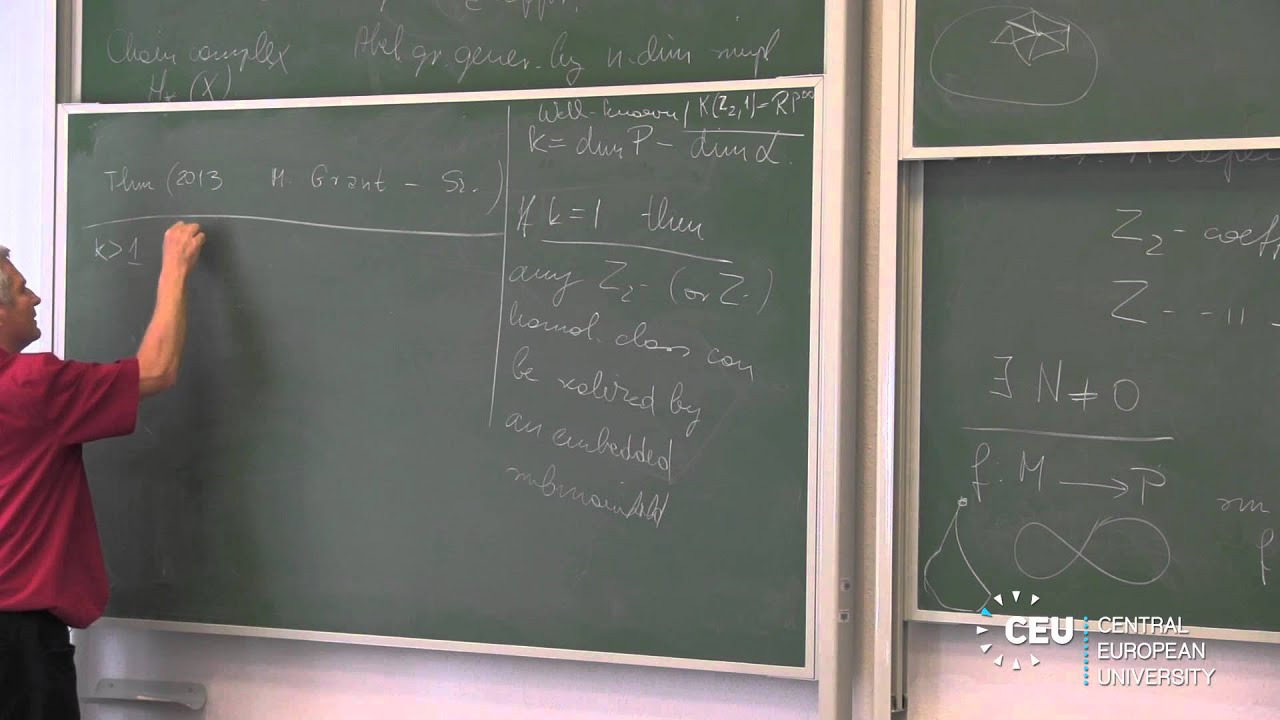
Last year with a young English topologist Mark Grant we showed that immersions (i.e. locally embedding maps) are not sufficient for
realizing all Z2-homology classes. Moreover for any finite set of multisingularities the maps having only multisingularities from this
list are insufficient to realize any homology class. In this sense homologies are infinitely complex and the algebraic realization is far away from the original geometric intuition, so the devil won again.
It is still open whether any finite set of local singularities is sufficient for realizing any homology class.
The proof for immersions uses a formula describing the homology class of the singularity of a smooth map. The proof for the multisingularities uses the classifying spaces of the singular maps with a given set of allowed multisingularities.
Reference: Grant, Mark; András, Szücs: On realizing homology classes by maps of restricted complexity. Bull. London. Math. Soc. 45 (2013), no.2, 329-34
Повторяем попытку...
Доступные форматы для скачивания:
Скачать видео
-
Информация по загрузке:


