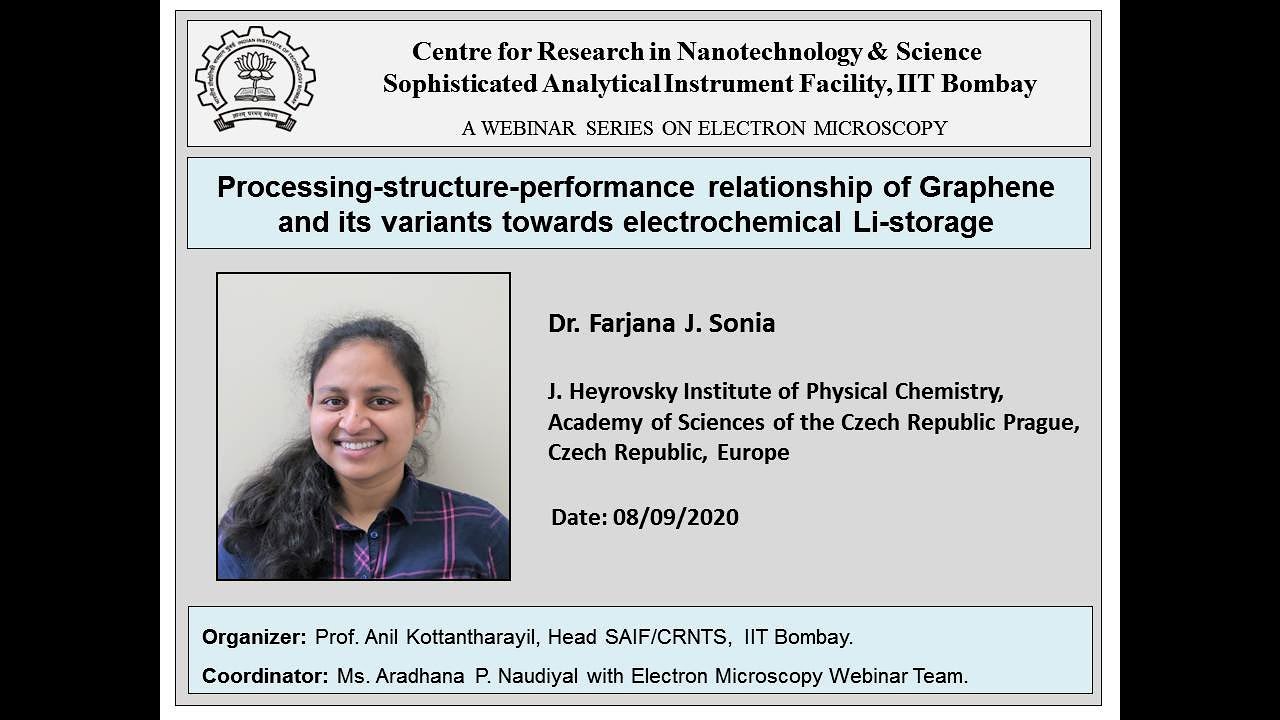
Processing structure performance of Graphene and its variants towards electrochemical Li-storage
Автор: Webinars SAIF IIT Bombay
Загружено: 2020-09-16
Просмотров: 362
Описание: Graphenic carbon, as the lower (or nano-) dimensional form of graphite, is expected to provide superior performance as compared to graphitic carbon in various field of applications, including electrochemical Li-ion storage. However, the structural/electrical/morphological properties of graphene get highly influenced by the preparation routes/conditions, which also have a significant impact on its electrochemical characteristics. Therefore, understanding the correlation between the processing routes, structural/physical properties, dimensional scale (including the number of constituent graphene layers), and electrochemical behavior is very important for stimulating practical usage of graphenic carbon as anode material for Li-ion battery. In this lecture, our observations on how the structural and electrochemical properties of CVD grown graphene and reduced graphene oxide (rGO) evolve depending on the processing techniques/parameters will be discussed. This study indicates that the classical Li- intercalation/de-intercalation inside graphene interlayer spaces does take place even for such reduced (nano)dimensional form of ‘graphitic’ carbon, but upon having the ‘graphitic ordering’ nearly perfectly maintained, addressing the long-existing debate on the Li-storage mechanism of such materials. An additional Li-storage on the exposed surface and also at the ‘stepped’ edges of graphene was observed to be the major source of improved electrochemical performance of graphene compared to graphite [1,2]. Furthermore, the Raman spectroscopy, in situ X-ray diffraction and high-resolution TEM imaging indicated that thermally treated reduced graphene oxides (t-rGO) possess significantly reduced defect contents and near-perfect ‘graphenic’ ordering with a uniform interlayer spacing compared to the graphene oxide (GO) and chemically reduced graphene oxides (c-rGO). This resulted in higher reversible Li-capacity and improved rate capability of the t-rGO in comparison to GO, c-rGO, and even the bulk graphitic carbon [2,3].
Повторяем попытку...
Доступные форматы для скачивания:
Скачать видео
-
Информация по загрузке: