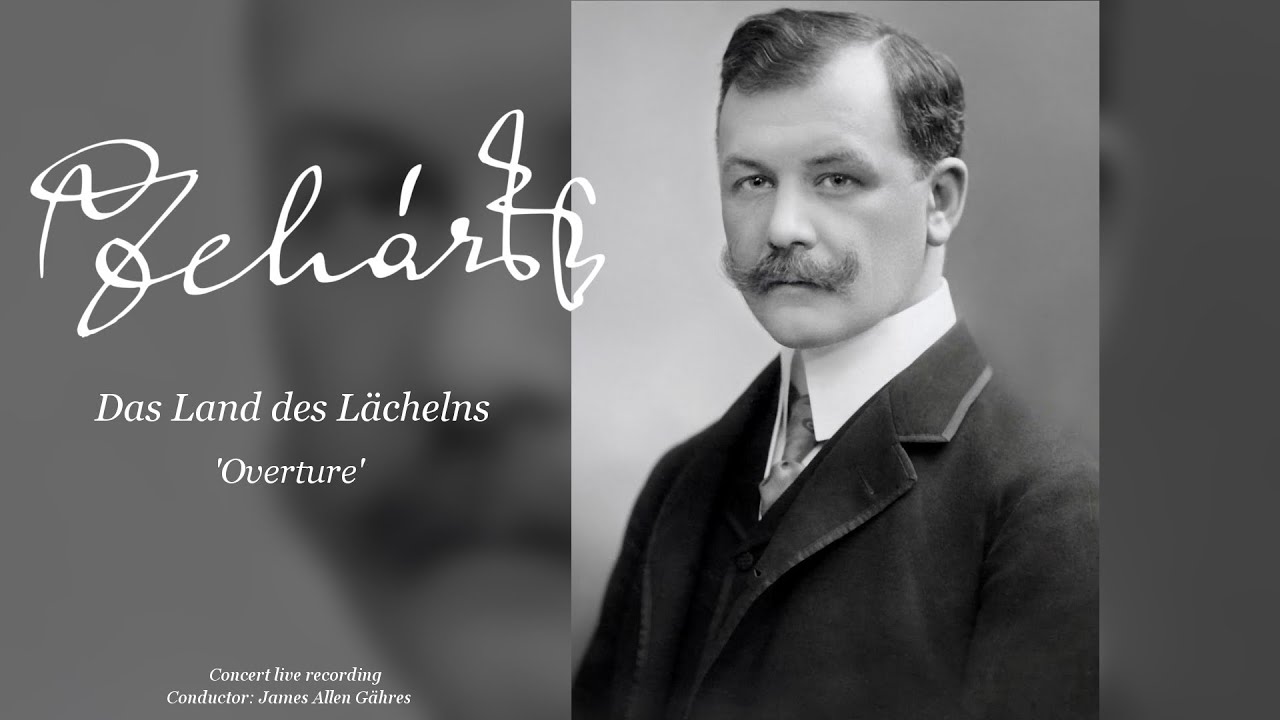
Franz Lehár - Das Land des Lächelns, Overture - James Allen Gähres, cond., Ulm Philharmonic
Автор: Wolfgang Wilhelm
Загружено: 2019-04-27
Просмотров: 4861
Описание:
Ulm Philharmonic
James Allen Gähres, conductor
Franz Lehár
Overture to 'Das Land des Lächelns' (The Land of Smiles).
Live recorded during open public concert.
Ulm, Germany
Cover: Photograph of Franz Lehár, c. 1906, by Carl Pietzner K.u.K. Hof Photographer (@Museum der Stadt Bad Ischl).
Photo: Lehar at the piano in his study in Ischl, 1910.
– Die gelbe Jacke (originally title of The Land of Smiles ) musical quotation by Franz Lehár, dated March 16, 1923.
– Title page of the Festschrift for the world premiere of Das Land der Lächelns, on October 10, 1929 at Berlin Metropol Theater.
Lehár - Gold und Silber Walzer (Gold and Silver Waltz), Op.79 - James Allen Gähres, cond., Ulm Philharmonic: • Franz Lehár - Gold and Silver, Waltz, Op. ...
Das Land des Lächelns is an operetta in three acts by Franz Lehár. The German language libretto was by Ludwig Herzer (1872–1939) and Fritz Löhner-Beda (1883–1942).
Though best known for the "Tauber tune," the romantic hit "Dein ist mein ganzes Herz" (You are my heart's delight), this work is filled with a wide variety of music, from Mi's soubrettish melodies to hints of Orientalism to pensively amorous tunes, as well as the standard Viennese waltzes. The bittersweet plot, with its sad but not tragic ending, allowed Lehár to add more musically and dramatically serious elements (as with Giuditta). While in its first appearance "Dein ist mein ganzes Herz" is a passionate expression of romantic devotion, the melody later serves almost as a leitmotif when the action turns tragic; it is somewhat reminiscent of "Du bist der Lenz," reprised at Siegmund's death in Die Walküre as a love song that briefly returns to evoke the sadness of lost love.
The work was originally produced under the title Die gelbe Jacke (The Yellow Jacket). It premiered at Theater an der Wien, Vienna, on February 9, 1923 and ran for about 100 performances. It was not a great success, and Lehár later revised it. Under the new title of Das Land des Lächelns it was first performed at the Metropol Theater, Berlin, on October 10, 1929. With a new cast and new music, the work captured audiences both at the Berlin premiere and worldwide. The two leads, Richard Tauber and Vera Schwarz, had plenty of star appeal, and the new numbers, including "Im Salon zur blau'n Pagode," "Bei einem Tee a deux," and of course, "Dein ist mein ganzes Herz," added even more to the operetta's charm and light exoticism. The work has firmly remained in the operetta repertoire ever since, though in the late twentieth and early twenty first centuries, some of the cultural concepts can be uncomfortable to audiences.
For all of the fame he achieved in his lifetime, Franz Lehár (1870–1948) remained something of a frustrated artist. His most famous composition, The Merry Widow (1905), ranks as arguably the most successful operetta ever written. Many more stage works also enjoyed widespread acclaim during the composer’s life. Indeed, his music brought him considerable wealth and made him a celebrity far beyond the borders of his native Austria. Nevertheless, Lehár could not escape the feeling that his accomplishments were not taken seriously, that despite his popularity – indeed, perhaps because of it – his rank as a composer would never rise above that of a talented entertainer.
Lehár objected strongly to this prejudice and, for a time at least, sought to convince the public of his stature as a serious artist. In an autobiographical essay published in 1907 he defended the consummate skill required in composing a successful operetta and made a special point of highlighting the strength of his musical background. In casting the story of his life, Lehár invoked the familiar travails of genius: a childhood prodigy, who, as the son of a military bandmaster, grew up in many corners of the Austrian Empire and was sent off for schooling at the Conservatory in Prague. Here he was misunderstood, forced to hone his considerable skills as a violinist while inwardly devoted to composition. Private lessons from the highly respected Czech composer, Zdenek Fibich, subsequent contact with Dvořák and even attention from Brahms held out the promise of a bright future for the teenager. There followed years of hardship: toiling with trivial duties as a military bandmaster while in his precious spare time working on his serious compositions. So convinced was he of his first major work, an opera entitled Kukuschka, that he laid aside his baton and uniform for the life of a freelance composer. The opera enjoyed only limited success and he was soon back in the military, simply to earn his keep. Only upon turning to operetta, so ends the story, did he finally gain the recognition he deserved.
Повторяем попытку...
Доступные форматы для скачивания:
Скачать видео
-
Информация по загрузке: