kidney stone II RENAL STONE causes symptoms treatment
Автор: Dr. Shipra Mishra
Загружено: 2025-12-30
Просмотров: 85
Описание:
RENAL STONES
More common in males
90% radio opaque
Aetiopathogenesis – (HI DIDI, mai MR hu)
Hot climates
Infection: Urea splitting organisms such as Proteus, Pseudomonas, Klebsiella
recurrent UTI.
Dietary factors-
Vit- A deficiency
Diet rich in calcium- milk, tomatoes, spinach produce calcium oxalate stones.
Immobilization
Decreased urinary citrate- promotes precipitation of urinary calcium phosphate & carbonates.
Inadequate urinary drainage
Metabolic causes- Hyperparathyroidism, Gout
Randall's plaques- calcium phosphate deposits
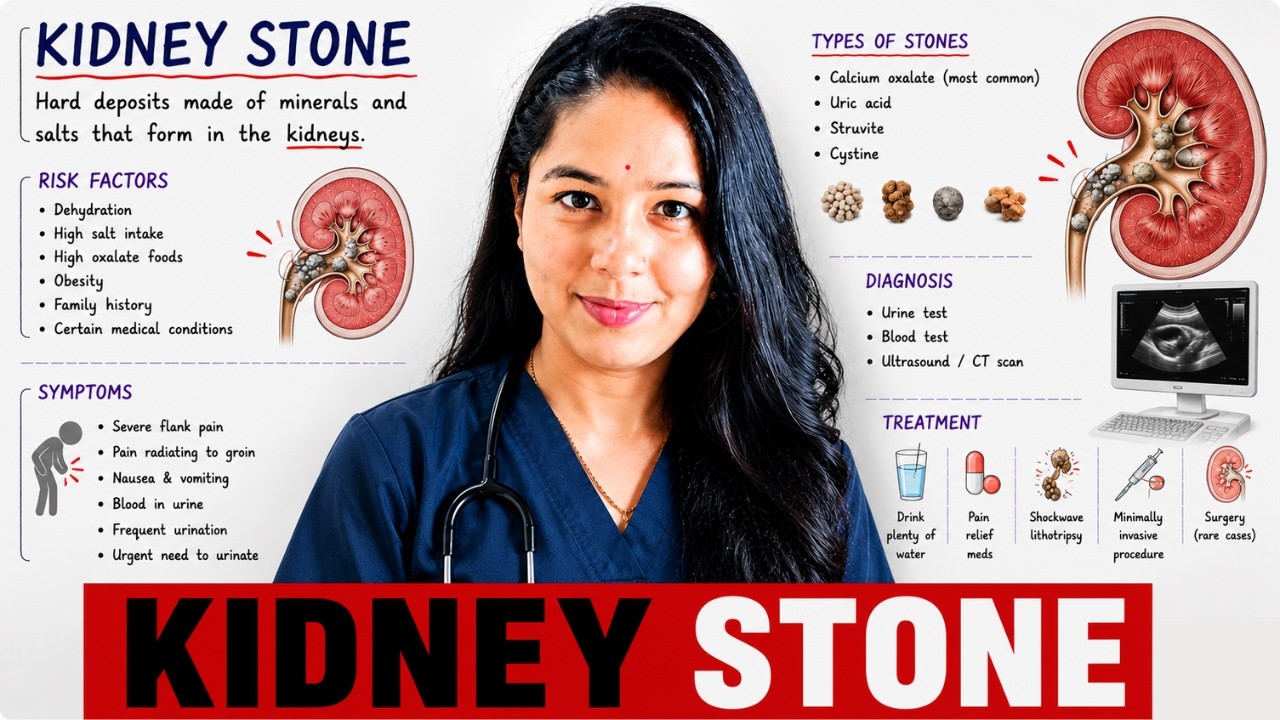
Types of renal stones-
Calcium oxalate stone (mulberry calculi)
Uric acid stone
Phosphate stone
Cystine calculus
Calcium oxalate stone (mulberry calculi)
Common type of stone
It is irregular having sharp projections
Oxalate stone is hard and single
Produces hematuria very early, resulting in deposition of blood
over the stone giving a dark colour to the stone.
It occurs in infected urine
Contains alternate layer of calcium and bacterial vegetation. It is visualised in plain X-ray KUB.
Uric acid stone
Multiple, small, hexagonal, faceted, yellow coloured.
Contain calcium oxalate which makes them opaque. Pure uric acid stones are radiolucent.
Occur in acidic urine
Common in patients who consume red meat
Best responsive to lithotripsy
Cystine calculus-
Rare kidney stones (caused by a genetic disorder called cystinuria)
Cystinuria is an inborn error of metabolism which occur due to decreased resorption of cystine from the renal tubules.
Occurs in young girls at puberty
Increased excretion of cystine in urine results in cystine calculus.
Stones are hard and radio-opaque due to sulphur
Phosphate stone
Smooth, round
Consists of triple phosphate of calcium, magnesium and ammonium.
Dirty white to yellow in colour
Commonly occur in renal pelvis and tend to grow in alkaline urine.
As it enlarges in the pelvis, it grows within the major and minor calyces and slowly forms staghorn calculus. This calculus produces recurrent urinary tract infection and hematuria and slowly damages the renal parenchyma
Clinical features
Renal pain: Dull aching to pricking type of pain posteriorly in the renal angle.
Ureteric colic: When the stone is impacted in the pelvi ureteric junction or any where in the ureter, severe colicky pain originating at the loin and radiating to the groin, testicles, vulva and medial side of the thigh.
Hematuria is common with renal stone because the majority of stones are oxalate stones.
Recurrent UTI: Fever with chills and rigors, burning micturition, pyuria may occur, along with increased frequency of micturition.
Investigations
Blood urea and creatinine to rule out renal failure.
Plain X-ray KUB- To diagnose stones 90% of the renal stones are radio opaque. Enlarged renal shadow can be seen.
USG- Exact size and location of the stone can be evaluated.
IVP - To locate the stone exactly in relation to kidney and ureter and to assess renal function.
Urine for culture and sensitivity.
1 Nonoperative treatment-
Conservative
Extracorporeal shock wave lithotripsy (ESWL)
Laser lithotripsy
II. Operative treatment
l. Endoscopic procedures- Percutaneous nephrolithotomy (PCNL)
2. Open procedures- Pyelolithotomy
Nephrolithotomy
Extended pyelolithotomy
Pyelo nephrolithotomy
Partial nephrectomy
Nephrectomy
Повторяем попытку...
Доступные форматы для скачивания:
Скачать видео
-
Информация по загрузке:


