Solving SQL Server: Update a Column Using Two Variables for Dynamic Data Population
Автор: vlogize
Загружено: 2025-10-08
Просмотров: 0
Описание:
Discover how to automatically update a column in SQL Server using two variables for dynamic month and year data. Learn the solution step-by-step!
---
This video is based on the question https://stackoverflow.com/q/64569757/ asked by the user 'PratikJava' ( https://stackoverflow.com/u/14194140/ ) and on the answer https://stackoverflow.com/a/64569793/ provided by the user 'Suraj Kumar' ( https://stackoverflow.com/u/10532500/ ) at 'Stack Overflow' website. Thanks to these great users and Stackexchange community for their contributions.
Visit these links for original content and any more details, such as alternate solutions, latest updates/developments on topic, comments, revision history etc. For example, the original title of the Question was: Update a column using two variables
Also, Content (except music) licensed under CC BY-SA https://meta.stackexchange.com/help/l...
The original Question post is licensed under the 'CC BY-SA 4.0' ( https://creativecommons.org/licenses/... ) license, and the original Answer post is licensed under the 'CC BY-SA 4.0' ( https://creativecommons.org/licenses/... ) license.
If anything seems off to you, please feel free to write me at vlogize [AT] gmail [DOT] com.
---
Solving SQL Server: Update a Column Using Two Variables for Dynamic Data Population
In the world of SQL Server, many scenarios may require you to update a column's value based on dynamic data, such as the current month and year. This requirement often arises when auto-populating data for future use, which is particularly crucial for reporting and analytics purposes.
In this post, we will tackle a specific problem: how to update a column using two variables to represent the month and year in a varchar format. Let's present the problem, the initial SQL query, and then break down the solution in a simple, understandable manner.
The Problem
You are tasked with updating a column, month_of_usage, in a table named Mytable, where the desired format for the value is MM/YYYY—specifically the next month and year (e.g., 11/2021). You initially attempted to set this column with a string concatenation of the month and year variables, but encountered difficulties due to the data type of the month_of_usage column.
Here’s your original attempt:
[[See Video to Reveal this Text or Code Snippet]]
The critical issue here is the way the string concatenation was handled, leading to incorrect data formatting.
The Solution
To resolve this issue, we need to ensure proper data type conversion while constructing the string for month_of_usage. Here’s how the corrected SQL update statement should look:
[[See Video to Reveal this Text or Code Snippet]]
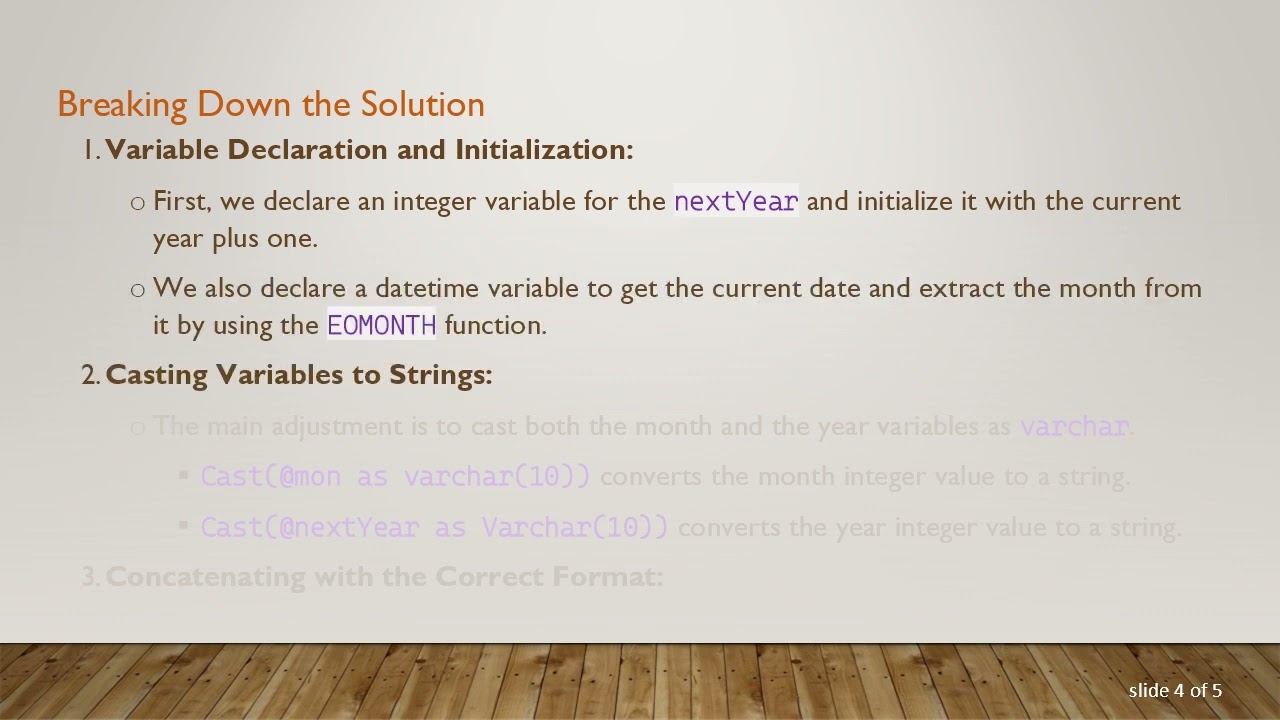
Breaking Down the Solution
Variable Declaration and Initialization:
First, we declare an integer variable for the nextYear and initialize it with the current year plus one.
We also declare a datetime variable to get the current date and extract the month from it by using the EOMONTH function.
Casting Variables to Strings:
The main adjustment is to cast both the month and the year variables as varchar.
Cast(@ mon as varchar(10)) converts the month integer value to a string.
Cast(@ nextYear as Varchar(10)) converts the year integer value to a string.
Concatenating with the Correct Format:
The two values are concatenated with a / in between to create the desired format (MM/YYYY).
Executing the Update:
The final update statement modifies the month_of_usage column for the specified row (where id = 1), setting it to the newly formed string.
Final Thoughts
By following this approach, not only do we ensure the values are dynamically generated based on the current date, but we also maintain the correct format needed for your database schema.
This solution supports automating reports and analytics in SQL Server by allowing dynamic updates based on the current system date, making your data management more efficient and effectively structured.
Remember, SQL Server's handling of data types can often be tricky, but understanding how to cast and concatenate variables correctly is key to successful data manipulation!
Повторяем попытку...
Доступные форматы для скачивания:
Скачать видео
-
Информация по загрузке: