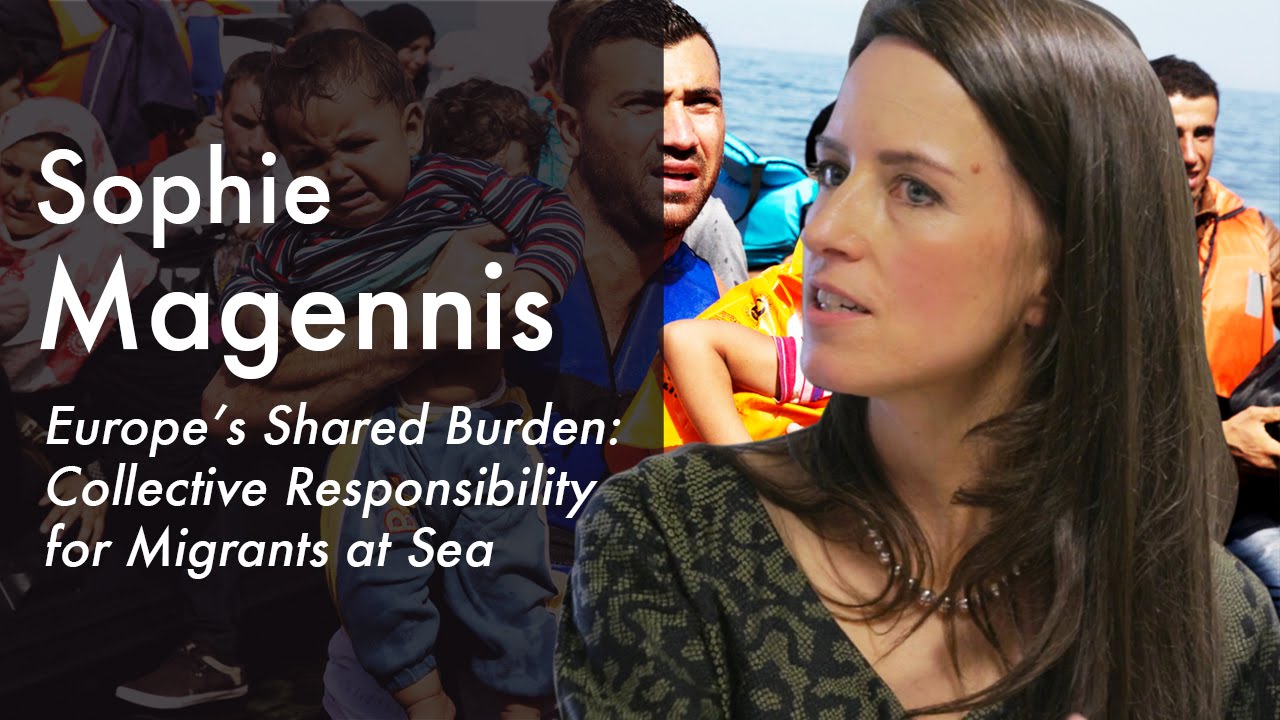
Sophie Magennis | Europe’s Shared Burden: Collective Responsibility for Migrants at Sea (2015)
Автор: UCD - University College Dublin
Загружено: 2015-10-23
Просмотров: 754
Описание:
Head of Office, UNHCR Ireland, Sophie Magenis' introductory response to the UCD School of Law's "Europe’s Shared Burden: Collective Responsibility for Migrants at Sea" conference (09 October 2015).
The workshop aimed to foster a strong interdisciplinary focus in order to better understand and critically engage with the concept of collective responsibility in the context of irregular maritime migration. They received contributions from law, politics, philosophy, as well as other cognate social and human science disciplines.
Claims of moral, legal and political responsibility feature heavily in discourse on the phenomenon of irregular migration by sea (or “boat migration”). This is understandable given the growing humanitarian catastrophe being witnessed in the Mediterranean region at present. In fact, the International Organization for Migration (IOM) has predicted that in the Mediterranean the death toll from irregular migration could be as high as 30,000 in 2015 alone. The question of European states’ willingness to share in the burden of saving lives at sea has come into sharp focus in the aftermath of the EU’s decision in 2014 to cancel the Mare Nostrum rescue programme, and instead impose the more tightly circumscribed Triton security operation. With the unprecedented number of deaths at sea in recent months there seems to be growing acknowledgement in principle that responsibility for the fate of migrants is, or should be, shared amongst states and institutions at the European level.
There has been little systematic study of what this shared or collective responsibility actually entails in terms of specific duties and responsibilities. It is clear that existing policy and legal responses are failing, particularly given the rather fragmented and uncertain legal framework (engaging rules of the international law of the sea, refugee and migration law, EU law and international and European human rights law), not to mention inadequate financing, coordination and political will in policy response. Despite recent momentum leading to increased resources, new operational initiatives and reconsideration of refugee resettlement frameworks, there remains a concern that this has been a rather piecemeal, inadequate and uneven response, particularly geared towards border management and security imperatives, rather than consideration of root causes and humanitarian objectives.
UCD Twitter: / ucddublin
UCD Facebook: / universitycollegedublin
UCD Instagram: / ucddublin
UCD Homepage: http://www.ucd.ie
Повторяем попытку...
Доступные форматы для скачивания:
Скачать видео
-
Информация по загрузке: