MRCP-1 Corticospinal Tract Essentials
Автор: Dr Sheen Medical lectures
Загружено: 2025-12-13
Просмотров: 1
Описание:
Corticospinal Tract: The "Voluntary Motor Highway"
Core Function: It is the primary neural pathway for executing voluntary, discrete, and skilled movements, especially of the distal limbs (hands and fingers).
Anatomy (The Route): It follows a two-neuron chain:
Upper Motor Neuron (UMN): The command cell. Its body resides in the primary motor cortex (Precentral gyrus). Its long axon forms the tract itself.
Lower Motor Neuron (LMN): The final connection. Its body is in the ventral horn of the spinal cord. Its axon directly innervates muscle fibers.
The Crucial Event: The Pyramidal Decussation
The defining anatomical feature occurs at the medulla-spinal cord junction. Here, ~85-90% of the axons cross over to the opposite side at structures called the pyramids. This explains contralateral control (left brain controls right body).
Main Divisions:
Lateral Corticospinal Tract: The crossed fibers. Controls limb movement for fine, skilled acts.
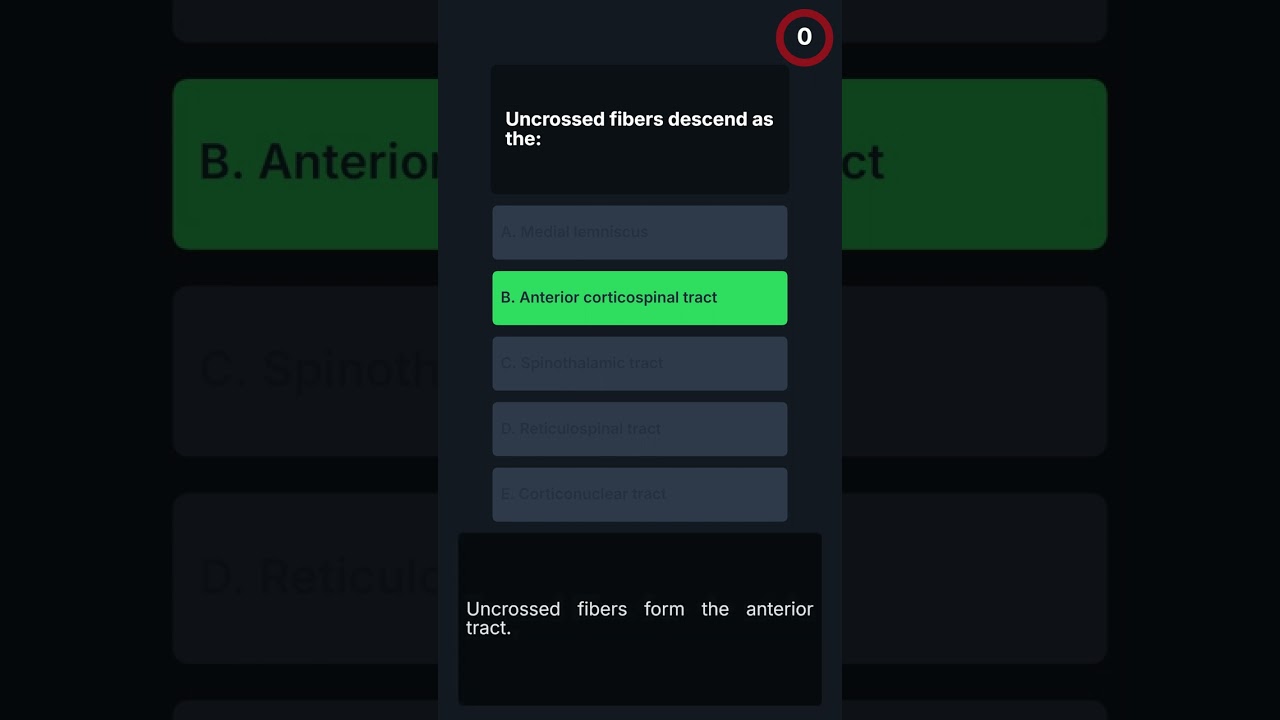
Anterior Corticospinal Tract: The uncrossed fibers (until spinal level). Controls axial/trunk muscles.
Key Clinical Rule (The LMN vs. UMN Lesion):
LMN Lesion (damage to neuron in spinal cord/peripheral nerve): Weakness at that specific muscle/level, with flaccidity, atrophy, and loss of reflexes.
UMN Lesion (damage to tract above the decussation, e.g., in cortex or internal capsule): Weakness of contralateral body region with spasticity, hyperreflexia, and preserved bulk.
In Essence: The corticospinal tract is the brain's direct line for precise motor commands. Its decussation in the medulla is fundamental to neurology, explaining the side of deficit after a stroke.
Повторяем попытку...
Доступные форматы для скачивания:
Скачать видео
-
Информация по загрузке: