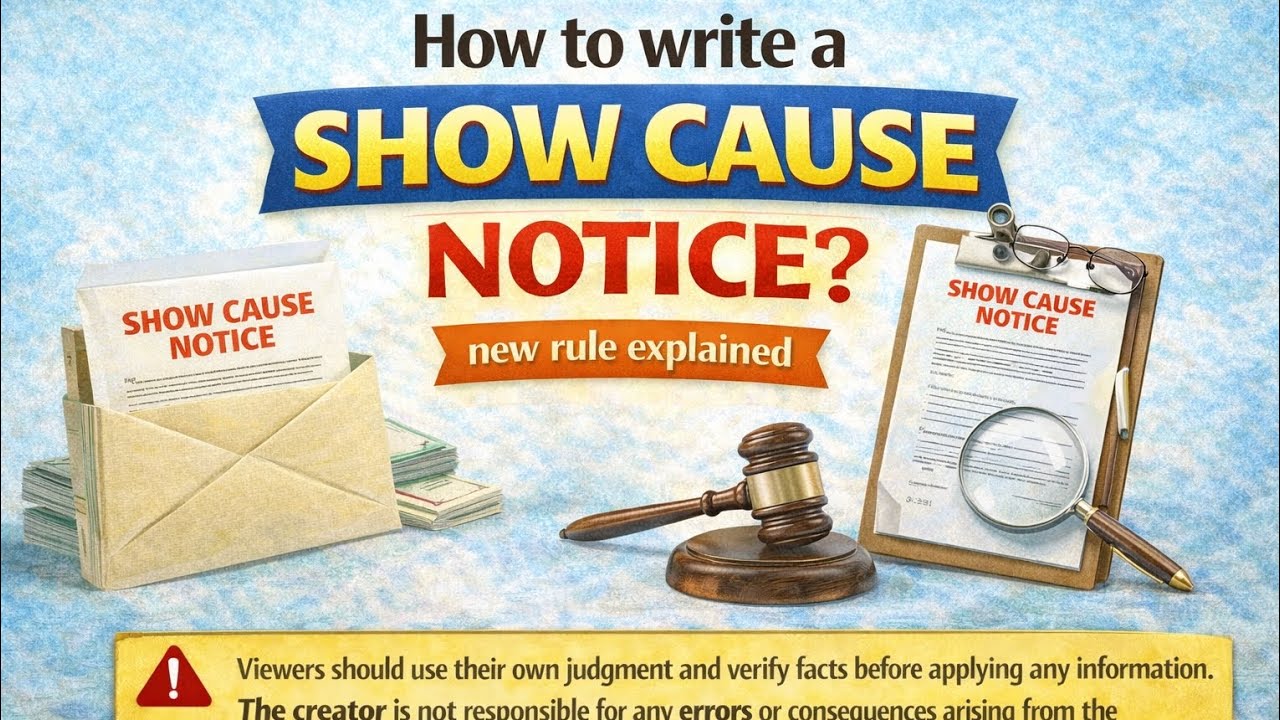
How to write a Show Cause Notice? Explained by Deepak Kapoor
Автор: Infomania - Govt Rules and Admn
Загружено: 2026-02-17
Просмотров: 52
Описание:
.
Process of Writing a Show Cause Notice
1. Understand the Purpose of a Show Cause Notice
A Show Cause Notice is issued to:
Inform an employee/person of proposed action,
Specify the alleged act of omission or commission, and
Give a reasonable opportunity to explain why action should not be taken.
📌 It is based on the principle of natural justice — audi alteram partem (hear the other side).
2. Identify the Legal Basis
Before drafting:
Identify the relevant rule, law, or instruction under which action is proposed (e.g., CCS (CCA) Rules, Service Rules, Contract Conditions).
Ensure that the competent authority is issuing the notice.
3. Collect and Verify Facts
Examine records, files, audit objections, complaints, or inspection reports.
Ensure facts are:
Accurate,
Verifiable, and
Relevant.
⚠️ Avoid assumptions or unverified allegations.
4. Structure of a Show Cause Notice
A well-drafted SCN generally contains the following parts:
(a) Heading and Authority
Title: “Show Cause Notice”
Reference number and date.
Name, designation, and office of the issuing authority.
Name, designation, and office of the noticee.
(b) Background / Statement of Facts
Brief narration of events in chronological order.
Mention:
Date(s),
Action(s) or omission(s),
Relevant documents or orders.
📌 Facts should be neutral, not accusatory.
(c) Allegation / Irregularity
Clearly state:
What rule or instruction appears to have been violated,
How the act/omission is prima facie irregular.
Avoid words like “proved”, “established”, “deliberate” at this stage.
(d) Proposed Action
Indicate the nature of action contemplated (administrative, disciplinary, recovery, cancellation, etc.).
Do not impose punishment in the notice itself.
(e) Opportunity to Respond
Provide reasonable time (usually 7–15 days).
Specify:
Mode of reply (written),
Address to which reply should be sent.
(f) Consequence of Non-reply
State that in case of no reply within the stipulated time, the matter will be decided ex parte based on available records.
5. Language and Tone
Use clear, simple, and neutral language.
Avoid:
Harsh or threatening words,
Presumption of guilt,
Emotional or subjective expressions.
6. Enclosures and References
List all documents relied upon.
Attach copies or allow inspection, if necessary.
7. Approval and Issue
Obtain approval of the competent authority.
Issue through:
Official channel,
Registered post / email / office order as applicable.
8. After Receipt of Reply
Examine the explanation objectively.
Record reasons in writing:
For acceptance, or
For proceeding further (disciplinary action, recovery, etc.).
9. Common Mistakes to Avoid
Issuing SCN without jurisdiction.
Vague or general allegations.
Not citing rules.
Giving insufficient time to reply.
Using SCN as a punishment order.
10. Conclusion
A Show Cause Notice is not a punishment but a procedural safeguard. Proper drafting ensures fairness, transparency, and legal sustainability, and protects the decision from being set aside on procedural grounds.
Draft Show Cause Notice
Government of India
[Name of Ministry / Department / Office]
[Address]
No.:
Date:
SHOW CAUSE NOTICE
To
Shri / Smt. / Ms. [Name of the Official]
[Designation]
[Office / Section]
Subject: Show Cause Notice regarding alleged irregularity in respect of [brief subject]
Whereas it has been observed from the records that [briefly state the facts in chronological order], as detailed below:
That you were entrusted with / responsible for [nature of duty / work] during the period [period].
That it has come to notice that [specific act of omission or commission] on [date(s)].
That the above action/inaction appears to be prima facie in contravention of [relevant rule / instruction / order], which provides that [brief rule position].
Prima Facie View
In view of the above facts, it appears that you have failed to discharge your duties in accordance with the prescribed rules and instructions, thereby rendering yourself liable for [administrative / disciplinary / recovery] action under the relevant provisions.
Opportunity to Show Cause
Now, therefore, you are hereby called upon to show cause in writing within [10/15] days from the date of receipt of this notice as to why appropriate action should not be taken against you in the matter.
Your reply, if any, should be submitted to the undersigned, along with relevant documents or evidence, if you wish to rely upon the same in your defence.
Failure to Respond
Please note that if no reply is received within the stipulated period, it shall be presumed that you have no explanation to offer, and the matter will be decided ex parte on the basis of available records, without any further reference to you.
Clarification
This Show Cause Notice is issued without prejudice and does not amount to a conclusion regarding your guilt or liability. A decision will be taken only after due consideration of your reply, if received.
Повторяем попытку...
Доступные форматы для скачивания:
Скачать видео
-
Информация по загрузке: