Belfast’s Divided Legacy: An Interactive Experience on Systemic Inequality Today
Автор: A4R Media Hub
Загружено: 2026-06-16
Просмотров: 0
Описание:
A4R 🎨 Podcasts are co created with GenZs Support our work by becoming a paid member..
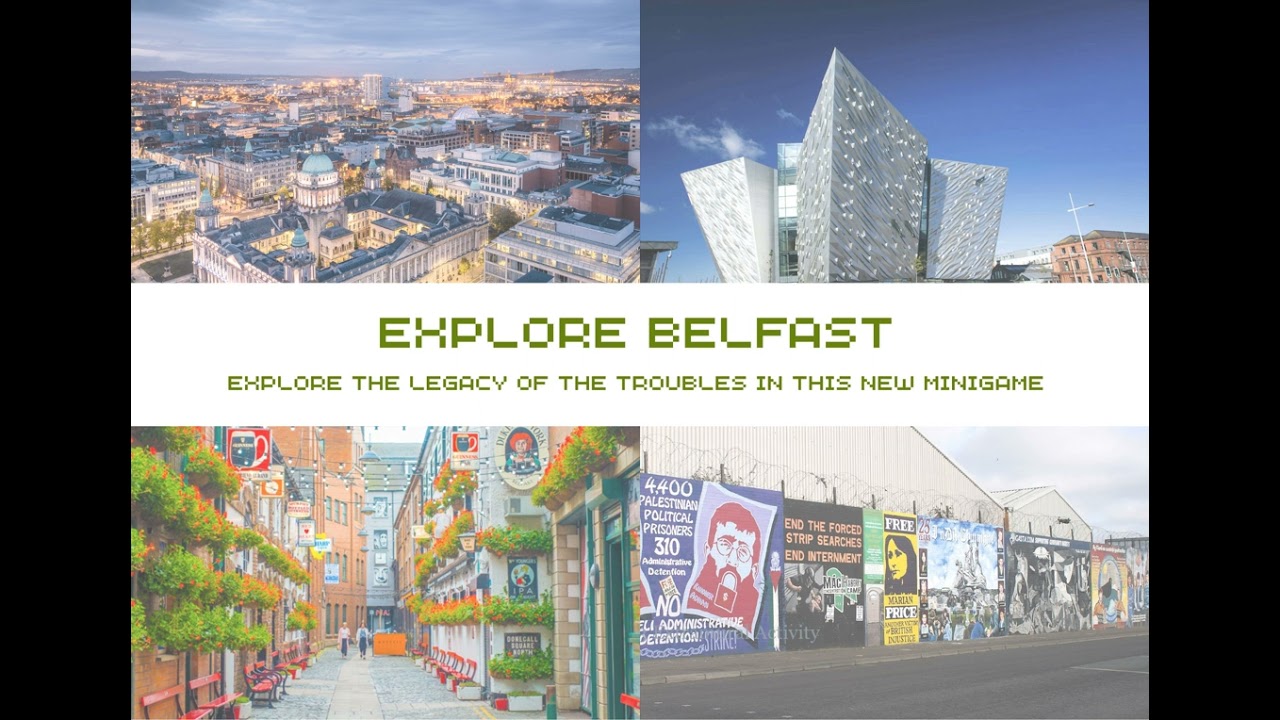
Click here (https://belfastgame-4yxms6cq.manus.sp...) to Explore Belfast.
Peace Without Prosperity? Child Poverty in Northern Ireland Since the Troubles
The Good Friday Agreement of 1998 is widely credited for bringing about the end of ‘The Troubles’ in Northern Ireland. It granted Northern Ireland a degree of self-determinism and achieved self-governance (https://education.niassembly.gov.uk/p...) , while also beginning a process of demilitarisation (https://education.niassembly.gov.uk/p...) . While sporadic violence in Northern Ireland is ongoing (https://www.irishtimes.com/news/crime...) , the Agreement was a key step towards peace. However, it did not dismantle deep structural inequalities, resulting in entrenched child poverty- defined by UNICEF as the deprivation of basic needs such as nutrition, shelter, education, and healthcare- in communities most affected by the Troubles.
The Good Friday Agreement arose from three decades of armed ethno-nationalist conflict. Known as the Troubles, the conflict was fought between the overwhelmingly Protestant Unionists on one side and the Catholic Nationalists on the other, and had a seismic impact on the structure of Northern Irish society, which became segregated along sectarian lines, something that we will explore using the example of Belfast.
This segregation was often physical. ‘Peace lines’- large walls separating Protestant and Catholic communities -were constructed to reduce violence, many of which still exist today, such as those between Shankill Road and Falls Road. While effective in limiting direct conflict, these barriers reinforced social and economic isolation. As a result, communities became increasingly insular, and areas already affected by violence experienced deepening urban decay and economic decline.
The Troubles’ spatial impact extended beyond neighbourhood division. Belfast city centre was protected by a ‘ring of steel,’ a network of security measures designed to prevent paramilitary attacks. This ensured the city’s economic core remained relatively stable and attractive to investment, while suburban areas - exposed to violence and military presence- saw infrastructure degrade and businesses withdraw. The urban-suburban division was cemented by many factors. Belfast’s secure city centre attracted investment, while conflict-affected suburbs saw disinvestment and decline. (https://pureadmin.qub.ac.uk/ws/portal...) With economic infrastructure, human capital, and business premises degraded by conflict, Belfast’s GDP fell by as much as 20% between 1966 and 1998 (https://www.economicsobservatory.com/...) . As a result, the spatial and economic inequalities created during the Troubles were not resolved by peace, but became embedded in Northern Ireland’s post-conflict landscape.
The late 1990s and early 2000s saw efforts to regenerate Belfast by investing in the city centre and waterfront. However, this only perpetuated the divide between the city centre and peripheral working-class areas. Ken Sterrett, a Northern Irish urban planner and designer, describes the approach to Belfast’s development as neoliberal urbanism (https://pureadmin.qub.ac.uk/ws/portal...) , a market-first approach that often results in the most wealthy areas becoming increasingly wealthy while underdeveloped areas are left behind. Furthermore, the unique issues faced by Northern Ireland in comparison to the rest of the UK have meant that councils have been forced to spend much more on public order and public housing than in other parts of the country, necessitated by the ongoing need for policing and intelligence and the legacy of colonial housing discrimination. (https://www.economicsobservatory.com/...)
Relative peace in Northern Ireland, therefore, has not generated the economic revival that may have been anticipated. These spatial and economic divides did not disappear after 1998, and they continue to shape everyday life. For children growing up in Northern Ireland today, this legacy is particularly stark. For one, it means that the social stratification of the Troubles will often dictate their home, social group, and class. As the Belfast Mobility Project (https://belfastmobilityproject.org/ma...) explores, Protestant and Catholic communities remain divided not only in residence but also in movement, with many individuals living and socialising within confi...
Повторяем попытку...
Доступные форматы для скачивания:
Скачать видео
-
Информация по загрузке: