Static vs. Dynamic Movement | Rock Climbing
Автор: Howcast
Загружено: 2013-08-26
Просмотров: 230365
Описание:
Full Playlist: • How to Rock Climb
-
-
Rockin’ Rock Climbing Commodities
Momentum Climbing Harness: http://amzn.to/1iN4Caq
La Sportiva Tarantulace Men’s Climbing Shoe: http://amzn.to/1FL2Qvz
La Sportiva Tarantulace Women’s Climbing Shoe: http://amzn.to/1UTo5SH
Half Dome Climbing Helmet: http://amzn.to/1QfLxZ8
Chalk Bag with Belt and Zippered Pocket: http://amzn.to/1OtW84a
REVERSO 4 Belay Device: http://amzn.to/1F170Vi
Watch more How to Rock Climb videos: http://www.howcast.com/videos/512701-...
So, when you're climbing, there's 2 easy ways to classify almost all the motion. Static motion and dynamic motion, the critical difference being static motion is slow, typically more fluid, very controlled, and the dynamic motion often involves more power and momentum. It's kind of the speed of when you're doing these moves.
The dynamic move, you're going to be moving from balance to a position of unbalance to a position of balance, kind of tossing your body a little bit, moving with momentum. In a static move, you'll be controlled the whole time, always moving while your body is within balance, kind of allowing you to almost undo that move the same way you would do it.
How you know when you need to use that static move or dynamic move depends certainly on what type of climbing you're doing, where the hand holds are, the size of the hand holds, lots of variables, one important one being where your center of gravity is. You'll need to use a dynamic move if you have to move your center of gravity outside your base of support, meaning you might be reaching beyond where your feet are.
Maybe the hand hold is too far for you to get to by just pulling up and keeping your body in that position. You need a little bit more momentum to move that center of gravity outside all the points of contact you have with the wall, which is known as your base of support.
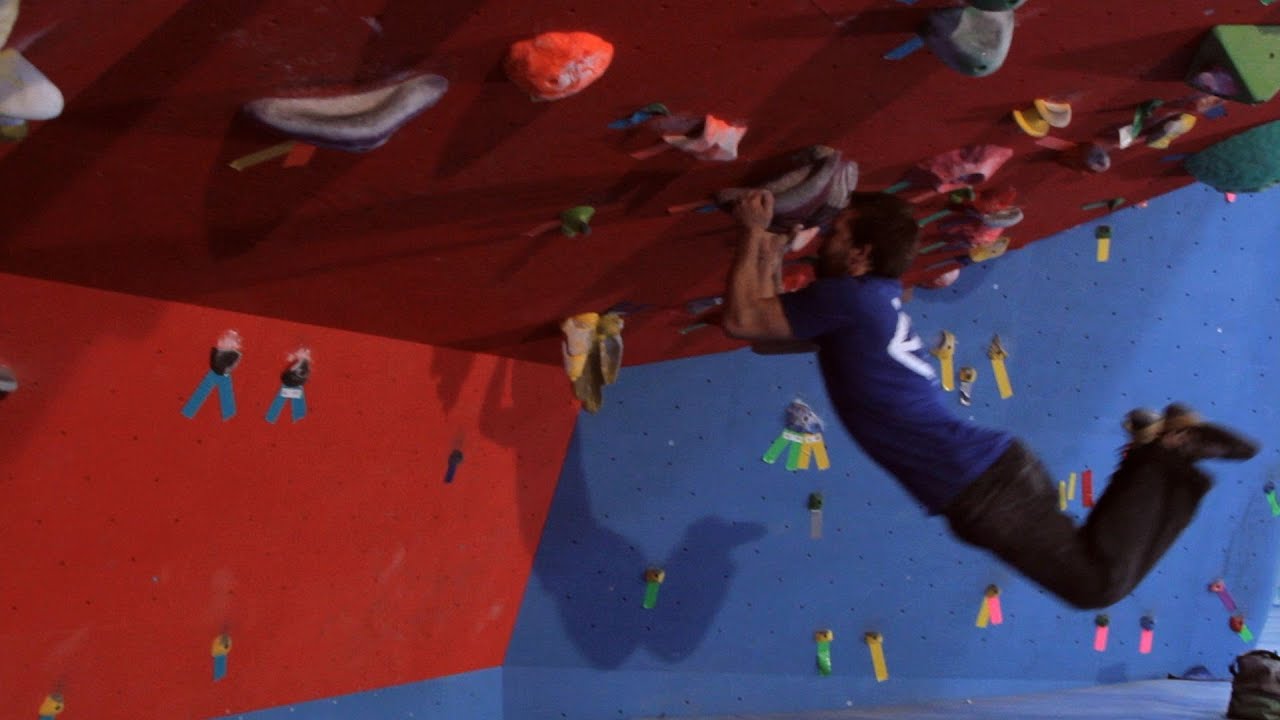
A couple examples of static and dynamic motion can be demonstrated here on this 45 degree overhanging wall. To show you some static motion, I'll demonstrate some moves on this particular climb. You'll notice while I'm climbing, my body is moving very slow, very controlled, my feet are staying on the wall the whole time, and I'm always balanced. I'm never doing a move when I need to swing or generate any momentum. I can pull my body up, hold it in position, and grab the next hold. So, each time the appendage that I'm moving is completely unweighted, and I can move it very intentionally, very slowly, and with a lot of control and precision. That would be an example of static motion.
To do the same climb dynamically, I'll be using more momentum, moving my body much quicker, using more power, and potentially skipping holds, climbing it very differently, allowing my feet to come off the wall, and putting them back on. So, that would be an example of dynamic motion. It allows you to cover a bit more ground with each move, but you're really recruiting some more muscles, using a lot of force and a lot of power to generate all that momentum and move dynamically from one position to another. That's the basic difference between static and dynamic motion.
Повторяем попытку...

Доступные форматы для скачивания:
Скачать видео
-
Информация по загрузке: