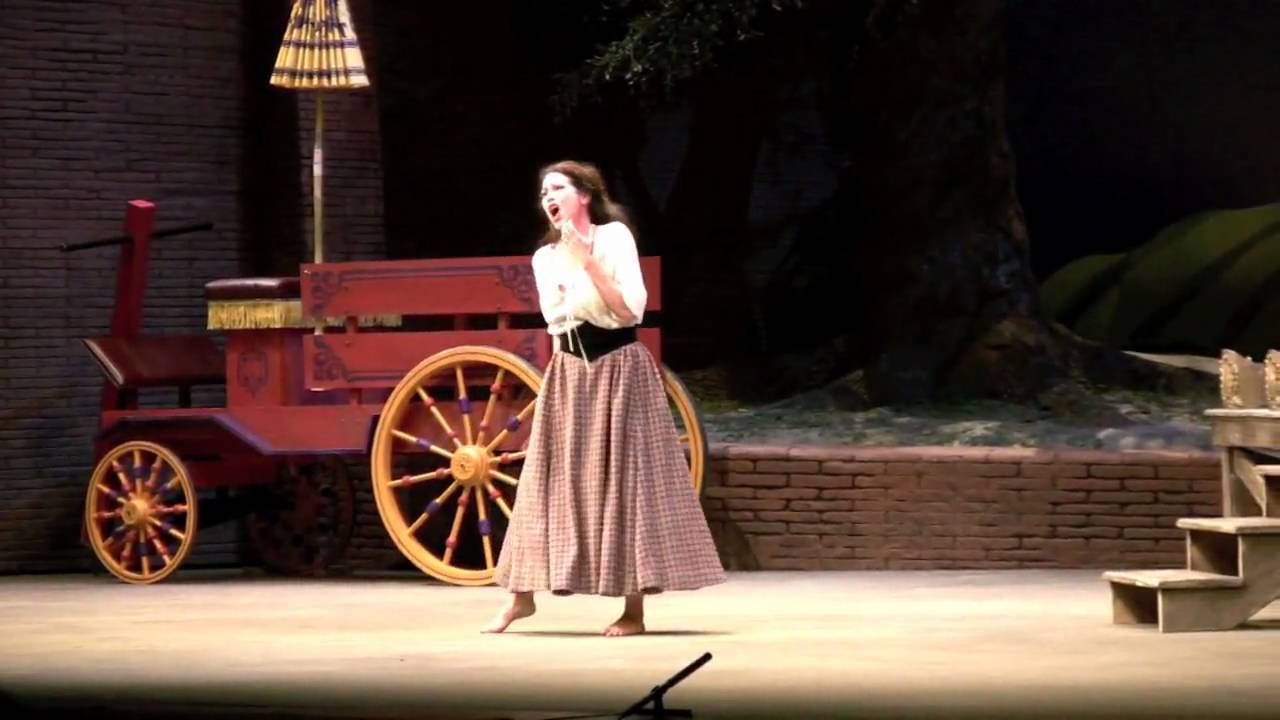
Elizabeth Futral's highly acclaimed New York City Lakmé
Автор: songbirdwatcher
Загружено: 2024-12-20
Просмотров: 538
Описание:
THE SONGBIRD: Elizabeth Futral was born in North Carolina in 1963, but grew up in Louisiana. She studied with the legendary Virginia Zeani and was a winner in the national Met Auditions in 1991. Her European debut was as Lakmé in Dublin in 1993 (also available on this YT channel). The following year she sang Lakmé to acclaim in the New York City Opera production (this performance was on Sept. 17, 1994). The New Times praised her performance as “refined and accurate, hitting her high notes without strain or artifice, giving her vocal acrobatics warmth without ever succumbing to egoism. She was not out to prove anything; the song ['The Bell Song'] was not laden with excessive emotion or elaborate musical gestures: it had the virtues of her performance throughout the evening, offering simplicity, grace and directness.”I was living in NYC at the time, but sadly missed it. I did get to see her live in recital at the small Carnegie Hall venue in 1995. Futral has had a very active and adventurous career in opera houses and concert halls around the world. Her Met debut was Lucia in 1999. She has sung nearly all of the standard lyric-coloratura roles, as well as been in revivals of uncommon works (Rossini's "Matilde di Shabran," Meyerbeer's "L'etoile du nord," Halévy's "Le Juive," Berlioz's "Benvenuti Cellini") and premiered new works (Dun's "The First Emperor" at the Met, Previn's "A Streetcar Named Desire" and "Brief Encounter," Laitman’s "Scarlett Letter," and Gordon's "Twenty-Seven" as Alice B. Toklas).
THE MUSIC: "Lakmé" by Leo Delibes was first performed in 1883 in Paris. The work epitomizes the orientalist trend at the time through the perceived novelty of colonial English people in an exotic location, namely India. The title role, the daughter of a Hindu priest, is one of the cornerstones of the light coloratura soprano repertoire. It was written for Marie van Zandt, who became one of the foremost sopranos of her era. Lakme's Act 2 aria "Où va la jeune Hindoue" is commonly referred to as the Bell Song because the soprano mimics a set of magic chimes while telling the haunting legend of the Pariah's daughter. It is standard practice to sing three High Es in the aria -- the first one in the vocal prelude and the one in a flourish after the first bell refrain are both in the score as optional variants, while the climactic sustained High E6 at the end is actually not in the score.
Повторяем попытку...

Доступные форматы для скачивания:
Скачать видео
-
Информация по загрузке: