The Missing Layer in Modern Medical Education (No.1515, VPT 071, 1/26/2026)
Автор: Health Talk with eclaireMD
Загружено: 2026-01-31
Просмотров: 2
Описание:
The Missing Layer in Modern Medical Education (No.1515, VPT 071, 1/26/2026)
Gerald C. Hsu
EclaireMD Foundation.
Category:
Medical Education
Introduction
Modern medical education has achieved extraordinary success in anatomy, biochemistry, pharmacology, diagnostics, imaging, and surgery. Yet despite this progress, a fundamental gap remains: medicine explains what is happening but often fails to explain how disease evolves over time, why damage accelerates, or why collapse appears sudden after long stability. Current training emphasizes snapshots, averages, and categories, but neglects trajectories, accumulation, and nonlinear failure dynamics.
The Missing Columns
Science traditionally rests on four pillars: mathematics, physics, chemistry, and biology. Modern medicine relies mainly on biology and chemistry. Without mathematics and physics, the structure is incomplete. Just as buildings collapse from accumulated sideways forces, chronic disease results from silent stress and fatigue. Biology and chemistry suffice for acute care, but long-term disease progression requires math and physics.
Why Statistics Alone Is Not Enough
Medical training emphasizes statistics, useful for populations but inadequate for individuals. Disease does not progress as averages; it accumulates within one body under stress, fatigue, and delayed failure. Catastrophic events occur when reserve is exhausted, not when thresholds are crossed. Outliers are warnings, not noise. Understanding requires mathematical and physical tools that address time, accumulation, and nonlinear change.
Mathematics for Trajectory-Based Medicine
Calculus: teaches rates of deterioration and acceleration of risk.
Linear algebra: explains multivariable interactions among glucose, blood pressure, diet, sleep, stress, and activity.
Set theory: clarifies overlapping diagnoses and fuzzy boundaries.
Partial differential equations: model processes across time and space, such as diffusion, perfusion, and metabolic regulation.
Complex variables: describe oscillation, feedback, and stability in cycles like circadian rhythms.
Topology: identifies disease progression patterns and failure pathways beyond thresholds.
These tools allow physicians to see direction and momentum, not just static values.
Physics and Engineering: The Language of Damage
Mathematics describes change; physics explains damage. The body is a physical structure subject to stress, fatigue, and rupture.
Elastic vs plastic behavior: reversible vs permanent damage, mapping to early vs late disease.
Statics and dynamics: explain silent accumulation and sudden collapse.
Linear vs nonlinear models: linear for early stages, nonlinear for tipping points and catastrophic failure.
Strength of materials and fatigue: blood vessels stiffen, organs lose compliance, tissues weaken under repeated stress.
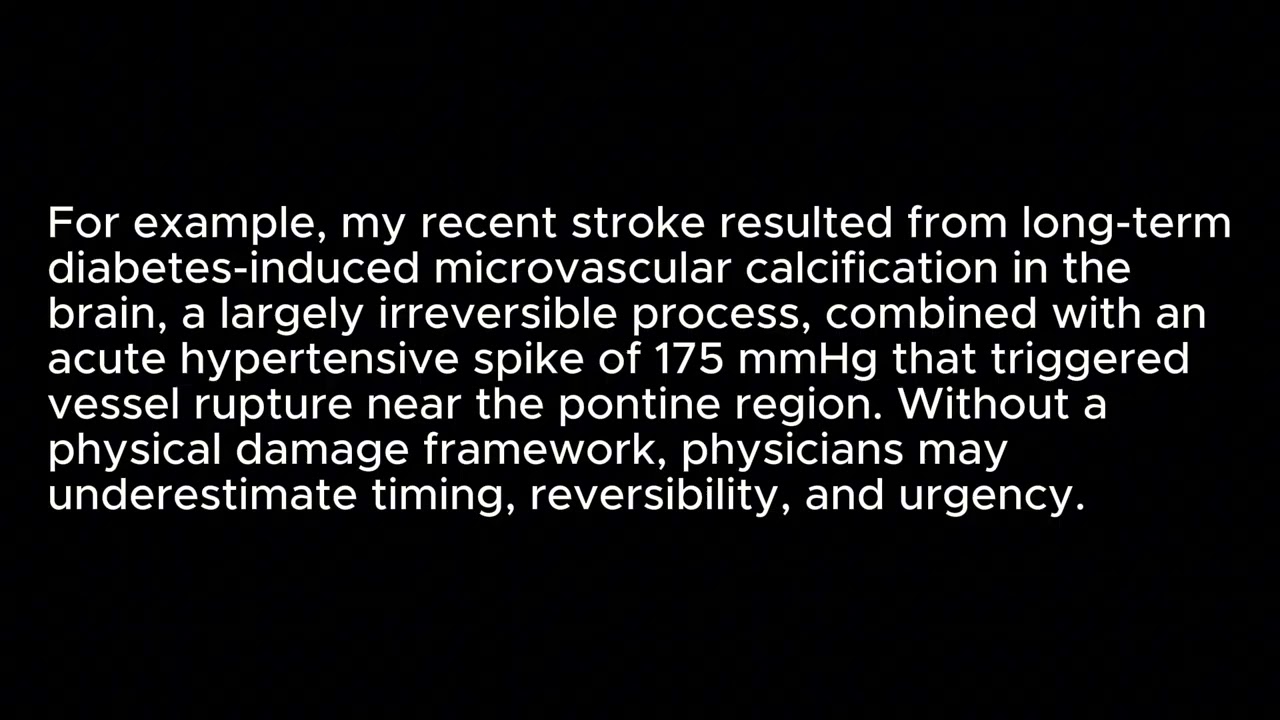
Without physical reasoning, physicians underestimate timing, reversibility, and urgency.
Integration, Not Replacement
Math-physical medicine complements biomedicine. Physiology explains function, pathology explains injury, biochemistry explains mechanism, mathematics explains trajectory, and physics explains consequence. Together they form a complete framework. This integration strengthens clinical judgment, explains divergent outcomes, and improves long-term decision making.
Preparing Physicians
With math-physical training, physicians recognize disease trajectories, study outliers, and explain progression clearly to patients. They can describe not only current lab values but where they are heading and why. In research, causality replaces correlation, and outliers are valued as warnings. This restores a missing dimension, reconnecting medicine with time, structure, and physical reality.
Conclusion
Based on 17 years of study and over 1,500 papers, I argue that math-physical medicine is a necessary extension of modern medical education. It does not replace biochemistry but completes it. Surgery already demonstrates integration of theory and practice; internal medicine can benefit similarly. Medicine exists to serve humanity, and adding mathematics and physics strengthens its foundation against long-term stress and cumulative damage.
Epilogue
At age 79, after years of learning and survival, I can synthesize these insights. This perspective is not final but reflects something real and missing in current medical thinking. If it helps future educators and clinicians see disease more clearly in terms of time, structure, and progression, it has achieved its purpose.
Disclaimer
This paper is for educational reference only, not medical advice. No doctor–patient relationship is created. All rights belong to Gerald C. Hsu.
Повторяем попытку...
Доступные форматы для скачивания:
Скачать видео
-
Информация по загрузке: