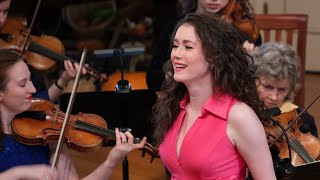
Dowland: Lachrimae Verae, The Voice of the Viol consort, performed with Elizabethan viols. 8K video.
Автор: Voices of Music
Загружено: 2025-11-19
Просмотров: 4464
Описание:
Dowland's Lachrimae Verae pavan, from Lachrimae or Seven Tears, performed on Elizabethan viols by the award-winning Voice of the Viol consort, directed by Elisabeth Reed. This work presented here for the first time in 8K video on period instruments, in preparation for Dowland's 400th anniversary.
Musicians (left to right)
Wendy Gillespie, Elisabeth Reed, Farley Pearce,
William Skeen & David Miller, Elizabethan viols
David Tayler, renaissance lute by Andreas von Holst
after Wendelio Venere, circa 1582.
Dowland's Lachrimae: Dowland was primarily a composer of songs and consort music, and his Lachrimae was widely imitated and admired, so much so that Dowland attached "Lachrimae" to his signature. "Lachrimae verae," the "true tears", is the seventh of the seven pavans which all share a thematic transformation of the descending phyrgian tetrachord. Although a lute part is provided in the print along with five instrumental parts for viols or violins, Tayler here improvises a part from open score, since the printed lute part essentially duplicates the polyphony and Dowland would not have needed a written-out part.
We are very fortunate to have a matched consort of early English viols for this performance.
Additional notes: Lachrimae was well known in the early 20th century and used in movie soundtracks with the lute part played by modern harp. Philip K. Dick used it in the title of "Flow my tears the policeman said." The song was covered by Sting and other well known artists. The descending phrygian tetrachord that characterizes the opening tune was used as the opening bass part for Dowland's "I saw my Lady Weep." Lutenist David Tayler wrote in depth on the collection "Lachrimae or Seven Tears" for his PhD in musicology at UC Berkeley in 1989.
Elizabethan viols Voices of Music is developing programs for two consorts of viols, one from the Elizabethan period and earlier (in this video), as well as an early renaissance consort from around the year 1500 to perform works published by Petrucci, the first music publisher, and his contemporaries.
The renaissance Elizabethan viols are primarily based on the work of John Rose, who was famous by the 1550s for his “vyalls” and other instruments. Although these instruments were from the middle of the century, only the later instruments survive, and it is not known if Rose’s style changed over the years, so these instruments either reflect the practice as early as the 1550s or, more likely, as late as the 1590s, although the changes may have been minor over the years. Notably, the design of the Amati violins from roughly the same time period changed very little. The Rose workshop parallels Elizabeth’s reign as queen, and so these instruments are an excellent choice for this repertory.
The English court imported a great many Italian instruments beginning with the reign of Henry VIII, but the Rose instruments were considered preeminent for the viols, even as the lutes and recorders were mainly sourced from Italy and Germany. For the renaissance ideal, the consort was conceived of as a matched set, and all the instruments played tonight were made by one builder, Wesley Brandt, using similar patterns, techniques and timbers based closely on historical models. The close matching gives the ensemble a unique sound and is essential for consort music.
8K Video: Lloyd Hryciw and Rob Clevenger
Audio engineer: Boby Borisov
Post Production: David Tayler and Andrew Levy
Produced by Hanneke van Proosdij
Score transcribed, transnotated and arranged by Voices of Music
8K technology: David Tayler
Audio mastering, video cutting and final 8K color and render: David Tayler
Copyright 2025 Voices of Music
Pitch: A=415.3 Hz quarter comma meantone
Special thanks to Margaret Cohen & Mimmo Peruffo
Copyright Voices of Music 2023.
#dowland #Dowland400
Повторяем попытку...

Доступные форматы для скачивания:
Скачать видео
-
Информация по загрузке: