The Birth of a Multipolar World Order”lll Is the American Century Over?”
Автор: EpicMix 360
Загружено: 2026-01-25
Просмотров: 98
Описание:
The Birth of a Multipolar World Order”lll Is the American Century Over?”
For nearly eighty years, the global system revolved around a single center of power. After World War II, and especially after the collapse of the Soviet Union in 1991, the United States emerged as the world’s only true superpower. Its military presence spanned every ocean, its currency dominated global trade, its institutions shaped international rules, and its culture influenced societies across the planet. This period came to be known as the “American Century” — a unipolar world where one nation stood above all others.
But history never remains frozen.
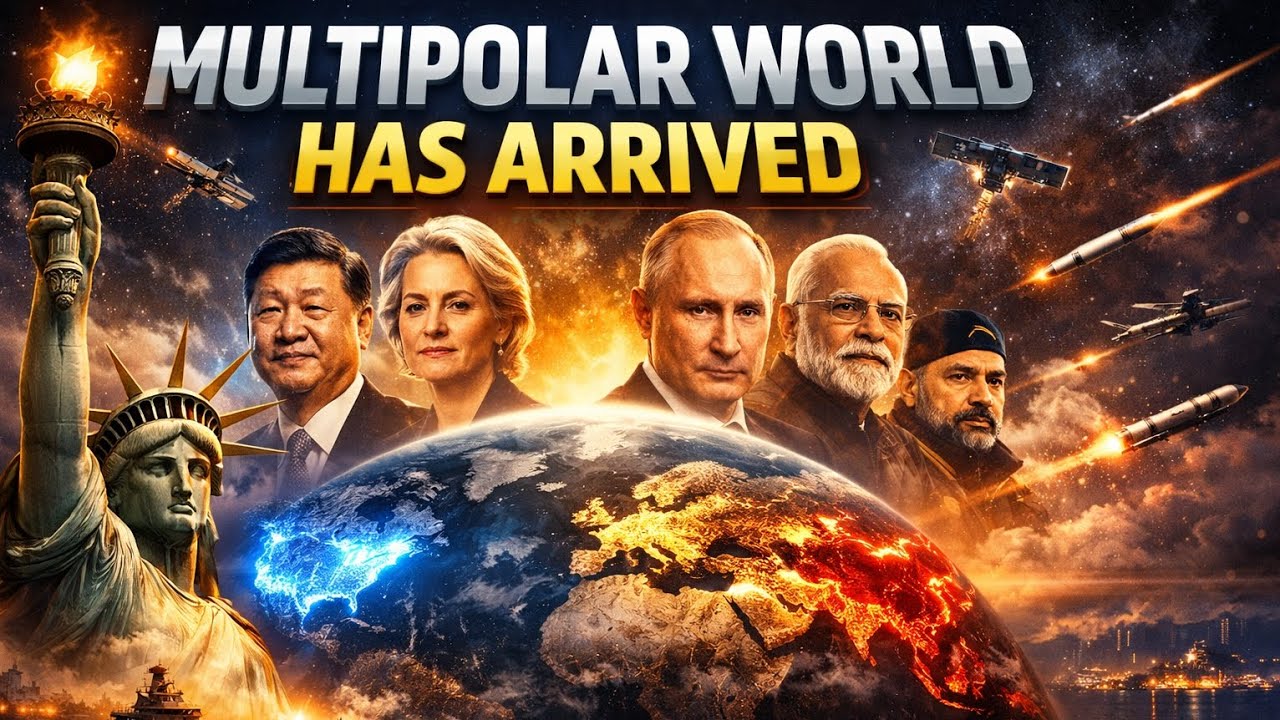
Today, that unipolar moment is fading. In its place, a new structure is forming: a multipolar world. Power is no longer concentrated in a single capital. Instead, it is being shared among several major centers — the United States, China, Russia, India, the European Union, and a growing group of regional powers across the Global South.
This video explores how and why this shift is happening, and what it means for the future of global order.
The story begins with the Cold War, when the world was divided between two superpowers: the United States and the Soviet Union. Their rivalry shaped politics, economics, and security for decades. When the Soviet Union collapsed, something unprecedented occurred. For the first time in modern history, only one superpower remained. The US stood alone at the top, with unmatched military reach, economic influence, technological leadership, and control over global institutions.
Yet the very forces that strengthened the United States also helped create new competitors. Globalization spread technology, capital, and knowledge across borders. Emerging economies grew rapidly. Military capabilities became more accessible. Over time, power diffused.
China’s rise has been the most dramatic. From a developing nation, it transformed into the world’s second-largest economy and a major technological and military power. Through massive infrastructure projects, global trade networks, and strategic investments, China has expanded its influence far beyond Asia.
Russia, though economically smaller, has reasserted itself as a key strategic player through military modernization, energy leverage, cyber capabilities, and assertive foreign policy, challenging Western dominance in multiple regions.
India represents another pillar of the emerging order — a civilizational state with a massive population, growing economy, expanding military, and a strategy of strategic autonomy rather than alignment with any single bloc.
Europe remains a major economic and diplomatic force, while countries such as Brazil, Turkey, Saudi Arabia, Indonesia, and South Africa are increasingly shaping their own regions instead of simply following Western leadership.
This is the essence of a multipolar world: no single nation can dictate the rules alone.
But does this mean the United States is collapsing as an empire? Not exactly.
America remains the world’s strongest military power, with unmatched global alliances, advanced technology, and immense economic strength. Its universities, corporations, and innovation ecosystem still drive global progress. The dollar continues to dominate international finance.
What is changing is not absolute power, but relative power. The US is no longer without rivals. Leadership has become more costly, more contested, and more complex. Allies are more independent. Rising powers demand greater influence. Global problems now require cooperation among multiple centers of strength.
The transition, however, is not without danger. History shows that periods when several great powers rise together are often unstable. Rivalries sharpen. Arms races accelerate. Miscalculations become more likely. Flashpoints such as Ukraine, Taiwan, the South China Sea, and the Middle East are not isolated conflicts — they are fault lines of a world order in transformation.
A multipolar system can bring balance, but it can also bring uncertainty. Without a single referee, competition can easily turn into confrontation. The challenge of the 21st century will be whether major powers can manage rivalry without allowing it to spiral into global conflict.
This is not simply the story of one nation declining. It is the story of many nations rising.
The unipolar era is ending. A new chapter is being written — one defined by shared power, strategic competition, and a reordering of global influence.
The American century may be giving way to something far more complex.
The multipolar world has arrived.
Повторяем попытку...
Доступные форматы для скачивания:
Скачать видео
-
Информация по загрузке: