12 Principles Part 4: Apply Self-Regulation and Accept Feedback
Автор: The Homestead Consultant
Загружено: 2026-01-13
Просмотров: 47
Описание:
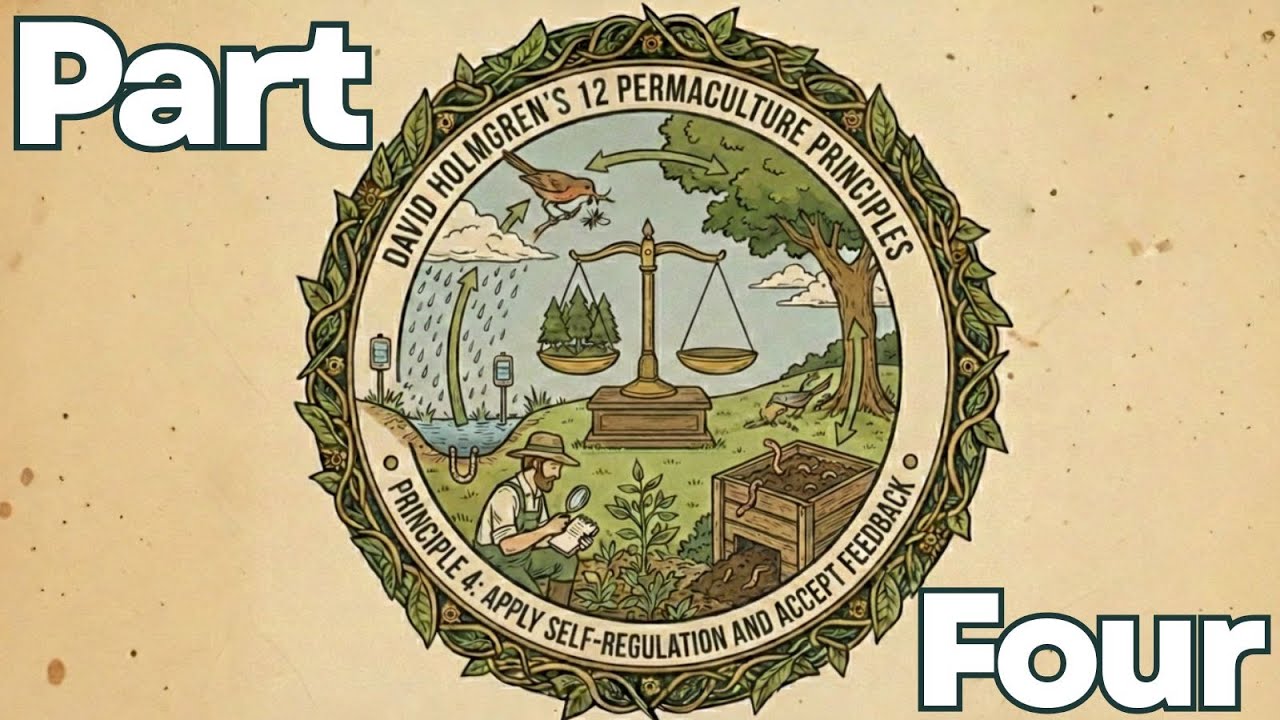
David PRINCIPLE 4
APPLY SELF-REGULATION AND ACCEPT FEEDBACK
Free handbook: https://files.permacultureprinciples....
Universe 25 • The Universe 25 Experiment [All Mice Died]
Jared's Store website https://www.resilientlivin.com/
Ryan's Consulting Website https://www.thehomesteadconsultant.com/
‘The sins of the fathers are visited on the children
unto the seventh generation’
Principles 2 and 3 involve positive feedback to support growth and
development, but uncontrolled cellular growth in our bodies is called cancer,
while positive feedback through a sound system creates an intolerable noise
that can damage the system. Apply self-regulation and accept feedback deals
with self-regulatory aspects of permaculture design that limit or discourage
inappropriate growth or behavior.
In nature, predators maintain balance when they hunt, kill and eat a proportion
of prey animals, while in society the law works to regulate and, where
necessary, punish behavior that would threaten or destabilize the system.
This negative feedback is essential in all systems to maintain health and
balance. Culling excess plant growth in the garden is often necessary, even
though it may seem ruthless from another perspective. However, our goal as
designers should be to create plant guilds and animal associations that are
more harmonious and self-regulating to reduce our workload in activities such
as weeding. Often the pathway to those harmonious guilds requires some
culling that tips a balance point – in this way the garden is ‘accepting the
(negative) feedback’. The fact that we tend to see negative feedback as bad
is itself a reflection of a culture out of balance.
Self-maintaining and regulating systems might be thought of as the ‘Holy Grail’
of permaculture: an ideal that we strive for but might never fully realize. We can
go a long way towards achieving it by applying the principles of integration and
diversity (see Principles 8 and 10), but it is also fostered by making each
element in a system self-reliant and energy efficient. A system composed of
self-reliant elements is more robust to disturbance. Use of tough, semi-wild
and self-reproducing crop varieties and livestock breeds, instead of highly
bred and dependent ones, is a classic permaculture strategy that exemplifies
this principle.
On a larger scale, self-reliant farmers were once recognized as the basis of a
strong and independent country. Today’s globalized economies make for
greater instability, where effects can cascade around the world. Rebuilding
self-reliance at both the element and system level increases resilience. In the
energy descent world, self-reliance will become more valued as capacity for
high and continuous input declines and economies of scale and specialization
reduce.
Traditional societies recognized that the effects of external negative feedback
controls are often slow to emerge. People needed explanations and warnings,
such as ‘The sins of the fathers are visited on the children unto the seventh
generation’ and the laws of karma. In modern society, we take for granted an
enormous degree of dependence on large-scale, often remote, systems for
provision of our needs, while expecting a huge degree of freedom in what we
do without external control. Our whole society is like a teenager who wants to
have it all, and have it now, without consequences. Even in more traditional
communities, older taboos and controls have lost much of their power, or are
no longer ecologically functional due to changes in the environment,
population density and technology.
One of the challenges of environmentalism is the development of behavior
and culture that is more attuned to feedback signals from nature, to prevent
overexploitation. Negative feedback needs to be well-targeted and strong
enough to bring about corrective change, but not so strong that it damages
further development of the system. For example, rainwater collection and use
in a house brings awareness of limits to both yield and quality. If a wood stove
flue produces a smoky taste to water, this negative feedback encourages
corrective action. The common aim of designing sustainable systems with zero
hazard from negative feedback is like trying to raise children without exposure
to immunological and accident hazards: it leads to more serious hazards in the
future. The open acceptance of hazards from negative feedback must be
constrained by ethics and be primarily applied to ourselves, families and
communities (in that order), rather than outsourcing regulation to government
as occurs in the monetary economy.
Повторяем попытку...

Доступные форматы для скачивания:
Скачать видео
-
Информация по загрузке: