Moving Charges & Magnetism - 6 | Conversion of Galvanometer into Ammeter & Voltmeter | CBSE | NCERT
Автор: RSK Physics Institute
Загружено: 2026-01-18
Просмотров: 32
Описание:
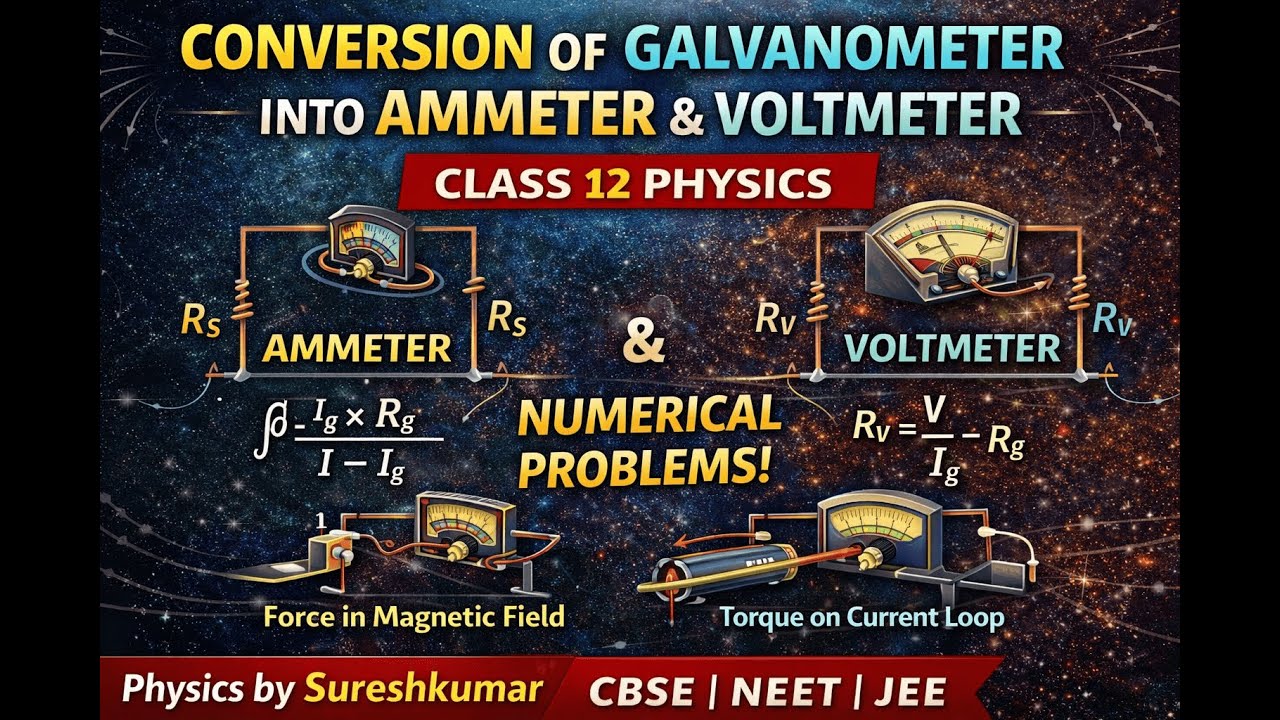
In this video, we cover Conversion of Galvanometer to Ammeter and Voltmeter – Class 12 Physics as per the CBSE / NCERT syllabus, with clear explanation, diagrams, formulas, and example problems. The lecture also includes numerical problems to strengthen understanding and exam preparation.
Topics covered:
• Principle of conversion of a galvanometer into an ammeter
Use of a shunt resistor, calculation of shunt resistance, and factors affecting accuracy
• Principle of conversion of a galvanometer into a voltmeter
Use of a series resistor, calculation of series resistance, and practical considerations
• Relation between full-scale deflection current and resistance
Formulas to determine shunt and series resistances for given specifications
• Numerical problems based on conversions
A galvanometer coil has a resistance of 15 Ω and shows full-scale deflection for a current of 4 mA. Convert it into an ammeter of range 0 to 6 A. (AI 2019)
A galvanometer shows full-scale deflection for current Ig. A resistance R₁ is required to convert it into a voltmeter of range 0–1 V and a resistance R₂ to convert it into a voltmeter of range 0–2 V. Find the resistance of the galvanometer.
A galvanometer of resistance G can be converted into a voltmeter of range 0–V volts by connecting a resistance R in series with it. How much resistance will be required to change its range from 0 to V/2? (AI 2015C)
• Numerical problems based on circular coil
Two very small identical circular loops, marked 1 and 2, carrying equal currents I are placed vertically (with respect to the plane of the paper) with their geometrical axes perpendicular to each other, as shown in the figure. Find the magnitude and direction of the net magnetic field produced at the point O. (Foreign 2014)
Two identical coils P and Q, each of radius R, are lying in perpendicular planes such that they have a common centre. Find the magnitude and direction of the magnetic field at the common centre of the two coils, if they carry currents equal to I and 3I respectively. (Foreign 2016)
Important formulas:
For ammeter (shunt resistor Rs):
Rs = (Ig × Rg) / (I – Ig)
For voltmeter (series resistor Rv):
Rv = (V / Ig) – Rg
Where:
Ig = full-scale deflection current of galvanometer
Rg = resistance of galvanometer
I = desired current range for ammeter
V = desired voltage range for voltmeter
Key concepts explained:
• Practical method of measuring high current and voltage with a sensitive galvanometer
• Importance of shunt and series resistances
• Step-by-step numerical problem solving approach
• Understanding accuracy and limitations of converted meters
Useful for:
• Class 12 CBSE & State Board students
• NEET / JEE foundation level
• Board-oriented theory questions and numericals
• Developing speed and confidence in magnetism and current electricity problems
👨🏫 Faculty: Sureshkumar
🎓 Qualification: M.Sc. Physics & Electronics
📜 Qualified: TNSET | CTET | TNTET
📱 WhatsApp (Classes & Academic Queries): +91 9047872275
📧 Email: [email protected]
Повторяем попытку...
Доступные форматы для скачивания:
Скачать видео
-
Информация по загрузке: