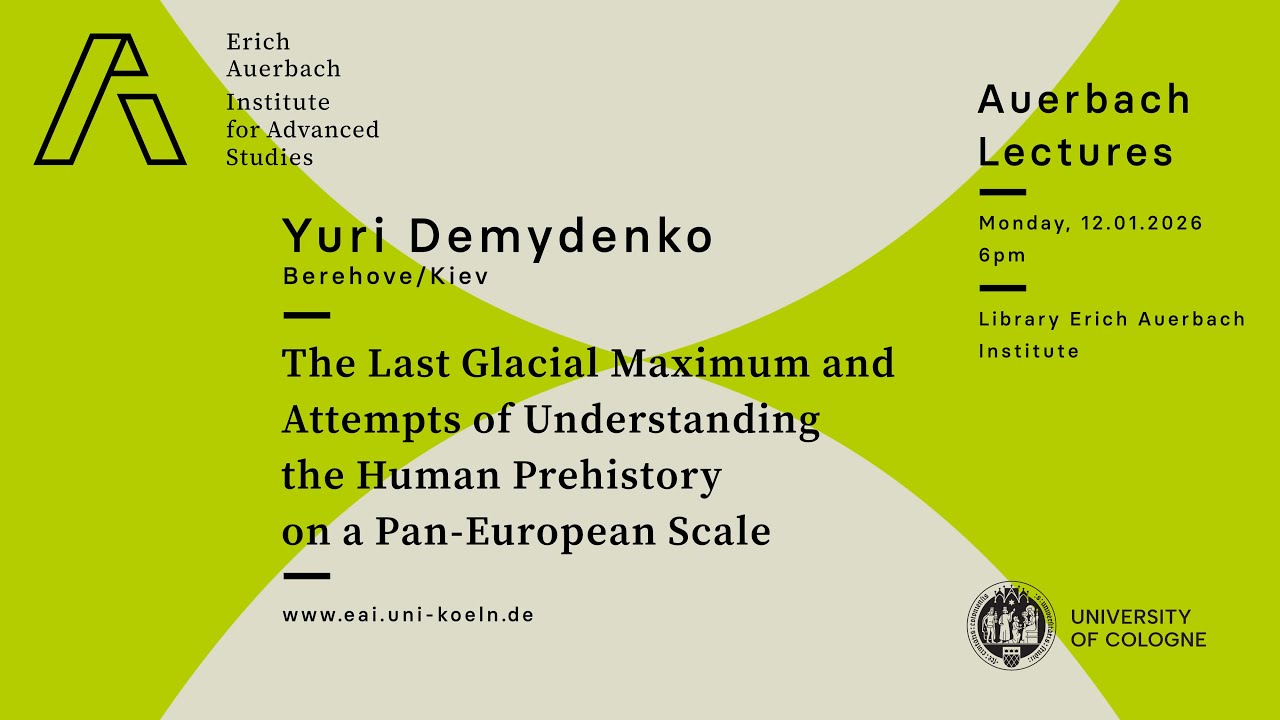
Yuri Demydenko (Berehove/Kyiv): The Last Glacial Maximum
Автор: UniversitaetzuKoeln
Загружено: 2026-01-28
Просмотров: 48
Описание:
Am 12. Januar 2026 hielt Yuri Demydenko (Paläolithische Archäologie, Berehove/Kyiv) eine Auerbach Lecture zu »The Last Glacial Maximum and Attempts of Understanding the Human Prehistory on a Pan-European Scale«.
Abstract:
The period roughly between 26.5 and 19 ka cal BP (“calibrated years before the present”) coincides with the so-called Last Glacial Maximum (LGM) sensu lato. The LGM with its harsh climatic conditions did not only significantly change the environment and climate in Europe due to the maximum extent of the ice sheets during the last glaciation coupled with a significant sea-level fall of c. 120-130 m, but it also had a great impact on the continent-wide “archaeological picture.” Traditionally, from an archaeological point of view, the LMG in Europe has mostly been considered as a period of depopulation of northern Europe and high-altitude territories, resulting in the displacement of human groups to “refuge areas” in southern Europe. However, some recent studies allowed to put forward hypotheses on the depopulation starting earlier, between ca. 29 and 24 ka cal BP during Late Gravettian, while the LGM itself was a period of renewed population growth. A conspicuous phenomenon of the LGM period is the large number of more or less contemporaneous archaeological industries defined for this period (e.g., Late Gravettian, Aurignacian V, Epi-Aurignacian, Terminal Gravettian, Proto-Solutrean, Solutrean, Badegoulian, Early Epigravettian, Grubgrabian, Kasovian, and others) which is significantly higher than for any other Upper Paleolithic (UP) period. This likely reflects some prehistoric reality, inasmuch as a distortion of large-scale networks brought about by the demographic developments addressed above. However, it also reflects research focusing on small-scale or national areas. A better understanding of this material and nomenclatorial patchwork thus requires large-scale comparisons.
The present lecture aims to shed some new light on the Late UP industry variability in Europe. To do so, changing paleoenvironments and human groups moving in and out of various regions are considered as well as archaeological and climate data for Europe. Such large-scale comparisons are prerequisite to a better understanding of the European LGM human prehistory.
Повторяем попытку...
Доступные форматы для скачивания:
Скачать видео
-
Информация по загрузке: