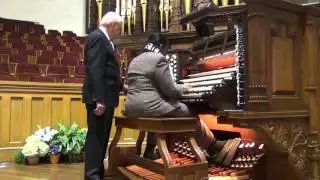
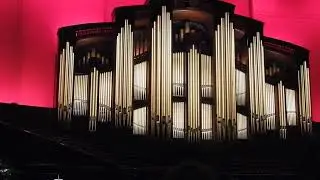
Come, Come, Ye Saints arr. Frank Asper (From: Mormon Tabernacle Organ Recital Columbia LP-6215)
Автор: Panoplyimaging
Загружено: 2014-05-05
Просмотров: 7101
Описание:
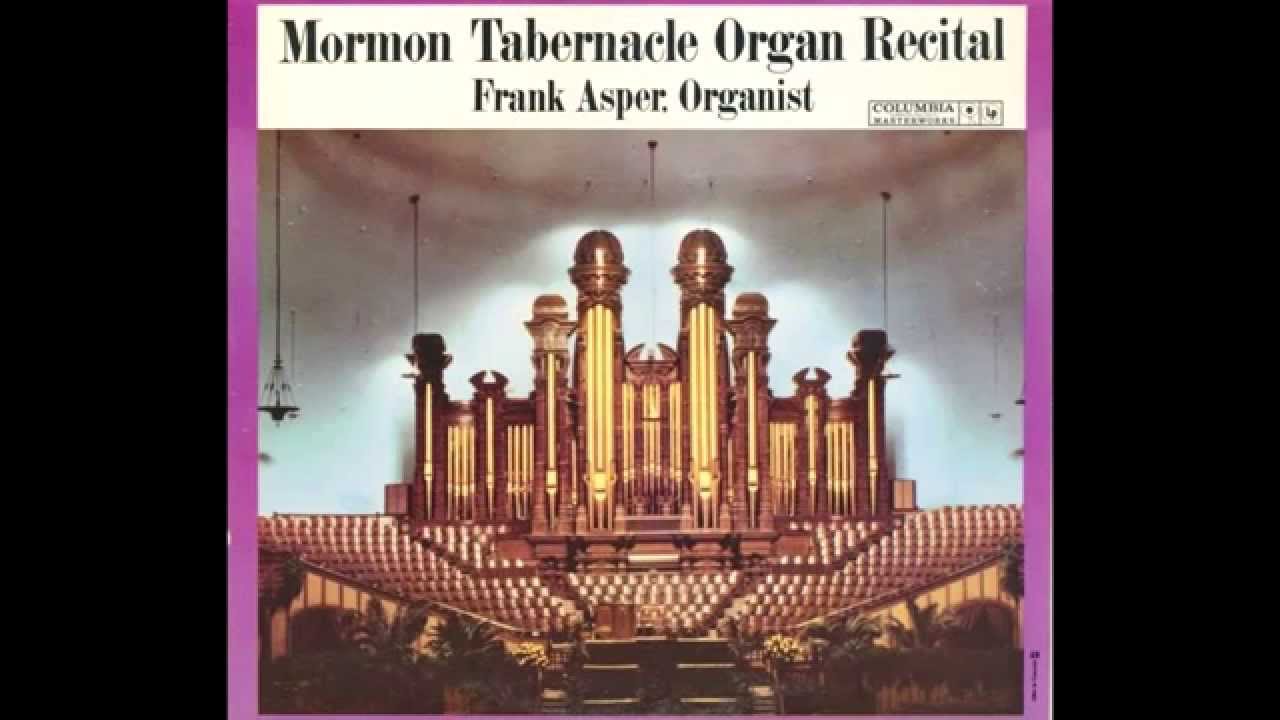
Vinyl transcription of a Columbia Masterworks LP-6215. Mormon Tabernacle Organ Recital, Frank Asper, Organist, recorded 1961.
Recorded 24b x 96KHz with a Sumiko Blue Point Special, light de-click in Adobe Audition.
"With an interest in sheer sound typical of a true Romanticist, Dr. Asper is quick to point out that color is not just a matter of pulling stops. I includes styles of touch, from the broadest legato to the sharpest staccato, that cooperate with the timbre of the pipes to produce a total effect:".
From the LP jacket:
For more than half a century in daily recitals and for more than three decades in weekly radio broadcasts with the Choir, the Salt Lake Tabernacle Organ has found a place in the hearts and homes of a large segment of this country's population, owing not so much to its size as to its unique acoustical properties and the musicanship of the men who play it.
It is significant that the organ and the Tabernacle which houses it were planned and constructed together during the years 1863-67. They were built as a unit, and to this day they are, so to speak, one instrument. Inasmuch as there was no railroad in the West in 1863, the bulk of the materials for both were obtained locally. The Mormon pioneers found suitable lumber for the 32-foot pipes some 300 miles south of Salt Lake City and set about with sixty yoke of oxen to haul it in.
Some of this material still remains in the organ, although it was enlarged in 1885, 1900, and 1915, and rebuilt in 1948 by the Aeolian-Skinner Organ Co. under the direction of G. Donald Harrison. It has grown from the original 700 pipes that first sounded in 1867 to the 189 ranks of nearly 11,000 pipes that sing today.
In the dome-shaped Tabernacle, which seats close to 8,000 persons, the organ occupies a commanding position which gives it an unusual acoustical advantage. Located within the walls of the tabernacle rather than in a recessed chamber, it is coupled directly with its sounding board. Indeed, the ensemble has be likened to a giant violin of wood with a curved back and organ pipes for strings.
Whatever tones emanate from the pipes- from the gently dulcet tones to the blaze of trumpets or the scintillating brilliance of the 18 mixture stops- most of them are enhanced by the peculiar acoustics of the building, at once subtly diffuse and blurring, reverberant and prolonging, and with some tones, sharp and focusing because of the concave shape of the ceiling.
One of the most familiar figures at the console of this instrument is Dr. Frank W. Asper, who, with coloristic resources reaching astronomical proportions at his call, approaches them with a mind tuned to orchestral values. With an interest in sheer sound typical of a true Romanticist, Dr. Asper is quick to point out that color is not just a matter of pulling stops. It includes styles of touch, from the broadest legato to the sharpest staccato, that cooperate with the timbre of the pipes to produce a total effect.
Another characteristic feature of his playing is his phrasing. Taking his cue from vocal music he affirms, "All performance should be based on singing, which is the natural form of music. Every part must sing."
This dual orchestral-vocal approach to his instrument is derived from a broad background in both fields. From his post-missionary days as a flutist in a German opera orchestra to his conductorship of local orchestral and choral forces, he has observed widely and drawn together his own artistic principles.
Dr. Asper's memorable interpretations plus an unusual sensitivity in choosing repertoire have earned for him the affectionate title of "poet-organist". Typical of the effect he has had on his listeners is a note that he once received from an elderly Scottish couple who wrote that they laughed and cried as they heard the strains of Afton Water from the great Tabernacle Organ. The old folks recalled their happy childhood in the "bonnie woods of Craigless near Kilmarnock."
Повторяем попытку...
Доступные форматы для скачивания:
Скачать видео
-
Информация по загрузке: