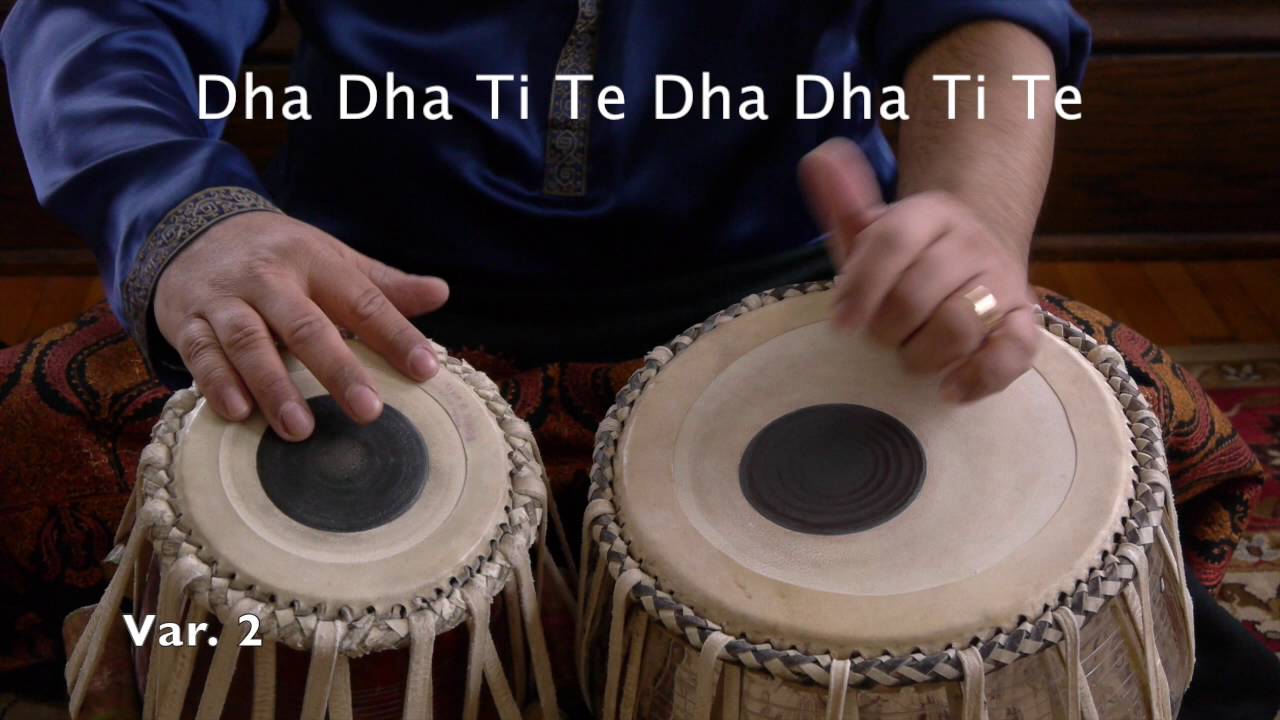
Tabla Lessons - Kaida #4 (Combination note for DA & DIN)
Автор: OctavesOnline
Загружено: 2016-05-11
Просмотров: 6141
Описание:
WhatsApp - +91-8072415626 for online classes. Tabla Lessons - Kaida #4 (Combination note for DA & DIN)
Kaida is very important for both the performance and pedagogy of tabla solos. The word Kaida means "rule" (Kapoor, no-date). It implies an organized system of rules or formulae used to generate theme and variations. It originated in the Delhi style (i.e., Dilli gharana) but has spread to all the other gharanas. In the Benares style it is referred to as Bant or Banti (Stewart 1974). Attempts are occasionally made to distinguish kaida from bant. Such attempts usually are motivated by a chauvinistic attitude toward particular gharanas and are not based upon any objective musical criteria. The results of these efforts have been musically insupportable.
Kaida is defined by its structure. It is a process of theme and variation. Any bol may be used, so the bol has no function in its definition. It is also hard to consider function as a defining criteria. Kaida may be thought of as a process by which new patterns may be derived from old. We will illustrate this with a well known beginner's kaida. (Most kaidas are excruciatingly long so this short one will suffice.)
It has already been stated that the word "kaida" means rule, so it is convenient for us to go over the rules. This last example will serve to illustrate it.
The first rule of kaida is that the bols of the theme must be maintained. In other words, whatever bols are contained in the main theme are the only ones that can be used in the variations. A brief glance at our example easily bears this out. However let us go beyond a mere glance. Close examination reveals that the syllable Ti suddenly appeared in the third variation. It is clearly a variation of Ti , which was present from the beginning. If one thinks in English then this subtlety will be missed, but if one thinks from the standpoint of North Indian languages this becomes a major alteration. Tabla bols show a tremendous tolerance in their vowels (i.e., swar) but show very little tolerance in their consonants (i.e., vyanjan). Although this is an interesting topic it is not possible to go into it in any depth in this paper.
Another rule of kaida concerns its overall structure. It must have an introduction, a body and a resolving tihai. The introduction is usually the theme played at half tempo, yet one may hear introductions which involve complex counter-rhythms (i.e., layakari) and even basic variations upon the theme. The body consists of our main theme played at full tempo and the various variations. It must finally be resolved with a tihai. The tihai is essentially a repetition of a phrase three times so that the last beat of the last iteration falls on the first beat of the cycle (i.e., sam)
For more videos visit www.octavesonline.com Music learners, to post your questions or to participate in discussions visit the OctavesOnline forum - https://www.octavesonline.com/forum
For music-related assessment and certification visit - https://www.octavesonline.com/service...
Повторяем попытку...
Доступные форматы для скачивания:
Скачать видео
-
Информация по загрузке: